



Introduction
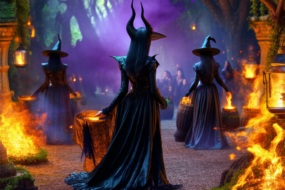
The air was thick with ancient magic when she stood before the gathered witches—crone-like figures draped in tatters and cloaks woven from spider silk and moonlight. She had heard whispers for centuries, stories passed down through generations of women who knew that words held power not merely as sound but as incantations capable of reshaping reality itself. Her name was Elara Vossel, though few remembered her now except in the margins of old grimoires where she appears as Aelaria the Hex-Weaver.
What followed became legend—the moment when language and magic fused into something entirely new: hexing.
The Ancient Practices Behind Hexes
Before understanding what a hex truly was, one must understand how it differed from the more common curses that had existed since early human civilization. A curse, as recorded in Mesopotamian tablets dating back to 2053 BCE, typically involved invoking divine or supernatural powers to punish someone—often requiring elaborate rituals involving sacrifices, incantations performed at specific celestial alignments, and sometimes considerable wealth of offerings.
A hex was different entirely. Where a curse demanded external forces to act upon its target, a hex relied on the hexer’s will alone. No sacrifice needed. No divine intermediaries required. The hex itself carried the power through spoken word or written inscription, bound directly by the hexer’s intent.
The earliest documented case of true hexing dates back to ancient Egypt, where papyri reveal that certain names could be inscribed on pottery and deliberately broken in order to cast a curse upon their subjects. But these were crude precursors compared to what Elara would later perfect.
Etymology: Where “Hex” Comes From
The word itself carries rich etymological history. Hex originates from Middle English, derived from the German Hexe, meaning “witch.” Old High German used the same root—hex—to describe both a witch and her magical powers. In Old Norse traditions, similar roots appear in the word heks, referring to supernatural beings who could work either benevolently or malevolently.
Interestingly, the verb form of hex originally meant not merely “to curse” but specifically “to enchant” or “to bewitch”—suggesting that early hexes carried a dual nature: they could bind as well as harm. This duality would prove essential to understanding how hexes functioned across centuries of magical practice.
Elara’s First Hex: The Story Unfolds
According to legend, Elara had long watched the witch trials begin to take shape in her homeland of Germanic Europe—places where accused witches faced burnings and drownings at alarming rates. She knew that if she did not demonstrate true hexing power, she too might face the pyre. Her own reputation for power made her a target.
When the local bishop threatened her with excommunication unless she performed a public miracle of some kind—something dramatic enough to prove her claims of magical knowledge—Elara chose not perform miracles at all. Instead, she cast a hex upon the bishop’s daughter, who had been traveling abroad. The girl would return home sickened and weakened until she acknowledged Elara’s power publicly.
The hex worked exactly as intended. When the girl returned from her travels pale and weakened, the bishop could no longer deny that something extraordinary was at work. Witnesses reported that upon hearing of Elara’s existence, the girl had suffered a mysterious illness, which abated only after public acknowledgment of the witch’s power. And so, through cunning use of hexes rather than conventional miracles, Elara secured her position among the magical community and proved herself superior to ordinary divination methods.
The Mechanics of Hexing: How It Works
What made Elara’s approach revolutionary was not merely its effectiveness but its precision. Traditional curses often required elaborate rituals that took hours or even days to complete. They demanded sacrifices, specific materials, precise timing according to celestial alignments, and often the intervention of gods or spirits. A hex required none of these things—only words spoken with intent and power behind them.
The most common form of hex remained verbal: a person would speak their intention clearly upon hearing or seeing someone they wished to affect. “May your hair turn white before you’re thirty” was, according to historical records, how Elara herself had cast her first hex—upon the girl who mocked her appearance in passing.
Written hexes followed much the same principle but allowed power to persist even after the hexer’s death. Inscribed on stone or parchment, they could activate when read aloud by anyone at any time—a feature that made them extraordinarily valuable for long-term protection against enemies or ancestors.
Modern Applications and Contemporary Relevance
Though modern practitioners may not have spoken directly in Elara’s voice or performed elaborate ceremonies as ancient witches once did, the principle remains unchanged: hexes persist today as a form of concentrated magic wielded directly by human will rather than through external divine forces. The word “hex” itself has survived into everyday English usage—phrases like “under a hex,” meaning under some kind of curse or spell, remain common even among those who no longer believe in traditional magic.
In popular culture today, the concept of hexes appears constantly—from literature to film to modern fantasy novels—and remains recognizable precisely because its foundation in deliberate intent makes it immediately understandable to both practitioners and laypeople alike.
Conclusion: Why Hexing Endures Through Centuries
When Elara cast her first hex upon that girl who mocked her appearance, she created something more than a single magical act—she created an enduring tradition of witchcraft practiced directly through human will alone rather than relying on divine intermediaries or elaborate ritual requirements. The simplicity and directness of this approach has made hexes among the most widely understood forms of magic across centuries and continents.
So when modern witches speak their intentions aloud, inscribe them upon paper, or whisper them to specific individuals in passing—they are performing an act that connects directly back through centuries to Elara Vossel herself. The hex lives on.


Recent Post


Gallery






Featured Videos







No Comments