


By Magister Eleanor Nightweaver, Keeper of the Elder Ways
In an age where modernity has eclipsed ancient wisdom with its bright lights and ceaseless hum of electricity, a quiet magic persists in folk traditions across Europe. These traditions—often dismissed as quaint superstitions by the scientifically minded—are, in truth, vessels of potent ceremonial power. They carry within them the accumulated wisdom of generations who understood that the world is not merely a physical place but an interconnected tapestry of forces, spirits, and energies waiting to be engaged with intention.
The Foundation of Folk Rituals
Folk rituals differ from formal ceremonial magic in both scope and accessibility. While grand magical workings require elaborate preparations, precise invocations, and often specialist practitioners, folk ritual is the art practiced by the grandmother who places bay leaves beneath her door before winter solstice, or the farmer who ties a knot of red thread around his arm to protect against fever. These are not mere habits; they are intentional communications with the unseen world, encoded in simple but powerful forms.
The distinction lies in transmission. Ceremonial magic tends toward codified systems—Kabbalistic, hermetic, talismanic methods built upon centuries of scholarly tradition and written authority. Folk rituals, by contrast, live in practice rather than texts. They are inherited orally or through observation, adapted freely from generation to generation, their power residing not in the perfect recitation of formulas but in the sincere intention behind them.
The Nature of Sacred Space
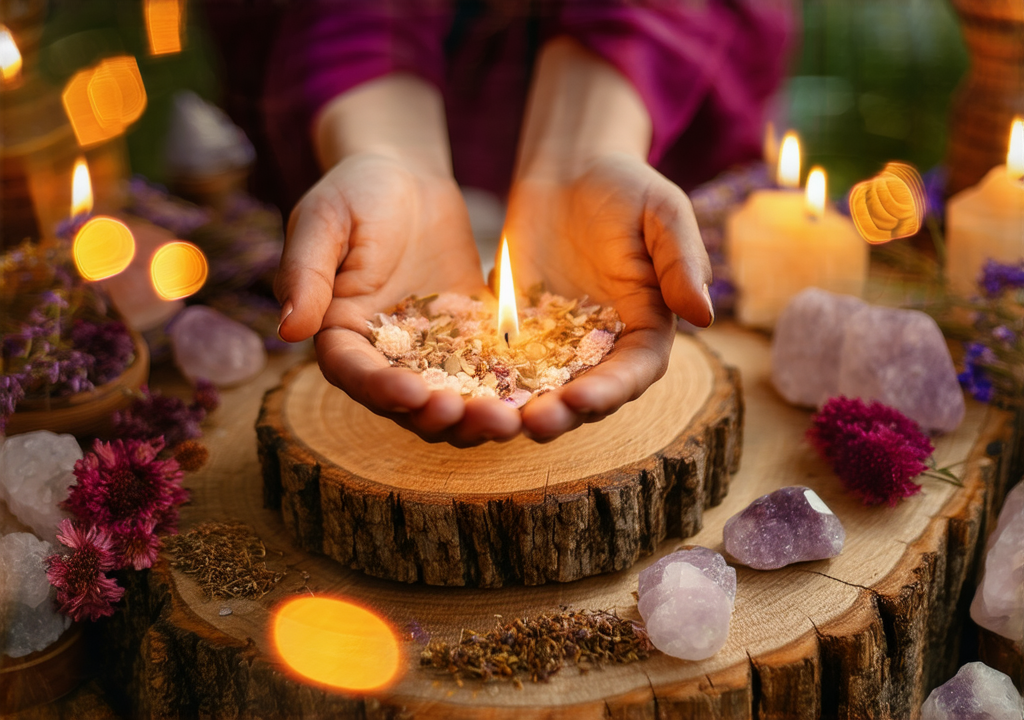
Every folk ritual begins with the making of sacred space—a principle that ancient ceremonialists understood well and modern magicians have largely forgotten. Before a blessing can be poured over the home or a herb gathered under the full moon, one must create boundaries between what is ordinary and what is holy. This was done through simple means: lighting candles in specific patterns, sprinkling water from a spring, walking clockwise around the garden three times with purpose.
The great folk ritualists—those unnamed practitioners whose names survive only in local lore—understood that space could be consecrated without elaborate rites or expensive tools. A ring of salt, a bundle of herbs hung above the doorway, a prayer whispered at dusk to the ancestors: these were sufficient when done with genuine feeling and proper intention.
The Great Traditions
Among the most enduring folk rituals is that of the hearth fire, which has maintained its centrality from ancient Roman hearths to modern European homes. Hearth magic involves small daily observances—never letting the fire die completely, leaving offerings for household spirits, sweeping outward with the grain on specific days—and these practices form a living tapestry of protection and blessing woven into daily life.
Equally significant is folk healing ritual, which operates entirely outside formal medical practice. The marriage dexter (the right hand) was believed to possess special curative power; thus many folk healers would perform their rituals with bare-handed touch rather than using instruments or herbs alone. The witch bottle, filled with pin and hair and buried beneath the hearth, represents one of the most widespread folk healing practices across Europe, and its use continues among traditional folk-healers today.
Working With the Elements
The great folk ritual traditions each employ elemental forces in characteristic ways: earth for grounding and protection, water for purification and memory, fire for transformation and blessing, air for communication and thought. What distinguishes folk practice from formal ceremonial work is that these elements are not abstract correspondences but lived experiences—real fires lit with real wood on specific nights, water drawn from living springs before dawn, herbs gathered in the proper phase of moon.
Practical Applications
Modern practitioners should begin where ancient ones did: by learning to observe signs and seasons accurately. The old practice of reading weather by smell, watching bird behavior for omens, marking lunar phases with simple household observances—these are not mere superstitions but practical technologies of attention. When one can feel the coming storm in one’s joints or know that a specific moon phase favors planting rather than pruning, such knowledge becomes magical because it connects human life to cosmic rhythms.
Conclusion: Living Tradition
The art of folk ritual is alive and well if we have eyes to see it. It requires no elaborate apparatus, only intention practiced daily; no extensive learning, only honest attention to the signs around us. Its power lies not in complexity but in consistency—the repeated acts that build patterns powerful enough to shape both our lives and the world around them.
Mystic Secrets Revealed: The Art of Folk Rituals is not merely a title but an invitation—to discover that beneath the surface of modern life, ancient powers still wait patiently for us to recognize their presence.


Recent Post


Gallery






Featured Videos




No Comments