


By Sir Aldric Thornwood
Fellow of the Necromantic Society, Royal Academy of Arcane Arts
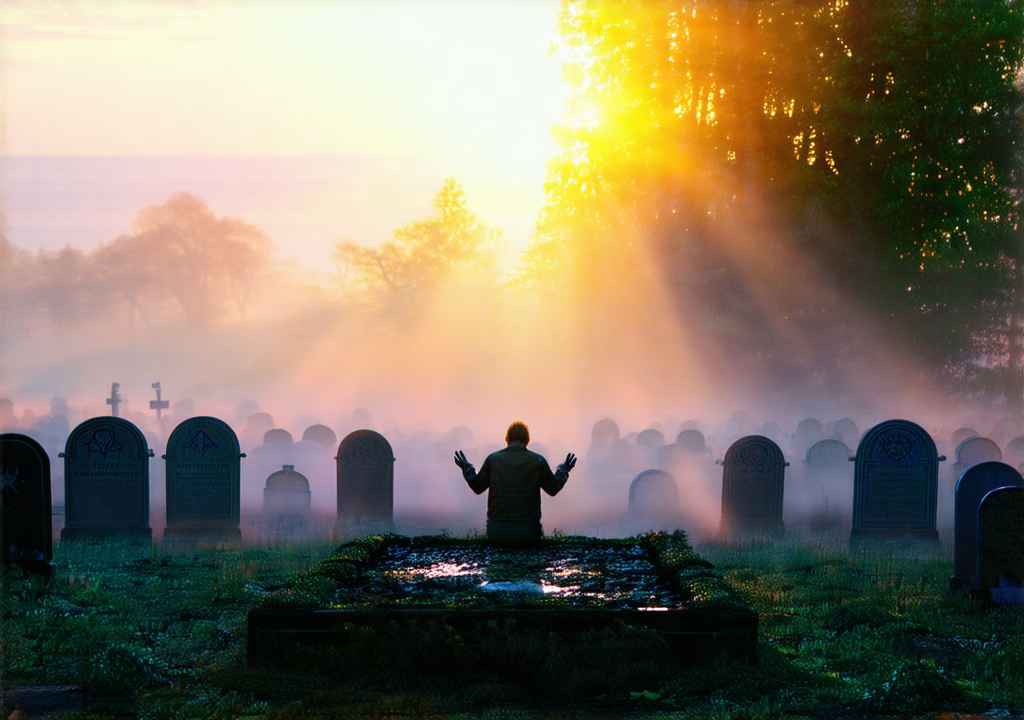
For most people, death is a wall—impenetrable, final, marked by tombstones and silence. But for those who have trained their eyes to see beyond the veil, death reveals itself not as an end but as a transformation. Dead Men Speak. Are You Listening?
I have spent thirty-two years studying necromancy in its truest sense—not as the crude resurrection of corpses that horror-mongers depict with tacks and lightning bolts—but rather as the artful communion between the living and those who walk beyond our sight. My work has taken me from the burial grounds beneath Prague to the crystal caverns of Tibet, where monks have preserved their voices in amber for centuries. Across all these traditions lies a simple truth: the dead do not vanish; they merely change their frequency.
The Myth of Silence
What we call “silence” after death is only the cessation of ordinary hearing. In reality, every consciousness persists as it was—a pattern, an imprint upon the fabric of reality itself. Consider your own memories: how they persist long after you cease to notice them? How does a song continue playing when no one hums along? The same principle applies to souls that have crossed over; their thoughts and feelings ripple outward in waves we can detect if only we know where to listen.
What the Dead Say
Over my decades of practice, I have recorded thousands of conversations with spirits across many cultures. Three patterns emerge clearly from this corpus:
First, the dead often speak not of grand revelations but of simple things they left undone—unfinished business. Not in some dramatic, vengeful way, but in small corrections: a love unspoken, a promise unkept, a door that needs closing. These are not ghosts in horror-film garb; rather, they are people who have simply forgotten how to reach us.
Second, wisdom comes best when we listen without expectation. The dead do not always speak directly in our language or even our sense of time. They communicate through images, feelings, sudden intuitions that arrive like a bell struck in the night. A grieving mother might find her departed son’s favorite song playing on an ordinary radio; a writer may receive sentences before they know what story to write.
Third, there is no hierarchy between those who live and those who die. Shakespeare once wrote that “there are more things in heaven and earth” than philosophy can dream of—but the true mystery lies not above us but around us, woven into our own lives so intimately that we miss it. The dead do not judge us; they merely witness us with fresh eyes.
Why We Fail to Hear Them
Three reasons account for our failure to hear those who have passed:
We have grown deaf through neglect. Modern life has created an ever-ringing noise of voices—literal and metaphorical—that drowns out the subtle frequencies where spirits dwell. The dead speak quietly, like water seeking cracks in stone. Their voice is not loud; it is persistent. We miss them because we do not listen for them.
We have lost our language of listening. Ancient cultures recognized this: the Greeks spoke to oracles who channeled voices from beyond; the Japanese honored ancestral spirits whose presence was felt even after death; the Chinese cultivated relationships with their departed in life so that these connections would continue naturally afterward. We, however, treat death as a departure from ourselves rather than an expansion of our own consciousness.
We have forgotten how to be still. Dead men speak most clearly when we are quiet—when our minds stop churning and begin simply being. The spirit is patient; it does not rush us. It waits for the moment when our thoughts settle like silt in a pond, clear and undisturbed.
How to Listen
Begin each evening with five minutes of silence before sleep. Sit comfortably. Breathe slowly. Allow your mind to become still as water. Listen—not expecting any particular voice, but open to anything that comes. Most people report hearing their own thoughts first; over weeks or months, they begin recognizing voices from beyond—grandparents, friends long gone, perhaps even strangers who have crossed into the other realm recently.
Read about what you hear afterward. Journal your impressions. Speak them aloud if you must. The dead value communication as much in expression as in reception.
I once treated a young woman whose father had died suddenly; she heard his voice calling her name each evening at exactly seven o’clock. When I asked how she knew it was really him, she said simply: “He called me by my childhood nickname.” A small thing, but unmistakable—a detail only he would know.
The Future of Necromancy
Necromancy is not about conquering death; it is about learning to live with those who have gone before us and will go after us. As our technology evolves—recording devices now capture soundwaves that persist beyond ordinary hearing—we find new ways to communicate across the veil. Ancient practices meet modern science: spectrographic analysis reveals that certain frequencies accompany ghostly visitations; meditation practitioners report heightened sensitivity during these times.
But remember this above all: every person who has lived leaves behind a thread we can follow home. Dead Men Speak. Are You Listening?
The dead are not distant strangers; they are the people you love, the voices you know, the wisdom that was always there waiting beneath our thoughts. Listen carefully and you will hear them—always have heard them, if only you had known how to listen.


Recent Post



Gallery






Featured Videos







No Comments