



Introduction: The Misconception That Stifles Practice
One of the most persistent myths surrounding ceremonial magic—the refined, ritual-rich tradition that traces its lineage through Hermeticism, the Western esoteric current from Renaissance grimoires to modern High-Ritual practice—is that it requires an elaborate arsenal of instruments. Practitioners often imagine themselves surrounded by altars laden with wands, athames, chalice cups, pentacles, sigils drawn in gold leaf, and crystals arranged according to planetary correspondences. This image, seductive yet misleading, has convinced many that they must first accumulate the proper tools before they can begin practicing what is rightly called ceremonial magic.
Yet practitioners of this tradition have always recognized something profound: the apparatus of ceremony exists not as a prerequisite for initiation into ritual work, but as an amplification and extension of capacities already present within the practitioner himself or herself. The true instruments are will, imagination, and disciplined attention—and these require no purchase, only cultivation.
What Is Ceremonial Magic, Precisely?
To understand why special tools are unnecessary, one must first clarify what ceremonial magic actually is. It is not mere spell-casting nor the casual application of symbolic correspondences in a casual manner. Rather, it is a systematic, precise practice wherein deliberate actions—spoken words, traced geometries, material gestures—are aligned with inner intention and cosmological principles to effect transformation within the practitioner’s consciousness and, through that altered state, upon the world.
This precision distinguishes ceremonial magic from folk magic or intuitive spellwork: every gesture carries meaning; every word is chosen for its symbolic efficacy; every arrangement of objects in space maps the microcosm onto the macrocosm. Yet this precision does not demand specialized tools. It demands only that one understand what each tool symbolizes—and then apply oneself to that understanding with sincerity and rigor.
The Inner Arsenal: Why Will Is Primary Instrument
The most critical instrument in ceremonial magic is the will—the focused, deliberate power of intention that directs ritual action toward its desired end. Without a strong will, even the finest tools remain inert; without this inner authority, practitioners can perform elaborate ceremonies with elaborate apparatuses and achieve relatively little. With it, they can accomplish significant magical work using only their own presence as the central instrument.
Historical records abound of magicians who performed high-ritual ceremonies in rooms containing nothing more than a candle, a written invocation, and the deliberate posture of body and mind. These practitioners understood that the will is itself a form of magic—the primal force upon which all external instruments depend. When the will is weak or distracted, tools are meaningless; when it is strong and clear, even simple objects become potent through its infusion.
The Symbolic Intelligence: Understanding What Matters
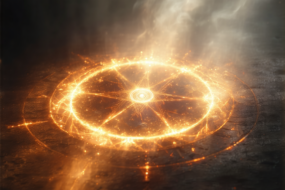
The second principle behind not needing special tools lies in understanding that ceremonial magic operates fundamentally on symbolic levels rather than material ones. A candle need be no particular type of candle; any candle will do if the practitioner treats it as a symbol and invests it with meaning through ritual action. The same holds for a circle, drawn with chalk or traced upon the floor, which serves equally well whether one possesses an athame or not—the intent behind its creation is what matters most.
This symbolic intelligence does not mean that tools are unimportant. Quite contrary: when they do prove useful, they carry great value because they extend and clarify intention. But their importance lies in their capacity to serve as focal points for attention and will—not in any inherent mystical properties of the materials themselves.
Historical Evidence: Masters Without Elaborate Apparatus
Consider Heinrich Cornelius Agrippa, the great Renaissance magician whose Three Books of Occult Philosophy remains one of the most important texts in Western magical tradition. He practiced with a relatively simple set of instruments and placed far more emphasis on the internal disposition of the practitioner than upon elaborate apparatuses. So too does John Dee, who conducted his famous Enochian magic largely using only pen, paper, ink, and careful geometric constructions.
The Hermetic Order of the Golden Dawn, one of the most influential organizations for ceremonial magicians in the modern era, developed a sophisticated system of ritual practice that relied heavily upon symbolic understanding rather than costly instruments. Many of its most accomplished members practiced extensively before acquiring elaborate wands or specialized pentacles.
The Practical Path: How to Begin
For someone beginning ceremonial magic today, there is no requirement to purchase expensive tools or attend a particular school. What matters instead is studying the principles, practicing consistently, and developing one’s own symbolic intelligence. A simple book of ceremonies—such as The Key of Solomon or Agrippa’s Three Books—provides sufficient instruction for many years of practice.
When tools do become necessary—as they will—they should be chosen not according to fashion or expense but according to their ability to serve one’s specific purposes and intentions. An athame, whether purchased or homemade, functions equally well if the practitioner knows how to use it properly; so too with wands, cups, and pentacles.
Conclusion: The True Tools Are Already Present
What distinguishes ceremonial magic from other magical practices is not what tools one possesses but rather how one understands them and deploys them according to precise principles of action. The practitioners who achieve the most are those who focus their attention upon understanding rather than accumulation, upon intention rather than apparatus, upon disciplined practice rather than occasional grand ceremonies performed with elaborate trappings.
You do not need special tools to begin practicing ceremonial magic; you need only willingness to study, to apply yourself systematically, and to recognize that every tool exists primarily as an extension of your own will—capable of being created by you, or recognized within yourself, whenever the moment calls for it.


Recent Post


Gallery






Featured Videos






No Comments