


What Is Ceremonial Magic?
Ceremonial magic represents one of humanity’s oldest and most sophisticated systems of magical practice, a discipline where precision meets intention through carefully structured ritual forms. Unlike spell-casting in folklore traditions—which often rely on broad strokes and sympathetic resemblance—ceremonial magic demands mathematical exactness: precise timing, specific geometric configurations, consecrated tools arranged according to established principles, and the deliberate invocation of divine names and planetary influences. This is not mere superstition; it is a rigorous art form that treats the cosmos as a living system with discernible patterns that can be harnessed through disciplined practice.
The foundation of ceremonial magic rests on several core assumptions: that reality operates according to underlying mathematical laws, that consciousness can interact with these laws through ritual action, and that the practitioner who masters the ceremony becomes an active agent within the larger cosmic order rather than a passive observer. Historical figures such as Cornelius Agrippa, John Dee, Eliphas Levi, and Aleister Crowley each contributed systematic frameworks to this tradition, refining it from medieval grimoires into what we recognize today as high ritual practice.
The Architecture of Ritual
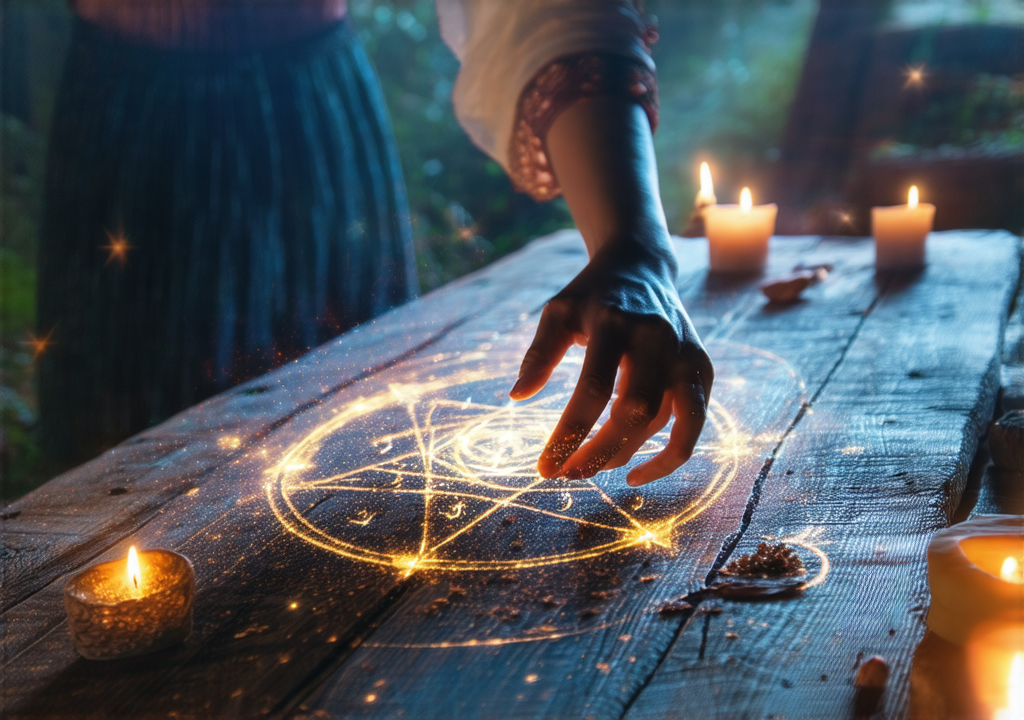
A ceremonial space must be prepared before any work can proceed effectively. This preparation begins with purification—whether through bathing in blessed water, fumigation with specific incense, or the recitation of consecration prayers that sanctify both practitioner and environment. The physical arrangement matters: the pentagram is drawn upon the ground or altar, the directional quarters are established with appropriate elemental correspondences (Air at East, Fire at South, Water at West, Earth at North), and candles or sigils representing the chosen planetary influence are positioned according to astrological timing.
The high ritual requires instruments—the athame (ritual knife) for cutting through energetic boundaries, the wand for directing will, the chalice for receiving inspiration, and the pentacle for grounding material concerns. Each tool carries specific symbolic weight: the pentagram drawn with chalk becomes a protective boundary when inscribed properly; the hexagonal sigil of Saturn invokes enduring stability; the triangle representing Mars embodies martial force. These are not arbitrary decorations but active components within a larger working.
Planetary Timing and Astrological Correspondences
Timing is critical in ceremonial magic, for every planetary influence carries its own quality and power. The practitioner must consult the ephemeris to determine when Mercury’s light is strongest or when Mars rises above the horizon. Working under the appropriate planetary aspect can multiply effect: invoking Venus during her hour yields greater success in matters of love and harmony; calling upon Saturn on a Saturday builds foundations that endure through time; performing the Great Work under Mercury’s influence enhances both communication and intellectual power.
The astrological correspondences provide an entire cosmology for ritual practitioners: each planet governs specific days, hours, zodiacal signs, colors, metals, stones, incense, herbs, and even musical notes. A Saturnian rite requires black candles on a Saturday in the hour of Saturn; a Venusian invocation calls for green robes with jasmine incense during her hour—details that matter when one seeks precision over approximation.
Sacred Geometry and the Power of Numbers
Beyond timing lies geometry—the mathematics of sacred space. The pentagram’s five points correspond to the elements plus spirit; the hexagon mirrors Saturn’s seal; the octangle represents Venus’s complete cycle of influence; the heptagon embodies lunar wholeness through seven planetary spheres. Each geometric figure carries inherent power that activates upon being drawn with appropriate materials and at auspicious times.
The number system operates similarly: three for purification (body, mind, spirit), four for stability (earth elements), five for manifestation (pentagram’s points), six for balance, and seven for cosmic harmony. These numerical correspondences guide everything from the duration of prayers to the sequence of invocations. When a practitioner invokes Jupiter in his own hour using a golden rod while tracing the heptagon, they are aligning microcosm with macrocosm—invoking the planetary power through geometric form during numerologically favorable conditions.
The Great Work: From Preparation to Completion
The ceremonial process unfolds through clear stages that demand both devotion and discipline. First comes preparation of space and instruments. Then follows purification of self through bathing, fasting, or meditation. The pentagram is drawn around the practitioner for protection; the hexagram or chosen geometric figure is traced with appropriate tools while invoking divine names. Incense rises as prayers ascend; the athame cuts boundary lines; candles burn according to their planetary correspondences.
Invocations are recited in sequence—not hastily but deliberately, each name carrying specific power when spoken at precisely the right moment and with precise intention. The practitioner must hold mental clarity, for confusion dilutes effect just as chaos weakens a circle. Each prayer is chanted or whispered with exactness; each gesture accompanies its corresponding verbal formula. Only then does the ritual reach completion—usually marked by extinguishing candles in reverse order (starting with Jupiter’s light), making final offerings, and closing the pentagram that was first drawn for protection.
Why This Matters Now
Modern practitioners often overlook ceremonial magic because they misunderstand what it requires: not mystical intuition or poetic inspiration, but systematic knowledge applied with disciplined precision. Anyone who has learned basic principles can perform a working effective within weeks of study. The difference between amateur and master lies not in extraordinary talent but in consistent practice—performing the ceremonies repeatedly until both body and mind internalize their structure.
What makes ceremonial magic distinctive is that it provides a complete framework: one need not invent new formulas or discover personal methods after years of experimentation. The old grimoires offer tested paths, ancient wisdom confirmed by centuries of practitioners across cultures. A single night can yield results—whether healing through invocation, protection through circle-drawing, or manifestation through planetary alignment—that would otherwise require months of lesser practice to achieve.
The hidden power exists within this discipline precisely because it has been preserved so accurately: in ritual spaces prepared according to ancient standards, at astrological moments verified by ephemerides, invoking names that carry millennia of accumulated authority, performing geometric figures whose mathematical relationships echo throughout the cosmos. When done correctly, even one evening’s work can shift energies permanently—proving that ceremonial magic remains not only viable but deeply practical for anyone willing to approach it with discipline and precision.


Recent Post



Gallery






Featured Videos






No Comments