



A Guide to Golden Dawn Ritual Magic & Elemental Symbolism
Beneath our daily gaze lie ancient symbols that have guided mystics for centuries—symbols embedded in architecture, sacred texts, and even the patterns of our own lives. The Golden Dawn emerged as one of the most profound mystical traditions of Western esotericism, weaving together Kabbalistic wisdom, Hermetic philosophy, elemental correspondences, and ceremonial magic into a coherent system of practice that remains relevant to this day.
Origins and Foundations
Founded in 1888 by William Wynn Westcott, Samuel Liddell Matthews Mathers, and Arthur Edward Waite, the Golden Dawn was more than a mere society—it was a living laboratory of spiritual experimentation. The order adopted its name from the title of an alchemical treatise, The Hermetica, and positioned itself as a bridge between ancient wisdom and modern understanding.
At the heart of the Golden Dawn lay a rich system of correspondences that connected seemingly disparate elements: colors to numbers, days of the week to planetary influences, directions to sacred geometries, and human consciousness to the cosmic forces at play in every moment of existence. This intricate web of connections is what makes the order’s symbolism so powerful—and why its symbols remain hidden in plain sight, waiting to be recognized by those who know where to look.
The Elemental Framework
Central to Golden Dawn practice is a rigorous elemental system that assigns specific colors, names, and directions to each manifestation of Spirit—Earth, Water, Air, Fire, and their subtle counterparts. This framework appears throughout the order’s rituals, particularly in the Lesser Banishing Ritual of the Pentagram, which has become one of the most widely practiced magical formulas in modern occultism.
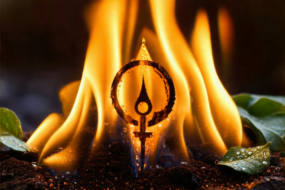
The system operates on principles of analogy: just as fire corresponds to the direction east and symbolizes transformation, so too does it correspond to specific names of deity, colors within the ritual space, and even particular incense burned during ceremonies. These correspondences are not arbitrary; they derive from centuries of accumulated wisdom about how energies manifest at different levels of being.
The Pentagram as Microcosm
Perhaps no symbol better illustrates the Golden Dawn’s approach than the pentagram itself—the five-pointed star drawn within a circle, which serves both as a protective sigil and as a representation of the macrocosmic order reflected in microcosm. When practiced correctly, the ritual creates an energetic boundary that can be cleared or consecrated according to specific intentions.
The Golden Dawn’s system goes deeper than surface-level correspondences, however. Each direction within the ritual carries not just elemental properties but also planetary influences—Vulcan, Jove, Mercury, and Luna all make their presence felt as one moves clockwise through the four quarters of the space being cleansed.
Kabbalah and the Tree of Life
No discussion of Golden Dawn symbolism is complete without reference to the Hebrew mystical tradition of Cabala or “Kabbalah,” specifically the system known as Sefer Yetzirah (The Book of Creation) and the famous Tree of Life diagram consisting of ten emanations or spheres connected by twenty-two paths. These correspondences include colors, planetary names, elemental associations, and even specific letters of the Hebrew alphabet.
The Golden Dawn adopted a particular arrangement of these symbols that would later be standardized in occult literature—and many readers encounter this same system whenever they glimpse a pentagram on a wall or read about tarot card meanings without realizing how deeply rooted these symbols are in living practice.
Practical Application: The Lesser Banishing Ritual
What makes the Golden Dawn truly remarkable is not merely its theoretical framework but its practical application—anyone can perform basic rituals using nothing more than intention, visualization, and spoken words while remaining largely ignorant of the symbolism surrounding them. Yet those who learn to see through the veil discover layers upon layers of meaning, each corresponding to a different aspect of being: body, soul, spirit, and beyond.
The Lesser Banishing Ritual serves as an excellent introduction because it is simple enough for beginners yet profound enough that practitioners continue discovering new insights after decades of practice. It combines visualization techniques with spoken invocations, creates energetic boundaries through the pentagram’s geometry, invokes specific divine names, and cleanses the ritual space according to precise correspondences between direction, element, and deity.
Symbols Hidden in Plain Sight
The true marvel of Golden Dawn symbolism lies in how these ancient symbols have remained present in our daily lives while remaining largely unnoticed. They appear in religious architecture—particularly gothic cathedrals that inherited their geometric patterns from medieval ceremonial magic; they manifest in tarot decks, which themselves emerged directly from the order’s own work on the subject; and they even echo through modern occult revival movements where practitioners continue using symbols first codified nearly a century ago.
When you next see a pentagram carved into stone or hear someone invoke “the powers of the four quarters,” recognize that these symbols are not mere decoration—they are active tools for shaping perception, energy, and consciousness themselves. The Shocking Truth About the Symbols Hidden in Plain Sight is this: they have been guiding practitioners all along, waiting patiently to be recognized by those who know how to look—and once seen, never truly forgotten again.


Recent Post

Gallery






Featured Videos





No Comments