


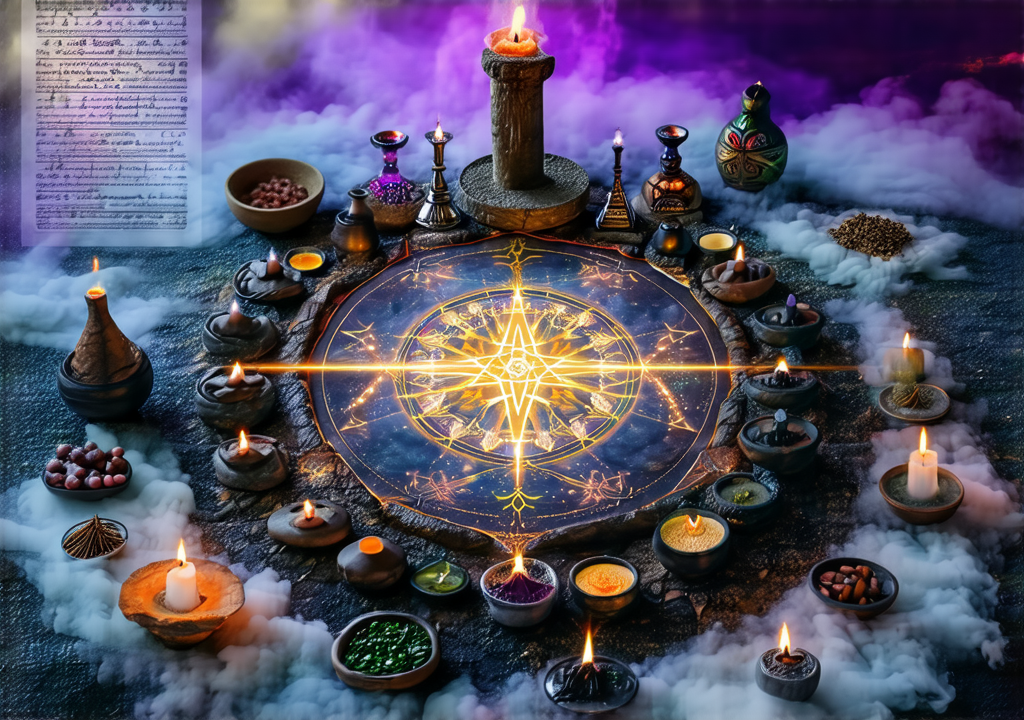
Ceremonial magic is one of humanity’s oldest traditions—a systematic practice that seeks to align the human will with cosmic forces through structured rituals, precise invocations, and deliberate acts of symbolic power. Unlike casual astrology or tarot reading, ceremonial magic demands precision: specific timings, geometries, materials, and words arranged in a carefully constructed order. It is a craft as much as it is an art, and understanding why it works requires exploring both its philosophical foundations and its practical mechanics.
What Is Ceremonial Magic?
At its core, ceremonial magic is the practice of effecting change through ritual means. Unlike folk magic—which often relies on simple charms, herbs, or household practices—ceremonial magic involves elaborate structures: invocations (calls upon spiritual entities), evocations (bringing forces into physical presence), and consecrations (transforming objects or spaces as tools for magical work).
The word “ceremony” itself derives from the Latin caerimonia, referring originally to sacred rites performed according to precise rules. In ceremonial magic, every element has meaning: the direction a candle faces, the incense burned, the sequence of gestures. These are not arbitrary traditions but carefully accumulated patterns of correspondence between the material and spiritual realms.
The History: From Antiquity to Modern Practice
Ceremonial magic traces back to ancient Egypt and Babylon, where priests practiced complex rituals involving precise timings, offerings, and sacred geometry. By the time we reach Hellenistic Alexandria (circa 200 BCE), Jewish mystical traditions began merging with Greek philosophical concepts, producing what scholars call hermeticism—a synthesis of magic, astrology, and philosophy that would become foundational to Western esoteric thought.
Medieval grimoires like the Arbatel, the Key of Solomon, and the Greek Magical Papyri codified many practices we see today: sealed circles for protection, named spirits and their signatures (drawings representing spiritual entities), and elaborate invocations using divine names and seals. Renaissance thinkers like John Dee (1527–1608) pushed these traditions forward with mathematical precision and philosophical depth.
The 19th century saw the founding of several major orders that established modern ceremonial magic: Rosicrucianism, The Hermetic Order of the Golden Dawn (1888), and later, Aleister Crowley’s Thelemic system (20th century). These movements systematized centuries of accumulated practice into coherent systems with specific rituals, hierarchies, and teachings.
Core Principles of Ceremonial Magic
1. The Principle of Correspondence
The foundation of all ceremonial magic is the principle that “as above, so below.” Macrocosm mirrors microcosm: planetary positions correspond to specific qualities in human experience, elements correspond to states of being, and numbers carry intrinsic meaning. This isn’t mere symbolism—it’s a theory of how cosmic forces actually manifest in material reality.
2. The Principle of Signature
Every entity—whether a planet, element, or spirit—carries an internal “signature”: its essence expressed through specific correspondences. A magician seeking Jupiter’s influence might invoke him using gold (Jupiter’s color), face eastward (traditional direction for expansion), use specific plant spirits like oak or walnut, and employ Jupiterian divine names.
3. The Principle of Will
Perhaps most importantly, ceremonial magic is not about passively receiving mystical experiences but actively shaping reality through will (will being the key word). The magician’s intent, directed with precision through ritual form, becomes the catalyst for change. This distinguishes ceremonial magic from mere meditation or prayer: it is an active technique of transformation.
How Does It Work?
The question “why does ceremonial magic work?” has two answers, and both are true.
First, on a philosophical level, ceremonial magic rests on a worldview that sees reality as fundamentally interconnected—not separate objects moving through empty space but a unified field where meanings, forces, and essences interpenetrate. When you cast the circle or invoke Jupiter’s name with sincerity, you’re not manipulating arbitrary symbols; you’re participating in real relationships between cosmic principles and material manifestation.
Second, on a practical level, ceremonial magic works because it engages both consciousness and environment simultaneously. The rituals are designed to focus attention (which shapes perception), alter consciousness through rhythm and incense, create psychological states conducive to willful action—and often the very act of performing ritual reliably shifts conditions in ways that become tangible.
Practical Examples: Where Ceremonial Magic Shows Up
- Magical seals: Geometric diagrams representing divine names or planetary forces—essentially magical blueprints
- Invocations and exorcisms: Calling upon spiritual entities by name, with specific verbal formulas, to draw their power into presence
- Conjurations of spirits: More complex rituals combining words, gestures, circles, colors, and incense to summon specific entities or energies
- Kabbalistic paths: Working through the Tree of Life—using Hebrew letters, sephiroth (emanations), and meditation to understand oneself as a microcosm reflecting the cosmic pattern
Modern Applications
While ceremonial magic originated in ancient temples and medieval grimoires, modern practitioners find it relevant today: for personal development, creative work, healing practices, and even as a serious spiritual discipline. The techniques don’t require belief—only participation—and can be applied whether you consider yourself religious, secular, or both.
Getting Started
To begin your own ceremonial magic journey, start with the basics: learn what corresponds to what (planets, elements, directions), understand the structure of a simple invocation, and practice regularly before attempting complex rituals. Remember that precision matters—not because the universe demands perfection, but because clear intention makes all the difference between mumbled words and genuine effect.
Conclusion
Ceremonial magic is neither mysticism nor mere ritual—it’s an active, systematic method for engaging with reality at a deeper level. It works because it aligns human will with cosmic forces through precise symbolic actions that have been refined over millennia. Whether you approach it as practitioner or scholar, its depth and utility remain undiminished after thousands of years.


Recent Post


Gallery






Featured Videos




No Comments