


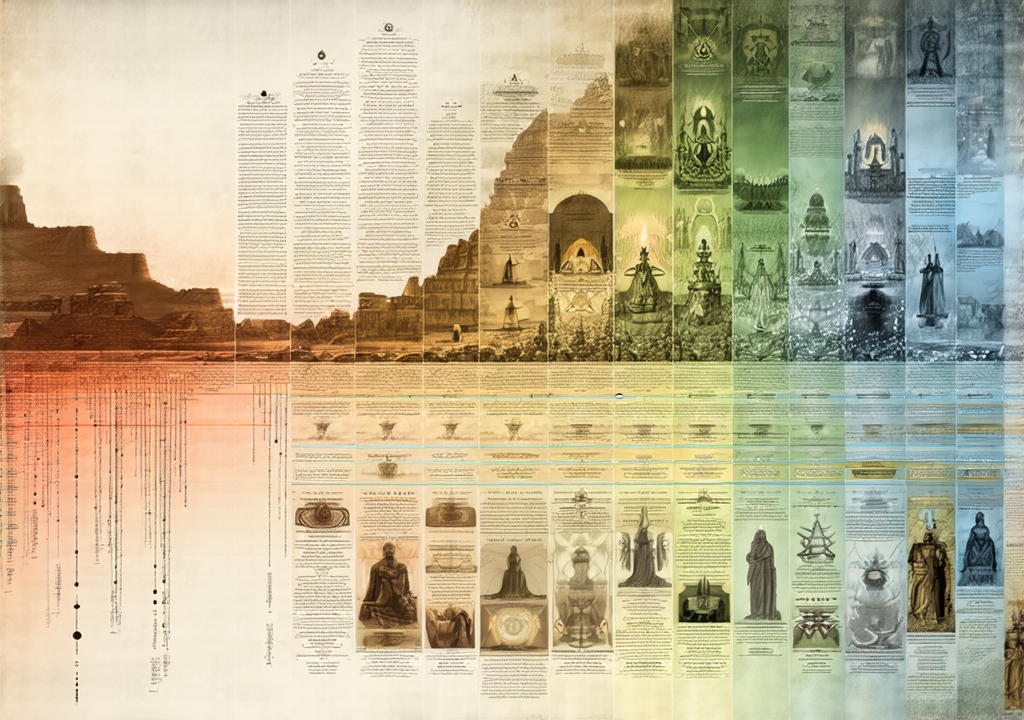
Ceremonial magic—often called high ritual—is an ancient discipline that relies on precise ceremony, intricate symbolism, and carefully orchestrated performance to effect supernatural change. Far more than mere superstition or folk practice, ceremonial magic demands exactitude in timing, direction, invocation, and material execution. It is the art of aligning human intention with cosmic forces through structured ritual, a tradition whose roots stretch back millennia and whose modern practitioners continue to refine its methods.
Origins: From Ancient Mesopotamia to Classical Antiquity
The earliest traces of ceremonial magic emerge from ancient Mesopotamian divination practices—extispicy (divination by examining animal entrails) and astral observation were already sophisticated systems of reading celestial patterns as divine messages. The Egyptians expanded this tradition, embedding ritual within temple practice where priests performed elaborate ceremonies using incense, precise gestures, and sacred geometry.
Greek philosophical traditions further refined these ideas through the Hermetic corpus, particularly the Corpus Hermeticum, which established a foundation for understanding magic as an art of aligning the microcosm (the human) with the macrocosm (the cosmos). Neoplatonism provided the metaphysical framework: if the universe is ordered hierarchically from the divine One downward through spirit, soul, and matter, then ritual can serve as a ladder for ascending back toward divine communion.
The Medieval Synthesis
During the medieval period, ceremonial magic crystallized into recognizable forms. The practice of magia naturalis (natural magic) merged with ritual techniques drawn from the Kabbalah, astrology, and Christian liturgy. Medieval grimoires such as the Key of Solomon codified specific procedures for summoning spirits, consecrating tools, and performing exorcisms according to astrological timing.
The Renaissance witnessed a particularly rich flowering of these traditions. Paracelsus introduced medical magic; Cornelius Agrippa published Three Books of Occult Philosophy, synthesizing planetary correspondences, elemental theory, and ritual practice into a comprehensive system. The Tarot itself emerged during this period as both divination tool and esoteric symbolism.
The Golden Age: 17th–19th Centuries
The seventeenth century saw the publication of major grimoires and the rise of societies dedicated to magical study, including the Rosicrucians. John Dee’s Monas Hieroglyphica (1564) combined mathematics, geometry, and symbolic representation into a unified system. The Hermetic Order of the Golden Dawn, founded in 1887, would eventually codify Western ceremonial magic for modern practitioners.
The Golden Dawn synthesized earlier traditions—Kabbalistic Tree of Life, Tarot, elemental correspondences, Enochian angelic invocations from John Dee and Edward Kelley—into a coherent system that remains the primary reference for contemporary ceremonial magicians. Their rituals are remarkably precise: specific incense types, directional alignments, colored robes, consecrated implements, and carefully timed performance of each ritual element according to established formulas.
Core Elements of Ceremonial Magic
What distinguishes ceremonial magic from other magical practices is its emphasis on precision. A properly executed ceremony requires attention to numerous details:
Materials: Altars, candles (in specific colors), incense (with specific types for specific purposes), robes and pentacles, ritual knives or wands, chalices, and the elemental correspondences each represents.
Timing: Rituals performed according to astrological timing—the planetary hour of execution, lunar phase alignment, zodiacal position—matter significantly in ceremonial practice. A spell intended for Mars must be timed during a Martian hour on a Tuesday; an invocation for Venus requires Friday and her planetary hour.
Direction and Geometry: Altars are oriented according to cardinal directions (North, South, East, West), each direction corresponding to specific elements and archetypal energies. The pentagram—drawn in the air or upon parchment—creates sacred space and defines the ritual circle.
Invocation and Visualization: The magician visualizes the desired result with precision, speaks invocations in specific languages (often Latin or Hebrew), traces sigils, and performs each gesture according to established practice. The body of the practitioner is itself an instrument of magic: posture, breath, voice, and movement all carry meaning.
Evolution Through the Centuries: What Has Changed?
While the core practices remain recognizably similar across centuries, several important shifts have occurred:
From Exclusivity to Accessibility: In earlier centuries, ceremonial magic was largely confined to educated elites who could read Latin texts, understand astrological charts, and afford the materials. Modern practitioners draw on digital resources, translated grimoires, online communities, and accessible instruction through books, podcasts, and video courses. The barrier to entry has lowered considerably while maintaining rigor.
From Exclusion of Skepticism: Medieval magicians often treated their practices as matters of faith and revealed knowledge. Modern ceremonial magic exists alongside scientific thinking; practitioners may simultaneously accept quantum physics and the efficacy of ritual. Many modern magicians treat ceremonies not as literally “real” in a supernatural sense but as psychologically potent acts that shape reality through focused intention, pattern, and symbolic action—a view influenced by Carl Jung’s psychological interpretations of archetypes.
From Local to Global: The tradition has spread globally, with practitioners from diverse cultures adapting elements while maintaining core practices. Japanese magicians study Western ceremonial magic; African practitioners incorporate local spirits into the framework. The internet enables global communities that preserve and expand these traditions continuously.
New Technological Integration: While modern ceremonial magicians still use candles and pentagrams, they may also record rituals on video, utilize digital astrological software to calculate planetary hours precisely, employ online forums for collaboration, and even create virtual altars in augmented-reality environments. The fundamental practice remains unchanged—only the tools expand.
Contemporary Practice: Where Ancient Ritual Meets Modern Life
Today’s ceremonial magicians might perform a ritual at dawn, dressed in robes, burning sage, invoking archetypes through structured ceremony—and then proceed to their day jobs as doctors or engineers or software developers. They may be drawing on practices from two thousand years ago while simultaneously participating in global communities across continents and cultures. The ancient practice endures not because it is static but because it adapts: the core remains precise ceremony, symbolic action, and focused intention, even as the expressions of these principles evolve with each generation.
Ceremonial magic survives precisely because it offers something that modern life often lacks: structure in an age of fragmentation, intentionality in an age of distraction, and connection to something older than any institution. The ancient practices endure not by remaining frozen but by breathing through centuries, adapting while retaining their essential character—a living tradition where every performance is both homage to the past and a genuine act of power.


Recent Post

Gallery






Featured Videos




No Comments