


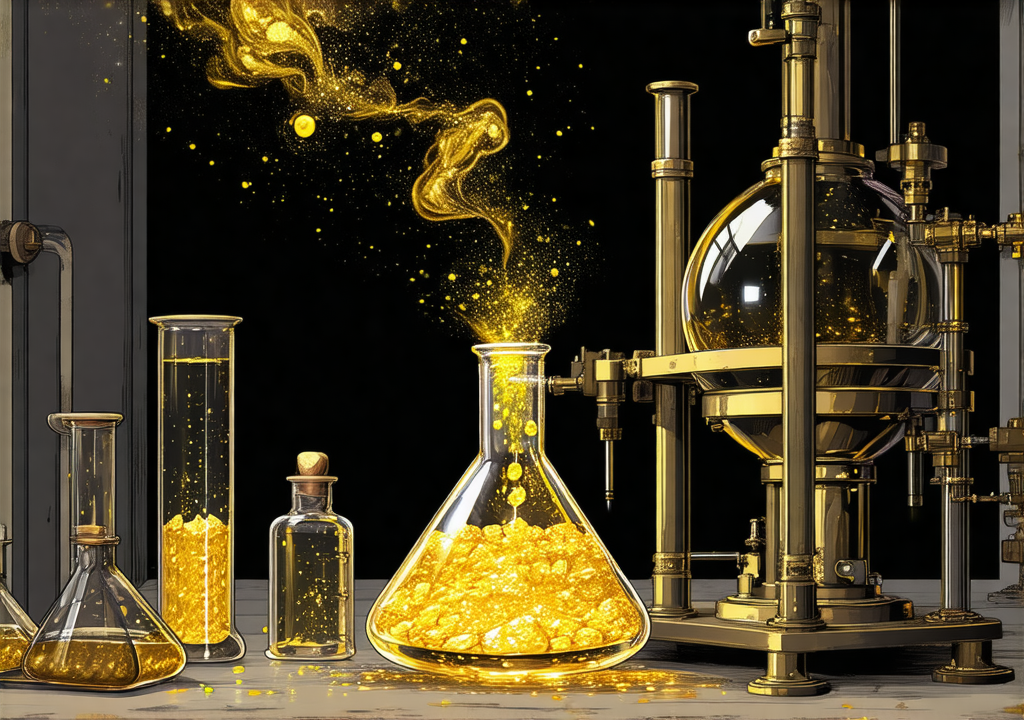
In the quiet laboratories of ancient wisdom, where philosophers pondered over glowing crucibles and mystics traced golden spirals through the air, a profound truth emerged—that life itself is an alchemical process. From the moment of our birth to the final breath of our dying days, we undergo constant transmutation. The Alchemist’s Secret reveals that within every human experience lies the potential for transformation: base lead into divine gold, mundane suffering into spiritual enlightenment, and ordinary consciousness into transcendent awareness.
The Nature of Elemental Transmutation
Alchemy is not merely the medieval pursuit of turning lead into gold or creating the legendary Philosopher’s Stone. At its heart, alchemy represents a fundamental principle of cosmic order—the understanding that everything exists on a spectrum between base and divine matter, between formlessness and perfection. The ancients observed that just as metals have their own unique essences that can be purified through fire, so too does human consciousness possess layers of refinement waiting to be uncovered.
The four classical elements—earth, water, air, and fire—serve not only as building blocks of physical reality but also as mirrors reflecting the spiritual journey. Earth represents our physical body and material existence; water embodies emotion and fluidity; air symbolizes thought and intellect; fire signifies spirit and transformative energy. When these elements dance together in proper harmony, transmutation occurs naturally. The alchemist’s work is to cultivate this internal balance so that life itself becomes a sacred operation—a living laboratory where the practitioner serves as both subject and experiment.
The Great Work: Internal Alchemy
What distinguishes the true alchemist from mere practitioners of external rituals is their understanding that the real transmutation happens within. The Philosopher’s Stone was never simply an object to be discovered outside; it was a metaphor for perfected consciousness—the vessel through which transformation becomes permanent. When one learns to observe themselves as both raw material and active agent, life ceases to be something that happens to them and becomes something they actively shape.
The great work begins with death of the ego—not literal dying but the willingness to surrender outdated patterns, beliefs, and identities so that something more refined can emerge. This requires patience, for transmutation takes time. Lead does not become gold instantly; it must be purified through successive stages of dissolution, separation, conjunction, and multiplication. Each stage represents a deeper level of understanding: first we must dissolve our defenses (nigredo), then separate truth from illusion (albedo), unite opposites within ourselves (rubedo), and finally multiply this inner gold into external manifestation.
Practical Alchemy in Daily Life
The beauty of the alchemist’s art is that it applies equally to spiritual and material realms. When difficulties arise—and they always do—the wise practitioner recognizes them as opportunities for transmutation rather than mere obstacles. Hard work, love lost, failure, unexpected setbacks—all become raw materials on the anvil of experience. Each difficulty has its own unique quality: some purify through patience; others refine through understanding; still others elevate through sacrifice.
The alchemist’s daily practice involves several elements that can be incorporated into any life:
Meditation and contemplation serve as the crucible where raw awareness is heated until it becomes refined. Just as the alchemist heats metal in the furnace, we heat our consciousness through sustained attention, allowing impurities of thought to settle so that essential understanding rises.
Creative work—whether writing, painting, crafting, or building—represents external alchemy made visible. When we bring inner visions into outer form, we enact the same principle by which spirit becomes matter. Every creative act is a small transmutation.
Relationships and service provide the field for testing purified consciousness. How do we relate to others when our ego is calm? Do we give freely or cling possessively? Through relationships, abstract spiritual principles become concrete practice.
The Secret of Gold: Understanding True Value
Why does alchemy focus on gold? Gold possesses unique properties that make it an ideal symbol for the perfected state: it resists corrosion (immortality), retains its luster indefinitely (perfection), conducts heat well (spiritual receptivity), and can be divided infinitely without losing essence. In human terms, these qualities represent a consciousness that endures hardship without losing itself, maintains inner beauty despite external decay, remains open to higher influences, and carries within it an infinite potential for expression.
The alchemist’s secret is thus revealed: the transmutation we seek in life mirrors the transmutation pursued in laboratories. Both require patience, both demand purity of intention, both involve heat (the fires of experience), both seek permanence over impermanence. What distinguishes them is scale and scope—the laboratory experiment produces gold; the alchemical life produces a living human who embodies gold-like qualities: endurance, beauty, radiance, and potential.
Becoming the Philosopher’s Stone
Ultimately, the Alchemist’s Secret teaches that we are not merely seekers of transmutation—we are its medium. When we understand this, every moment becomes alchemical work. Breath is fire; digestion is water; thinking is air; body is earth. Our desires become matter; our thoughts become spirits; our actions become gold. We need no external laboratory because the entire universe becomes our crucible when we awaken to this truth.
The life thus lived—conscious, deliberate, and aware of its own transformation—is itself a form of transmutation. Not merely from one state to another, but continuously, moment by moment, breathing in lead through raw experience and exhaling gold through conscious integration. This is the secret that alchemists have whispered across centuries: we were never truly separate from our work; we are the Philosopher’s Stone, living and breathing, transmuting reality as long as we live.


Recent Post



Gallery






Featured Videos





No Comments