



Matter Becomes Divinity.
These words echo through centuries of contemplation, from the misty laboratories of medieval Europe to the ancient alchemical treatises of East Asia, yet they capture a truth that transcends mere chemistry. To understand transmutation is not merely to observe the turning of lead into gold, but to witness something far more profound: the revelation that all matter contains within it the seed of divinity, and that through patient artistry, this hidden potential can be made manifest in the material world.
The Nature of Matter Before Transmutation
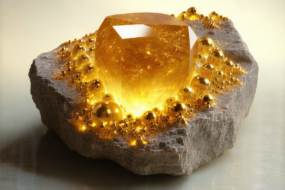
In the alchemical worldview, ordinary substances possess a certain heaviness, a density that marks them as base. Lead sits heavy in the palm, dark and stubborn, while gold shines with an incorruptible brilliance that seems to capture light itself. These were not arbitrary distinctions but reflections of deeper spiritual realities: lead represented mortality, corruption, and earthly limitation; gold symbolized perfection, immortality, and divine presence.
Yet between these two poles lay a continuum, not a chasm. The alchemists understood that the transformation from base to precious was not an artificial imposition upon matter but rather a revelation of what was always latent within it. The seed of divinity was already present in lead; it merely required the proper catalyst and the right conditions to awaken.
The Process of Transmutation: Art Over Accident
What makes alchemical transmutation distinct from mere chemical reaction is that it requires both the work of hands and the work of contemplation. It demands not only precise measurement and timing, but also a certain inner state on the part of the practitioner—what medieval texts call scientia per experientiam, knowledge through experience.
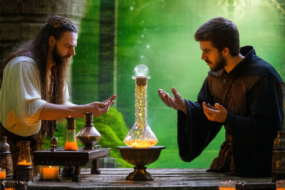
The great works were never completed in haste. They required months or even years of patient observation: watching as substances changed color from red to green, from black to white, from one form to another. Each transformation was a conversation between the alchemist and nature itself, a dialogue that produced not merely a product but wisdom.
The Philosophical Underpinnings
At the heart of transmutation lies an understanding of correspondence: as above, so below; as within, so without. The microcosm mirrors the macrocosm, the individual reflects the cosmos, and the transformation of base matter into gold serves as a symbol for the transformation of the soul itself.
This symbolic reading does not diminish the literal reality of transmutation; rather, it deepens it. When lead becomes gold in the laboratory, it participates in a larger pattern whereby all things strive toward their own perfection. The alchemist’s art is thus both practical and contemplative—a way of life as much as a technical process.
Spiritual Dimensions
The great transformation works were not merely physical procedures; they were spiritual exercises. Each stage of the work corresponded to stages in the soul’s purification: the blackening (nigredo) signified death and decomposition, the whitening (albedo) represented rebirth and clarity, and the reddening (rubedo) indicated perfection and illumination.
The practitioner who approached transmutation with proper intention found that the laboratory became a sacred space, each crucible an altar, each experiment a prayer in action. The matter transformed not merely by external means but through its participation in this sacred process.
Why This Matters Now
In our modern age of specialization and fragmentation, alchemical transmutation offers something we have lost: the understanding that transformation is possible at every level—from the smallest particles to the grandest abstractions. Matter Becomes Divinity not because matter lacks divinity within it, but because the world has forgotten how to perceive what was always there.
The practice of true transmutation, whether in laboratory or soul, requires the patience and reverence that our age often lacks. It demands attention—both to external detail and internal disposition—and the willingness to participate in processes whose results may not be immediately visible.
Conclusion
Matter Becomes Divinity is not merely a phrase but an invitation: to see gold hidden in lead, soul concealed in matter, potential latent within every moment. To practice alchemical transmutation is to engage actively with this truth, becoming oneself both subject and object of the great work. And in doing so, one participates not only in the transformation of base into precious metal, but ultimately in one’s own transformation—from mortality to something more enduring, from limitation to revelation, from mere existence to genuine being.


Recent Post



Gallery






Featured Videos





No Comments