


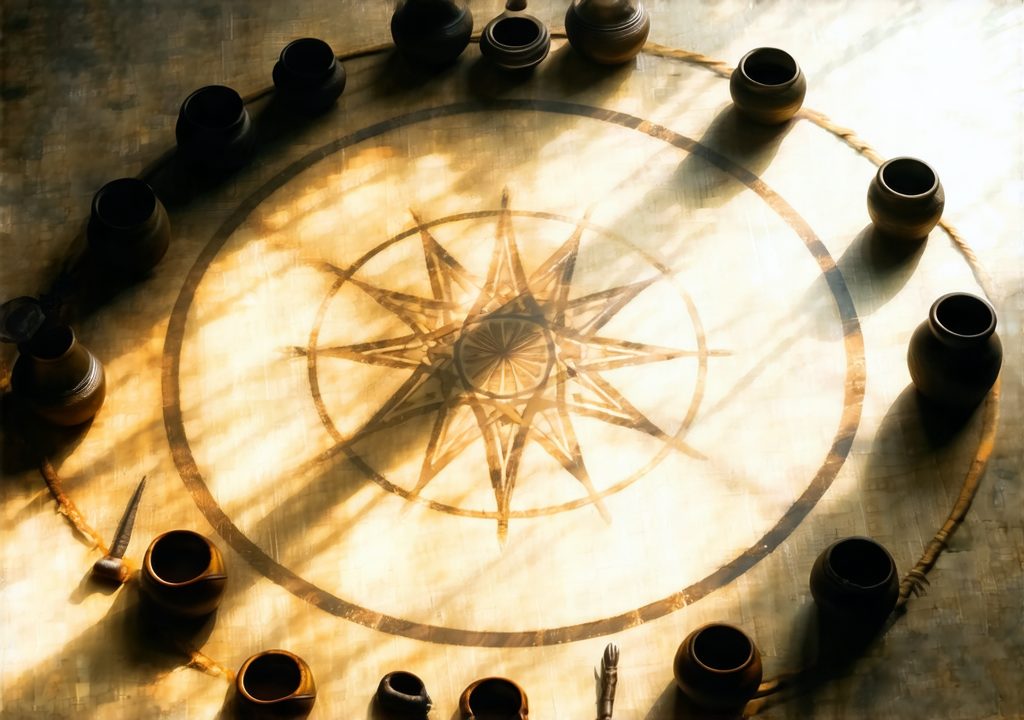
When we speak of ceremonial magic—the great art by which adepts work their will upon the world through precise ceremony—we are referring to a system far older than most Western traditions claim, one that has seen its practitioners raise stars to summon angels and bind them into service. This is not mere incantation or folk craft; this is high ritual, worked with mathematical precision, where every gesture, word, and material has been placed in its exact position according to a system of correspondences that connects the visible world to hidden powers.
The great ceremonial magicians—from Agrippa through Dee, from Drigg into modern practice—have all agreed upon certain essential truths: that magic is not a matter of primitive superstition but rather of art, of technique and knowledge; that it requires both preparation and execution; that the will of the magician is primary, but must be guided by understanding.
The Nature of Ceremonial Magic
Ceremonial magic differs from other magical traditions in its methodical approach to spellcraft. While folk magic relies on traditional recipes and inherited practices, ceremonial magic builds upon a systematic framework of correspondences—where specific names, symbols, colors, numbers, and materials each carry particular virtues that can be combined in precise ways.
The great principle underlying all ceremonial practice is this: as above, so below. The microcosm (the magician) corresponds to the macrocosm (the universe), and by arranging oneself within a properly constituted magical space, one may channel cosmic forces through specific means. This requires understanding the nature of the powers involved and selecting appropriate instruments for their invocation.
Preparation: Setting the Sacred Space
Before any spell is cast, there must be preparation. The magician must first establish sacred space—what some traditions call “casting circle”—by purifying the environment through incense, prayer, or other rites of consecration. This establishes a boundary between ordinary reality and the magical workings within it.
The choice of day matters enormously. Each day bears specific planetary influences that affect particular kinds of magic. Monday favors lunar workings; Tuesday suits Mars and martial magicks; Wednesday brings Mercury’s quickening; Thursday opens Jupiter’s generous energies; Friday draws Venus’s love and beauty; Saturday calls Saturn’s gravity and depth; and Sunday radiates with solar power.
Hourly considerations follow the same pattern, though less strictly in modern practice. Season also matters: Spring for beginnings and growth; Summer for power and manifestation; Autumn for harvest and completion; Winter for contemplation and inner work.
Essential Elements of Ritual
Every ceremonial spell requires certain fundamental components:
The Instruments: Each tool carries specific correspondences. The wand points the magician’s will; the pentacle represents material wealth and stability; the sword cuts through illusion; the cup receives divine influence; the bell calls and binds spirits; the athame serves as both blade and focus for visualization.
The Names of Power: True names carry authority over their referents. Angels, demons, planetary intelligences, and elemental beings each possess specific names that can be invoked to call them forth or bind them in service. The Great Seal of Solomon, Hexagram, and Sigil of the Prophet are among the most commonly used sigils for such purposes.
The Words of Power: These may include invocations (calling powers into presence), invocations of name (using specific divine names), and benedictions (blessings cast outward). Each has its particular form and function.
The Process of Casting Spells
A proper spell unfolds in stages:
First, the magician prepares personally through fasting, meditation, or other disciplines to align their will with the intended action.
Second, sacred space is established through the traditional methods described above. Instruments are consecrated, directions faced, and positions assumed.
Third, invocation begins—calling forth whatever powers are needed, using names, symbols, and gestures appropriate to their nature. This may involve reciting prayers, chanting invocations, or performing specific gestures while visualizing divine entities taking form.
Fourth, the spell proper is enacted through a combination of will, words, and works—the magician’s intention made manifest through deliberate action.*
Finally, thanks are given, space is closed, and the ordinary world reopens around the work done.*
Common Spell Types and Their Applications
Protection Spells: These create barriers against evil influences. They may be cast as circles (for general protection), pillars (against specific threats), or walls (between two points). Protection magic often works well with gold and silver, incense of frankincense, and the invocation of angelic hosts.
Healing Spells: Require gentleness in execution and particular attention to the flow of vital energy through the body. Herbs, crystals, and oils each carry specific healing properties that should be incorporated into the spell’s materials.
Binding Spells: Designed to hold or restrict specific forces—whether spirits, desires, enemies, or natural phenomena—in proper relations. These demand precise timing and exact wording if they are to work properly.
Advanced Techniques for Serious Practitioners
More advanced magicians may employ additional techniques such as:
- Evocation, where spirits are called from without rather than raised from within the magician’s own subtle body
- Ectoplasmic manipulation—the ability to shape magical substance into forms
- Astral projection for spellwork performed in different planes of existence
- Planetary hours and days for selecting optimal timing based on astrological positions
Practical Advice for Beginners
Start small—working with a single type of magic (protection or healing, perhaps) before expanding to more complex workings. Keep meticulous records: what worked, when it worked, and how it was done. This creates the foundation upon which deeper understanding grows.
Remember that will is paramount in ceremonial magic—but only when properly directed. A strong but unfocused will may be like a great force without aim; an untrained one may falter when obstacles appear. Train both your intention and your capacity to hold it steady through complex rituals lasting hours or even days.
With these principles in mind, you are prepared to enter into the grand art of ceremonial magic itself—to cast spells not as mere wishes but as deliberate acts that bend reality to your purpose, working within a system of power so ancient that its origins lie before recorded history and yet continue to be discovered anew by each generation of practitioners.


Recent Post


Gallery






Featured Videos





No Comments