


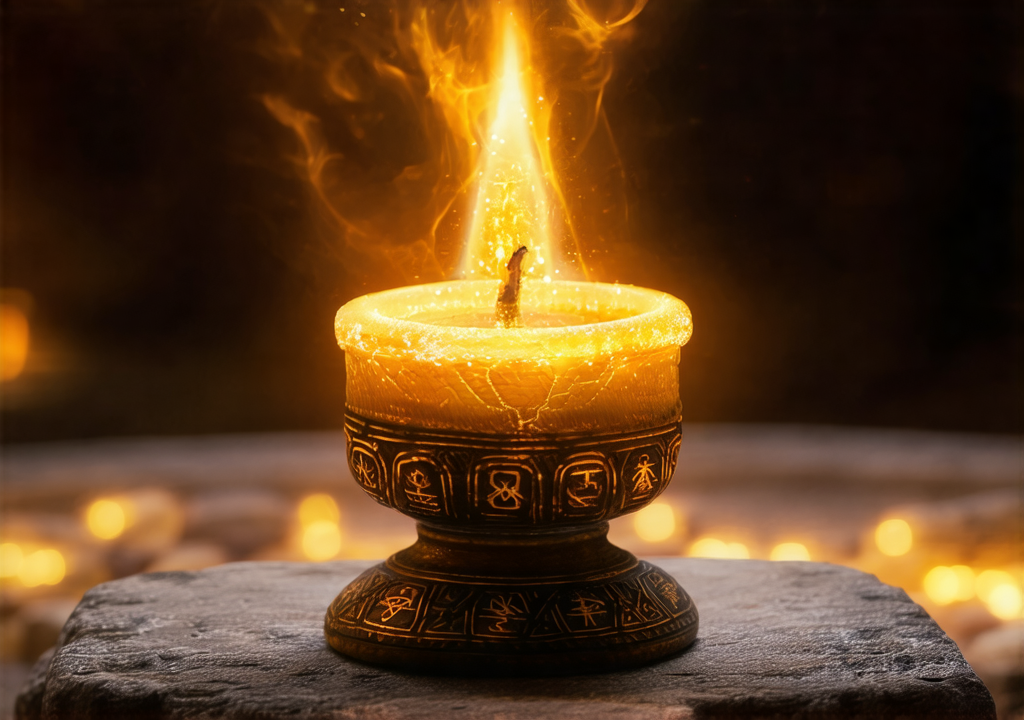
Introduction: A Crossroads in the History of Magic
Magic has been practiced since humanity first gazed upward at the stars and sensed that something greater was moving behind the veil of night. From ancient Mesopotamian incantations to medieval grimoires, ritual magic evolved from primitive charm-casting into a systematic art—a language of symbols, a geometry of spirits, a method of communion between the mundane and the transcendent.
Among this vast tradition, few rites have held as much weight as that single ceremony which so many sages of antiquity invoked when they needed to reach beyond ordinary perception: the invocation of the four elemental powers in concert, surrounded by their sacred symbols, calling upon them through their archangels and planetary correspondences.
It is this ritual—the elemental invocation proper—that became known among later magicians as the one that changed everything.
The Elemental Framework
The ancient world held that all things were composed of four fundamental elements: Earth, Water, Air, and Fire. These were not mere substances to the old magician; they were archetypes, principles active in spirit and matter alike. Each element carried its own quality, its own direction, season, color, gem, and divine name.
When performed correctly, this ritual could open channels through which elemental forces poured directly into the magus’s working space. It was believed that by calling upon these powers with precise gestures and sacred words, the practitioner became a conduit—a living bridge between heaven and earth.
The Structure of the Ritual
The rite typically began at the center of the magical circle, where the magician stood within a pentagram and raised their wand to summon each element in turn: East for Air (or breath), South for Fire, West for Water, North for Earth. With each invocation came a direction—north, south, east, west—and a corresponding color: white or yellow, red, blue or black, green.
Each invocation was followed by the drawing of an elemental sigil in sacred air and the speaking of a sacred name—for instance, YHVH to the North for earth’s domain, ADONAI to the South for fire’s power, ELIOI to the West for water’s depth, and TETRADEKAMVION to the East for the breath of spirit.
The order of invocation mattered greatly. Different traditions varied in their sequence: some placed Fire first, others Air; some called Earth last, some first. But across variations lay a consistent logic—the ritual moved from the subtlest (Air) to the densest (Earth), or alternatively from the purest (Fire) through refinement and descent into matter.
The Element Invocations in Practice
Let us examine one complete invocation, as it might have been performed by a medieval magician in full vestments:
“I invoke thee, Spirit of the North, mighty Archangel of Earth, who dwellest in the green fields of creation—come forth and manifest! Give me thy strength that I may work according to the law.”
The words were spoken with conviction. The wand traced a circle upon the air. And in that moment—the old texts claim—a palpable presence was felt: an energy, a presence, as if some ancient intelligence had answered the call across centuries of silence.
Symbolic Correspondences
What made this ritual so enduring was its rich web of correspondences. Each element carried with it a constellation of meanings: colors, numbers, planetary associations, sacred names, and archangelic dignities. When magicians invoked the elemental powers, they were not calling only upon brute matter—they were summoning the celestial intelligences that governed those powers from above.
The pentagram itself was often considered an elemental seal: its five points representing the four cardinal directions plus the center (or spirit). By tracing the pentagram with wand or staff, the magician could purify their space, banish unwanted forces, and establish a microcosm aligned with cosmic order.
Why This Ritual Endures
So why does this one ritual endure? Why do modern practitioners still study it, perform it in various forms, write commentaries upon its details?
I believe it is because the elemental invocation touches something fundamental about human perception. It appeals simultaneously to sight (the colors, the wand-drawn sigils), to hearing (the spoken words, the sacred names), and even to touch—the physical act of tracing circles, drawing squares in sand or air. By engaging multiple senses at once, it creates a holistic experience that cannot easily be dismissed as mere fancy.
Beyond this, it places the magician within a larger order: not isolated from nature but participating directly in her processes. When one calls upon Earth, Fire, Air, and Water to manifest, one becomes part of an ancient conversation between humanity and cosmos.
The Ritual’s Legacy
Centuries later, we find traces of this rite everywhere—in ceremonial magic textbooks, in the symbols drawn on altar cloths, in the gestures practiced by magicians who have never met each other across millennia yet still recognize their shared heritage.
The elemental invocation has survived not because it is complicated, but precisely because it is simple enough to be remembered and performed even when one’s mind is occupied with lesser concerns. It requires no elaborate machinery, no rare herbs or exotic oils—only a clear intention, a willing heart, and the courage to speak as if meaning something truly matters.
In that single act of invocation—the raising of the wand, the speaking aloud of sacred names—we find perhaps what makes ritual magic enduring: not any particular formula but the simple fact that we humans wish to be heard by the universe around us.


Recent Post

Gallery






Featured Videos




No Comments