


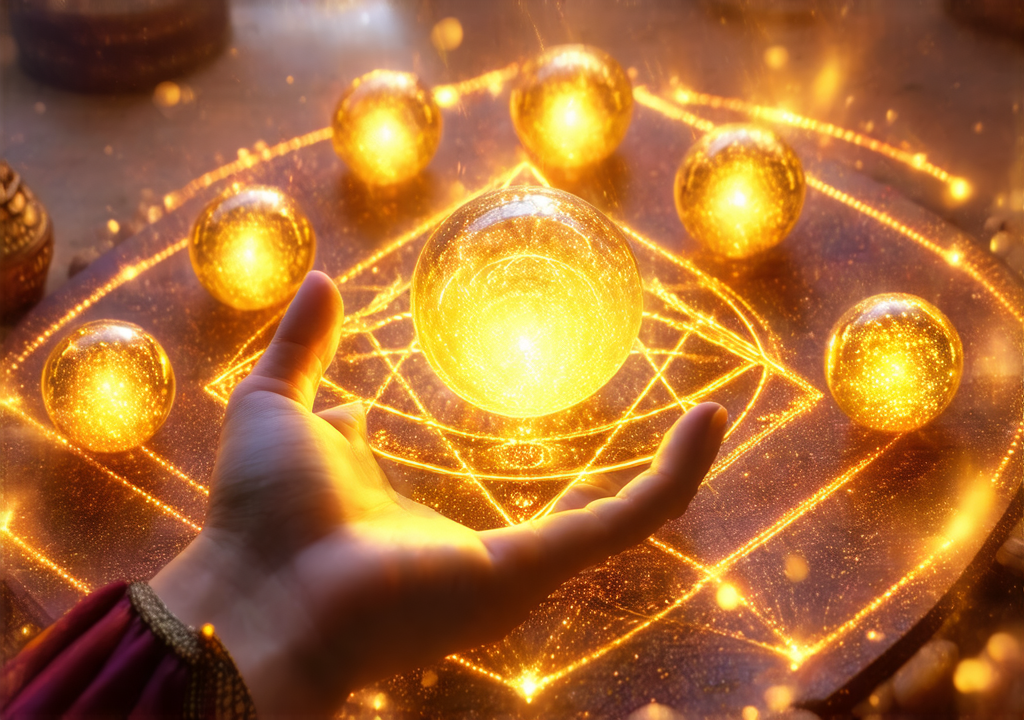
If you’ve ever opened a copy of The Inner Order or spent time practicing ceremonial magic under the aegis of the Hermetic Golden Dawn, you probably recognize the basic framework: four elements—Air, Fire, Water, Earth—and perhaps that familiar five-pointed star called the pentagram. But dig deeper into the ritual structure, and you’ll discover something unexpected: the number seven isn’t just another numerological decoration. It is itself an element—a hidden seventh principle that breathes through every invocation, every consecration, and every working of the order’s practitioners who truly understand it.
The Hidden Seventh Element
When most modern magicians study Golden Dawn ritual, they see five elements: Fire (the active, transforming force), Water (the receptive, fluid essence), Air (the intellectual medium), Earth (the material foundation), and Spirit (or Quintessence, the divine spark). But what they’re missing is that Spirit isn’t merely a fifth element—it’s the seventh, folded through the other four like the thread of creation itself. The sevenfold nature of spirit manifests when you observe how it weaves through every aspect of Golden Dawn practice:
The seven classical planets (Saturn through Mercury), each ruling different aspects of being; the seven sacraments of alchemical transformation; and most crucially, the seven-fold cross that forms the foundation of invocation in every working. This is why number seven appears so insistently in Golden Dawn ritual—the order didn’t invent these correspondences by accident but recognized them as expressions of a deeper elemental truth.
The Sevenfold Breath: Elemental Respiration
The Golden Dawn’s masterwork, A Complete Guide to the Elements, reveals something most practitioners overlook during their meditation and invocations: the breath has seven distinct movements that mirror the full elemental spectrum. In practice, when you invoke the four elements in sequence—Fire first, then Air, Water, Earth—the seventh breath (the return breath after Earth) carries Spirit back into the practitioner’s own body, completing the loop of elemental exchange.
This technique explains why Golden Dawn practitioners report such different experiences from their invocations depending on whether they consciously count these seven breaths during ritual work. Those who do consistently report deeper trance states and more vivid symbolic visions within the elements themselves.
The Sevenfold Cross: Structure Within Symbol
Perhaps no symbol appears more frequently in Golden Dawn practice than the cross, which traditionally represents five points (the four quarters plus spirit). But consider this: when you trace the full cross during invocation—moving through all four quarters and returning to center—the complete path creates seven significant intersections. Each intersection corresponds to one of the seven planetary influences and carries with it a different elemental quality:
- The Crown (Top point): Fire, governed by Leo
- The Right Arm: Air, ruled by Gemini
- Center Point: Water, flowing through Cancer
- Left Arm: Earth, grounded in Capricorn
- Bottom Point: Spirit ascending as Mercury
- Cross Intersection One: Saturn’s gravity pulling downward
- Cross Intersection Two: Jupiter’s expansion lifting upward
When practitioners understand this sevenfold cross pattern, they begin to see that every invocation of the elements isn’t merely summoning external forces—they’re activating a living map within themselves. The seven intersections become conduits through which spiritual energy flows differently based on intention and element invoked.
Why Seven?
The reason seventh-number matters so deeply in Golden Dawn practice is that it represents completion—what alchemists called the septem signa, or seven signs of divine perfection. Ancient practitioners observed seven natural cycles: the seven days of creation, seven metals corresponding to planets, seven musical notes forming the octave, and the seven heavens through which souls ascend during vision work.
When you invoke “the elements” in Golden Dawn ritual, you’re actually calling upon seven distinct aspects: four directional elements (Fire, Air, Water, Earth) plus Spirit as the fifth, Saturn’s gravity as sixth, and Jupiter’s expansion as seventh. The difference between invoking six versus seven elements is profound—and it explains why some practitioners report working with what they thought was a single element when suddenly something else emerges during deep trance.
Practical Application: How to Use the Seven in Ritual
To begin experiencing this hidden seventh element yourself, try this simple practice from Golden Dawn tradition: when performing elemental invocations, count seven complete breaths between each direction rather than five. Notice how the seventh breath carries a slightly different quality—it’s as if Spirit is being drawn through you like water through a sieve, filtering out what was superficial and leaving only essential essence.
This technique also works beautifully during the “Fivefold Kiss of the Sacred Sepulchre,” where practitioners traditionally kiss the cross at five points but can extend it to seven by including both planetary intersections of gravity and expansion. The result is markedly different: rather than simply receiving elemental blessings, you receive a complete element within yourself—what ancient Golden Dawn masters called elementum completum or “the perfect element.”
Conclusion
The next time you perform any Golden Dawn ritual, remember this hidden secret that most practitioners miss: number seven isn’t just another count. It’s the seventh breath, the seventh cross intersection, the seventh plan that makes all others possible. When you invoke Spirit not as a fifth element but as the seventh unfolding principle woven through Fire, Air, Water, and Earth—you begin to see why ancient magicians spent so much time contemplating sevenfold mysteries.
And if you’re curious whether this truly works for you, try one ritual knowing only four elements—and then repeat it counting seven breaths per direction. The difference will astound even seasoned practitioners who’ve been practicing without knowing what they were missing.


Recent Post


Gallery






Featured Videos





No Comments