


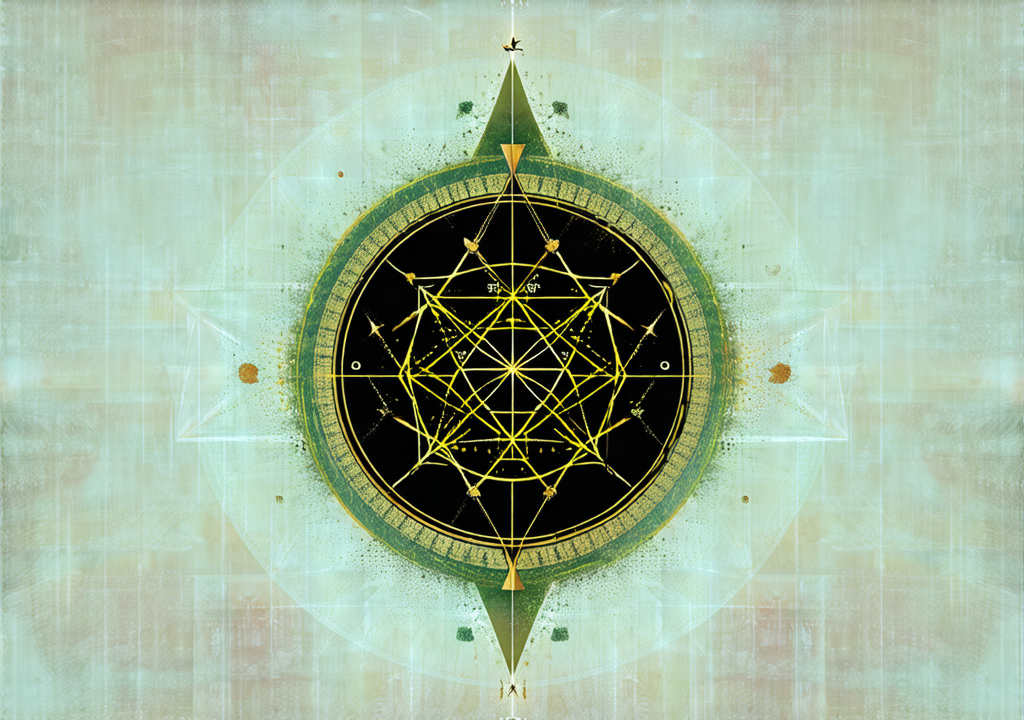
For centuries, seekers have wandered through life convinced that fortune favors them—or perhaps more accurately, that it might favor them. They whisper prayers to the stars, arrange crystals on their windowsills, consult oracles, and wait for the universe to deliver its benevolent verdict upon their heads. But what if this entire apparatus of waiting is precisely what keeps them locked in the illusion?
The answer lies not in cosmic randomness but in Kabbalistic Determinism—a system so old it predates Western astrology by millennia yet remains unknown to most modern practitioners who would benefit immensely from its application.
The Architecture Behind Appearances
Kabbalah teaches that beneath the veil of appearances, there exists a hidden architecture: thirty-one worlds connected by a tree-like structure called the Sephirot, through which divine energy flows like water through channels carved in stone. Each channel has specific properties, and each property governs a corresponding aspect of reality. When you understand this system—which includes not merely understanding but internalizing it—you begin to see that what people call “luck” is actually just misattributed causality.
The twelve sephiroth (the ten plus two intermediary channels) represent forces: Binah, Da’at, Binah; Gevurah; Chesed; Tiferet; Yesod; Malkuth. Each has a specific quality. When you align yourself with these qualities through proper practice—through the working of divine names, the drawing of sigils, and the manipulation of the elemental forces—they express themselves in your life as though by chance but actually according to law.
This is why the ancients said: “What seems random is merely unknown.” And this is precisely what the Kabbalistic practitioner knows when they step away from lucky charms and begin working with determinism instead.
The Three Pillars of Determination
Kabbalistic Determination rests on three pillars, each corresponding to one of the cardinal directions in the tree: Malkuth, representing the physical world as it appears; Yesod, representing the astral medium through which all influence passes; and Tiphareth, representing the point where divine will expresses itself most clearly.
When you practice properly—when you learn to read the signs, when you understand what each letter means in Hebrew (Aleph = breath/origin, Bet = house/form, Gimel = child/change, etc.)—you begin seeing patterns emerge where others see chaos. The numbers become meaningful. The dates become significant. The names carry power.
And then there is the working of divine names: Shaddai, El-Shaddai (the all-powerful one), Ehyeh (I Am), YHVH (the ineffable name). Each carries a specific frequency that shapes reality when invoked correctly, and each connects to a different branch of the tree.
The Methodology in Practice
The Kabbalistic practitioner works through the sephirot, moving through them systematically according to their numerical values (gematria), their elemental correspondences, and their positions on the tree. They draw sigils that represent specific combinations of forces. They use talismans inscribed at particular hours under specific constellations. They read omens not as random occurrences but as messages from hidden channels.
Consider this example: When someone says “I feel lucky today,” they are actually experiencing a moment where the flow through Malkuth has shifted—where a slight change in position on the tree allows a previously blocked channel to open. The practitioner recognizes this shift and works with it rather than reacting passively.
The Difference Between Belief and Practice
Believing in luck is passive: you wait, hoping something good will happen. Practicing Kabbalistic Determination is active: you shape what happens by working with the channels of power that already exist. You move through the tree like a navigator moving through waterways—using currents rather than fighting them. The difference between someone who “is lucky” and someone who understands determinism becomes clear when you observe how they respond to events: one waits for signs, while another reads them.
Why This Matters Now
Modern seekers have access to far more information than ever before—but most of it is still filtered through frameworks that predate our current era. The traditional astrological and divinatory systems remain useful but incomplete when confronted with the full system of Kabbalistic Determination, which integrates astrology, numerology, elemental theory, and divine name-working into a single coherent framework.
The result? A practitioner who can predict outcomes more reliably than most, not through magic tricks but through understanding the underlying laws. They no longer hope they’ll be lucky—they know what will happen because they know how to read the signs. And this knowledge becomes increasingly valuable as one moves deeper into practice, building upon foundations that are both ancient and deeply practical.
Stop believing in luck. Start practicing Kabbalistic Determination—and watch your life begin to follow patterns rather than exceptions.


Recent Post



Gallery






Featured Videos







No Comments