


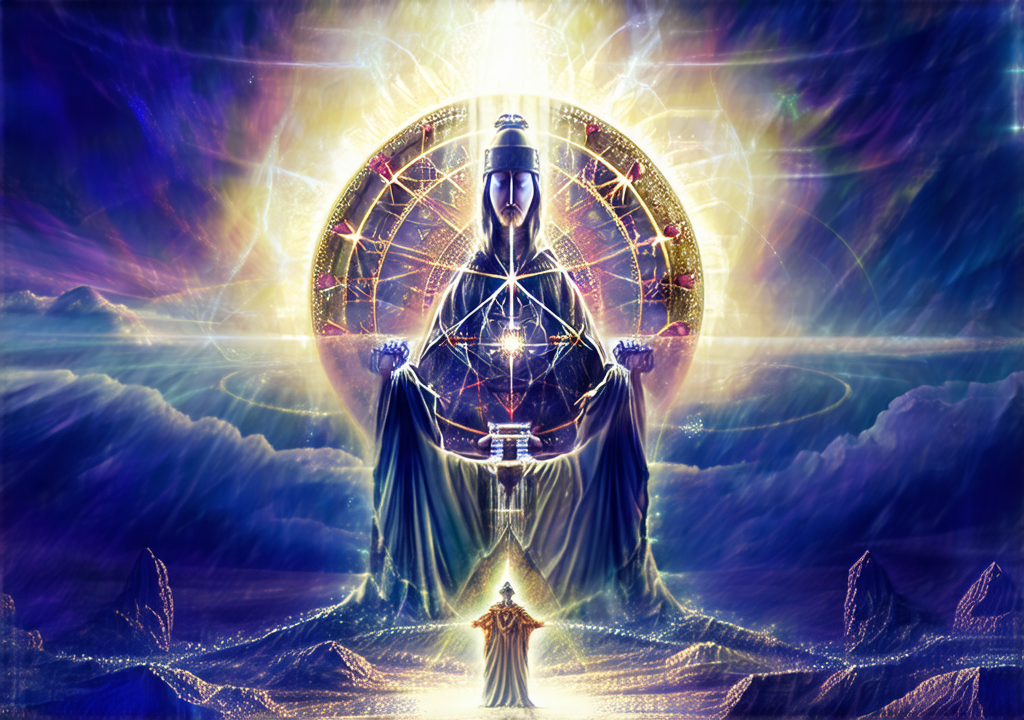
Have you ever stood in the center of your own life—surrounded by desires, choices, decisions—and felt that something was working against you? Not external obstacles, not bad luck or misfortune, but a subtle internal resistance, as if your very will were a river struggling to reach the sea through sand and stone. You desire one thing, yet another pulls you in its direction. The intellect commands, the heart responds differently. The spirit longs for elevation while the body drags it downward. In Kabbalistic terms, this is called hester panim—the hiding of God’s face—and it manifests as fragmentation within the soul.
I have taught thousands of students across the years, guiding them through the ancient paths of Hebrew mysticism, and I can tell you with absolute certainty: the solution to this internal fragmentation lies not in external discipline alone but in direct communion with the Three Holy Names that govern the architecture of reality itself.
The three names are Yod-He-Vav-He (יהוה), Elohim (אֱלֹהִים), and Adonai (אֲדֹנָי). Each operates on a different level of consciousness, each addresses a specific aspect of your will’s resistance. When you understand how they function individually—and when you begin to weave them together in meditation—the will that once struggled like a child against its mother’s embrace begins to move like iron following the magnet.
Yod-He-Vav-He (יהוה)—The Name of Pure Desire
This is the most intimate name, often called “Tetragrammaton” or “HaShem.” It represents pure existence itself, unmediated by form. When you invoke this name in meditation, you are not addressing God as an external entity but calling forth your own essential being from beneath the layers of habit, fear, and social conditioning.
The letter Yod (י) is the smallest Hebrew letter—a tiny mark that carries infinite potential. It sits at the beginning because it represents the initial impulse, the primal desire before intellect has shaped it into a specific object. The Heh (ה) is the breath, the vessel through which desire takes form. Vav (ו) connects heaven and earth—the bridge between spiritual intention and material expression. And finally, another Heh completes the cycle.
Students who begin with this name report that their will becomes more fluid, less rigidly attached to specific outcomes while still pursuing them relentlessly. This is not passive acceptance; it is active surrender—a paradox at the heart of Kabbalistic practice where you surrender your ego’s need for control in order to access a deeper form of volition.
Elohim (אֱלֹהִים)—The Name of Creative Power
Where Yod-He-Vav-He is pure desire, Elohim is power—the creative force that translates intention into manifestation. The word appears repeatedly in the Book of Genesis: “And God created…” and each time, you are reading not about an external deity creating something outside itself but about consciousness organizing chaos into order through its own will.
The name contains within it a hidden structure: Aleph (א) represents unity and spirit; Lamed (ל) is instruction and discipline; Heh (ה) is revelation; Mem (ם) marks the completion of vessels. Together, they describe how pure intention becomes concrete reality—and this process mirrors exactly what happens when you align your will with these names through focused meditation.
When students practice calling upon Elohim during moments of creative difficulty—whether in business, relationships, or spiritual work—they report a sudden clarity: What was vague becomes specific; what seemed impossible reveals its pathway. This is not magic divorced from natural law but the acceleration of natural processes through conscious participation.
Adonai (אֲדֹנָי)—The Name of Sovereignty
Adonai means “Lord” or “Master”—but in Kabbalistic practice, it signifies something far more nuanced than simple authority. It represents the integration of all wills into a single harmonious direction. When you invoke Adonai, you are not submitting to external authority but discovering that your own deepest will is already aligned with cosmic patterns.
The name appears in the Shema—the central declaration of Jewish faith: “Hear O Israel, the Lord our God, the Lord is one.” The repetition of Adonai emphasizes integration, wholeness, unity amid multiplicity. In practice, students find that invoking this name dissolves internal conflicts—the tension between head and heart, between action and rest, between individuality and connection to something greater.
How These Names Work Together in Practice
The true power comes not from knowing these names intellectually but from practicing them daily. I teach my students a simple routine: begin with Yod-He-Vav-He for ten minutes to align your desire; call upon Elohim during creative work or difficult decisions; and close each session calling Adonai to integrate all you have received.
I have watched reluctant practitioners—people who approached Kabbalah as a dry, academic subject and left transformed by its living power—discover that the will they once thought was theirs alone is actually a participation in something vast, ancient, and deeply personal. Their desires became clearer, their actions more effective, their lives more coherent.
The names do not compel; they reveal. They show you what your deepest self already knows but has forgotten how to access. When you begin to practice them consistently, over days and weeks, you will notice something remarkable: the same obstacles that once seemed insurmountable become opportunities for expansion, and the desires that once pulled you apart slowly draw together into a single, flowing current of will.
Make your will unstoppable—not by forcing it through sheer determination, but by aligning it with these three names until your own volition resonates with the rhythm of creation itself.


Recent Post



Gallery






Featured Videos






No Comments