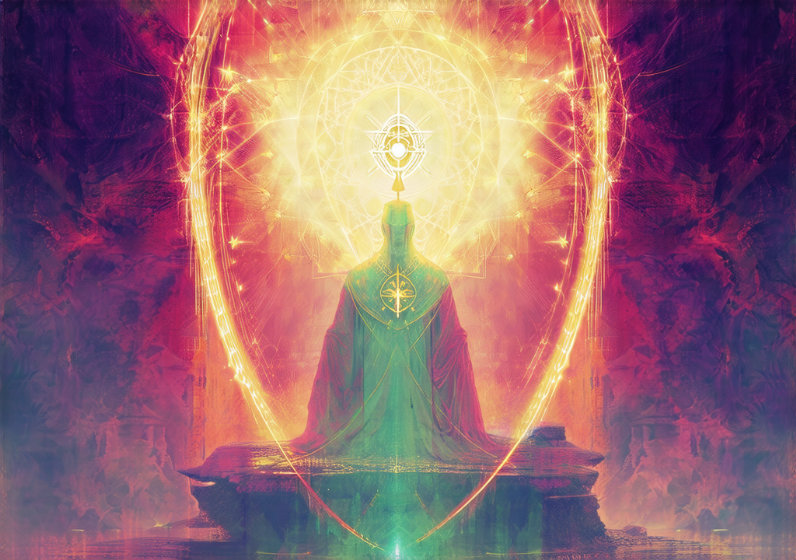
Your Everyday World Has Never Been More Magical
The Veil Is Thin: Why Your Everyday World Has Never Been More Magical
There was a time when magic was something you had to go looking for. It lived in the hedge, behind the stone wall, in the deep woods where the sunlight forgot how to fall. You had to travel there. You had to seek it out with candle and chalk, with incense smoke and whispered intention. Magic was an event—a weekend retreat, a full-moon ritual, a carefully constructed altar in a quiet corner of your home.
We have forgotten that magic does not require a journey. It never did.
The truth is this: your everyday world—the one you walk through eight hours a day, the one humming with notifications and traffic noise and the particular quality of light on your kitchen counter at 7 a.m.—has never been more magical than it is right now. Not because we have built more altars or burned more sage. But because something shifted in the collective field. The veil between the seen and unseen has thinned to gossamer, and if you know how to look—truly look—you will find that ordinary life is saturated with enchantment so dense it could sink a ship.
This is not wishful thinking dressed up as spirituality. This is an observation drawn from centuries of ceremonial practice, refined through the quiet discipline of watching, listening, and participating in the living world rather than escaping from it. Let us examine what this means, how it works, and why your daily life has become a more potent magical workspace than any ritual circle ever was.
The Old Model: Magic as Event
For most of recorded history, ceremonial witchcraft operated on a model of separation. The sacred space was distinct from the profane. You built an altar because you needed a place that was not your living room. You drew a circle because you needed a boundary between the world and the work. You chose specific times—solstices, equinoxes, full moons—because those moments were considered more permeable to spirit than the Tuesday afternoon when the milk is running low.
This model served us well for generations. It gave structure. It gave a container for intention. And it was, in many ways, correct. There are times and spaces where the veil is naturally thin, where the energy of the season or the moon creates conditions particularly favorable to working with spirit. The wheel of the year remains real. The phases of the moon remain meaningful. None of this has changed.
But here is what was never true about that model: it implied that magic only happens there, at that time, in that space. It created a binary. Sacred or not-sacred. Magical or mundane. You were either doing ritual, or you were just living. And when you were "just living," the magical field went dormant. The spirits retreated to their own realm and waited for your next full-moon gathering before re-emerging.
That was a useful fiction. It kept us from noticing what was already happening. It gave us permission to be distracted during the 45 minutes between leaving home and arriving at work, because those 45 minutes were not part of the sacred timeline. They were transitional. Profane. Not part of the story.
And now that fiction is dissolving.
The Thinning: What Has Changed in the Field
If you have practiced ceremonial witchcraft for any length of time, you have felt it. A shift. A change in the quality of the ambient energy. Where once the background hum of the world was a low, steady drone—present but not particularly active or communicative—it now feels closer to a chorus. Not louder, necessarily. But more present. More specific. More attentive.
Several things have converged to produce this effect.
The first is the collective shift in human attention. When an entire culture begins to quietly, incrementally open its awareness to the non-material dimensions of experience—when millions of people start meditating, journaling their dreams, practicing mindfulness that borders on ceremonial attention—the field changes. Attention is a form of magic. It is how we shape reality at the level of perception and memory. When more human beings are actively paying attention to the subtle layers of experience, those layers become more stable, more accessible, more real in the phenomenological sense. The veil thins because more people are pressing their faces against it from this side.
The second factor is technological mediation. This may sound paradoxical—how does a smartphone make the world more magical? But consider: before we had devices that constantly interrupt our attention with notifications, badges, and streams of information, human perception operated in longer continuous stretches. You could sit with a thought for twenty minutes without it being broken up by a ping. Now, your perception is fragmented into micro-moments of awareness separated by digital interruptions. And here is the key: each interruption creates a tiny threshold. A micro-portal. Your attention leaves one state and enters another. That transition is structurally identical to the moment between waking and sleeping, or between one room and another. And thresholds are where magic lives. You have now turned your entire day into a series of small ritual passages, whether you intended it or not.
The third factor is the dissolution of institutional distance. For centuries, spiritual authority was mediated through institutions—churches, temples, orders, lineages. You received your magical education from a master, a priest, a guild. There was a hierarchy between you and the numinous. Now that mediation has collapsed or at least loosened considerably. People practice without formal lineage. They read books, watch videos, talk to each other in online spaces. The knowledge is distributed. And when knowledge of the subtle world becomes widely available, people begin to notice it more. The spirits do not become more real because you learned their names. But your recognition of them increases, and recognition is half of presence.
The fourth factor is perhaps the most underappreciated: the quiet crisis of meaning. When a culture loses or questions its dominant narratives—when old certainties about progress, purpose, and hierarchy begin to waver—people look for other ways to make sense of their experience. They turn inward. They look at the texture of ordinary life with new eyes. And what they find there is not nothing. It was always there. The morning light on the wall. The particular way the neighbor's dog trots down the street. The smell of rain on hot pavement. These small phenomena, once taken for granted as mere background, begin to shimmer with significance. Not because they changed. Because you stopped being numb to them.
The Practice: Seeing What Is Already There
So what does this mean for your practice? It means that the most important work is no longer about building more elaborate rituals or acquiring more tools or mastering more complex symbolic systems—though all of those things have their place and value. It means learning to see the magical content already embedded in your daily life, and participating in it with intention.
Here is what this looks like concretely.
Morning light as threshold. When you wake and open your eyes, you cross a threshold between one state of being and another. The dream-state dissolves. The waking world assembles itself around you. This is not a metaphor. In ceremonial terms, it is a genuine passage from the unconscious to the conscious realm, from the inner temple to the outer world. Most people do this in a daze, half-attentive, already reaching for their phone. But if you take thirty seconds—just thirty—to sit still and notice what just happened: the light shifting on the wall, the quality of your first breath, the particular texture of awareness as it sharpens—you have performed a small ritual without building an altar. You have marked the threshold. And marking thresholds is one of the most fundamental acts in ceremonial practice.
Commute as procession. If you travel to work or school daily, that journey is a procession. In ancient practice, processions were sacred movements through space. The body moved from the private realm (home) through the public realm (street) into the professional realm (work). Each transition was marked by ritual gestures—touching a stone, saying a word, crossing yourself. You can recover this without any elaborate ceremony. As you step out your front door, pause for one breath and acknowledge that you are leaving your inner temple. As you arrive at work, take one breath and acknowledge that you have entered the public world. That's it. Two breaths. A micro-ritual performed in a car or on a bus or while walking down a street. And now your commute is not dead time. It is sacred movement.
Kitchen as laboratory. Your kitchen is where you transform raw matter into nourishment. You take ingredients that are inert, separate, and unconnected, and through heat, time, and intention, you make them become something new—something that will sustain a body, feed a mind, fuel the day's work. In alchemical terms, this is literally what alchemy does at the laboratory bench: transform base matter into gold. You are performing a domestic transmutation every morning when you make breakfast. The difference between "making toast" and "performing a small working with fire and grain" is nothing but attention. Notice the ingredients. Notice the transformation happening in the pan or the oven. Say one word of intention over the food before you eat it. Your kitchen practice just became more complete than most people's full ritual circles.
Work as offering. Whatever your daily labor—writing, teaching, building, coding, caring for others, managing systems—it is an act of shaping raw potential into form. You take undifferentiated material (ideas, students, code, patients, materials) and give it structure, meaning, and purpose. This is creative work in the deepest ceremonial sense: you are making something that did not exist before. When you sit down to work, take one breath and acknowledge what you are about to create. When you finish a task or a day's work, take one breath and release it into the world with gratitude. Your work becomes an offering. Not to a specific deity unless you wish—simply to the living world that will receive this form and make use of it.
Evening as dissolution. The end of the day is a second threshold—the reverse of morning. You are dissolving back from the public, structured waking realm into the private, unstructured inner realm. Before you sleep, take thirty seconds and consciously release the day's forms. Let go of the structures you built during the day. Allow yourself to return to undifferentiated potential for the night's rest. This is not self-care in the wellness-industry sense. It is a genuine ceremonial act: the unmaking of form so that new form can be made tomorrow.
The Deeper Structure: Why This Works
You might ask: why does paying attention make something more magical? Isn't this just... mindfulness with better branding?
It is, in part. But it is also structurally accurate to how ceremonial magic has always worked at the foundational level. Every ritual—no matter how elaborate—operates on the same principle as these micro-practices: you take a moment of transition (a threshold) and you mark it with intention. You acknowledge what is happening at that point in time or space, and by acknowledging it, you give it weight. You make it real in the field of experience. A threshold unmarked is just a place where one state becomes another. A threshold marked with attention and intention becomes a passage—a genuine movement between realms.
And this works because human perception is not passive reception. It is active construction. The world does not simply "happen" to you. You co-create your experienced reality through the quality of your attention, your intentions, your narratives, and your participatory gestures. When you attend to a threshold with intention, you are not creating magic from nothing. You are recognizing the magical structure that was already there, and by recognizing it, you stabilize it, amplify it, and make it available to your consciousness. The spirits were already at the threshold. The transformation was already happening in the kitchen. The procession was already occurring on the commute. Your attention is what brings these facts into the field of lived experience where they can affect your body, your mind, and your subsequent choices.
This is not solipsism. It is not "you create reality with your thoughts." Other people are there. Spirits are there (or natural forces, or collective unconscious patterns—label it however you prefer). The world has its own texture and resistance that your attention cannot simply wish away. What your attention does is participate in the co-creation of experienced reality. And participation changes the quality of what is created. A threshold attended with intention produces a different experiential outcome than one passed through in a daze.
The Subtle Shift: From Performance to Presence
There is another change worth naming, because it affects how people experience their practice. In earlier eras of ceremonial witchcraft, there was an emphasis on performance. You performed the ritual. You executed the working. There was a quality of doing—active, structured, visible. The magic was in the doing. The gesture mattered. The words mattered. The structure of the ceremony mattered.
This is still true and still valuable. Structure gives form to intention. Structure keeps the practitioner focused. Structure creates a container that holds the energy in a shape productive enough to do what it needs to do. You should not abandon structured ritual practice. It has its own logic and value, and there are times when you need the full apparatus of ceremony.
But the shift I am describing adds a second dimension: presence. Not doing magic at a particular time. But being magical in all times. Not performing at the altar. But participating continuously in the living field of your everyday life. The two dimensions support each other. Your daily micro-practices keep you attuned to the field, so that when you do sit down for formal ritual, your awareness is already calibrated and responsive. And your formal ritual practice gives you a vocabulary and structure for the subtler work you are doing in your kitchen or on your commute.
This is where the "everyday world" becomes genuinely magical: not because it has changed its properties, but because your relationship to it has deepened. You are no longer passing through life as if it were a corridor between two ritual events. You are in life. Participating in it continuously. And continuous participation produces a different quality of magic than episodic performance. It is quieter. Less dramatic. But more integrated, more stable, and—this is the key point—more available to you at any given moment because you never have to "go" somewhere or wait for a special time to access it.
The Specifics: What You Will Notice
If you begin practicing this continuous attentiveness, what will actually happen? Not in some vague spiritual sense, but in concrete experiential terms.
You will notice more coincidences. Not because coincidences increase, but because your attention is now wide enough to register them and connect them. Two people mention the same book on different days. You think of someone, and they call twenty minutes later. A specific color keeps appearing in your environment. These are not "proving" anything metaphysical. They are evidence that your perception is no longer narrowly tuned to immediate task-completion, but open to the broader pattern-field of your life. And that openness has practical value: you start making connections between things that were always connected but previously invisible to you.
You will notice more texture in ordinary moments. The way light moves across a room over the course of an hour. The particular quality of silence after rain. The rhythm of your breathing when you are not counting it. These become perceptible because your attention is no longer entirely captured by narrative or task-lists. You have space to register sensation, and in that registration, the world reveals its richness.
You will feel less separate from your environment. This is subtle but important. In a fully attentive state, the boundary between "you" and "the room you are in" becomes more permeable. The air in your lungs is the same air in the room. Your skin is the interface through which the world touches you continuously. You are not sealed off from your environment. You are an open system exchanging energy, matter, and information with everything around you. Attending to this exchange makes you feel less like a discrete object moving through space and more like a node in a living network. And that changed sense of self has downstream effects on how you make decisions, how you relate to other people, and how you experience your own work.
You will find that small acts of intention have outsized effects. A single word spoken over food before eating changes the quality of the meal. One breath at a threshold changes the quality of the passage. These are not "placebo" in any dismissive sense. They are genuine participatory gestures that shape the experiential field in which your body and mind operate. And because they require so little—no tools, no preparation, no special time—they can be practiced consistently in a way that elaborate rituals cannot. Consistency produces cumulative effect. And cumulative effect is where real change happens.
A Word About Authenticity
One caution: this practice requires honesty with yourself. It is not performative in the sense of "doing magic as a show." You are not putting on a magical persona for an audience (even if that audience is just your own self-image). You are simply attending to what is actually happening and participating in it. If you go through the motions without genuine attention, the effect will be thin. The threshold marking only works if you actually notice the transition. The kitchen ritual only works if you actually attend to the transformation of ingredients. This practice rewards authenticity and punishes performance. Keep that in mind.
Also: not every moment requires a gesture. You do not need to mark every threshold, speak over every meal, or perform a micro-ritual for every task you complete. The practice is about calibrating your awareness so that when an intention or gesture feels right—when the moment calls for it—you are able to respond with full attention and participate in what is happening. And when the moment does not call for it, you simply live. You drink your coffee. You walk to work. You do your task. The magic is in the quality of your presence, not in the frequency of your gestures.
The Inherited Wisdom: What This Practice Connects To
This approach is not new. It draws on a long lineage of practice that predates modern ceremonial witchcraft by centuries or millennia. Monastic traditions have used daily attention to thresholds and transformations as their core discipline for over a thousand years. Indigenous practices worldwide treat everyday life—gathering, cooking, traveling, sleeping—as continuous ritual participation rather than a backdrop for occasional ceremony. Alchemical tradition saw the laboratory work as an extended meditation on transformation, where every step in the process was both practical and symbolic.
What has changed is not the practice itself but its accessibility and visibility. More people have access to this knowledge now. More people are quietly practicing it without calling it what it is. And the cultural conditions—the thinning of institutional authority, the increase in collective attention to subtler dimensions of experience, the quiet crisis of meaning—have created a field where this practice can take root more easily than in previous eras.
You do not need permission from an order or a lineage to mark your morning threshold or attend to your kitchen work with intention. The knowledge is available. The practice is simple. The effect is real. And the world you are walking through has never been more saturated with it.
Closing: The Ordinary as Infinite
Here is the final point, and it may be the most important one: when you learn to see the magical structure embedded in your everyday life, ordinary life stops being a backdrop for your spiritual practice. It is your spiritual practice. Your kitchen is your laboratory. Your commute is your procession. Your workday is your offering. Your morning is your threshold passage. Your evening is your dissolution.
You do not need to go somewhere else to be magical. You are already here, in this body, in this room, in this specific quality of light falling across the wall at 7 a.m. The world you live in has never been less mundane. It has always been more than what you were told it was. And now that you know how to look—truly look, with attention and participation and honesty—you will find that your everyday world is not just magical.
It has never been anything else.