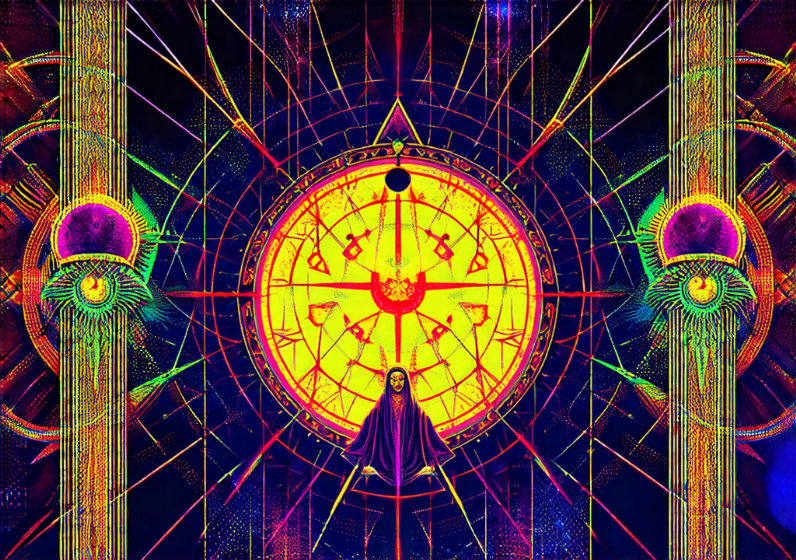
Why Your Phone Camera Can See What Your Eyes Can't (Sigil Edition)
The Lens of the Seer: Why Your Phone Camera Can See What Your Eyes Cannot
I. Opening Invocation 🌙
There is a quiet irony in our modern age that few have paused to meditate upon. We carry, in our pockets, devices capable of capturing frequencies of light and energies that the human eye was never designed to perceive. The smartphone camera—so mundane, so ubiquitous, so stripped of ceremony—has become an accidental oracle. And for those of us who work with sigil magic, this fact carries a weight far beyond mere technology.
You have probably seen it yourself: photographing a room and finding colors you didn't notice in person, or noticing subtle shifts in a space that your eyes had long since stopped registering. The camera sees what the eyes cannot. But why? And more importantly—what does this mean for your practice of sigil work?
II. The Eye vs. The Sensor 👁️
The human eye is a marvel of evolution, but it was not designed to see everything. It is tuned, through millions of years of natural selection, to detect the narrow band of electromagnetic radiation we call visible light—roughly 380 to 750 nanometers. Beyond that spectrum lies infrared, ultraviolet, and other wavelengths that carry information our retinas simply cannot transduce into conscious perception.
A smartphone camera sensor, by contrast, is a silicon photodetector array. It captures photons across a broader range, processes them through software algorithms, and renders images in ways that can enhance, shift, or reveal details invisible to the naked eye. Modern phone cameras also employ computational photography—layering multiple exposures, applying noise reduction, color correction, and HDR blending—to produce an image that is more of a constructed perception than a raw recording.
In practical terms: your camera sees contrast, subtle tonal shifts, hidden textures, and even faint luminescence that your visual cortex has already filtered out as "irrelevant." Your eyes are editors. Your phone is a witness.
III. The Sigil Lens: A Different Kind of Seeing 🕯️
Now let us step into the workshop. In sigil magic, we encode intention into form. A sigil is not merely a symbol; it is a compressed vessel of will, memory, and energy. When you create a sigil—through meditation, reduction, or any method that serves your practice—you are taking a diffuse intention and collapsing it into a single visual anchor. That anchor then resides in the unconscious mind, where it continues to radiate influence long after conscious attention has moved on.
Here is where the camera becomes interesting. When you photograph a sigil—whether drawn, carved, burned, or projected—the image captured is not identical to what your eyes saw during creation. The sensor records tonal variations, micro-textures, and subtle chromatic shifts that were present in the medium but below the threshold of your conscious visual processing. In a sense, the camera captures the residue of your intention at a level you cannot directly observe.
This is not mysticism dressed up as science. It is physics meeting phenomenology. Your hand moves with micro-variations guided by felt sense. The ink or chalk or pigment responds to pressure, temperature, and moisture in ways that create subtle differences invisible to the eye but faithful to the sensor. You are recording your unconscious expression in a medium that can preserve it at a fidelity beyond perception.
IV. Practical Applications in Sigil Work 🔮
1. Documenting Energy States.
When you enter a meditative or trance state before drawing a sigil, your motor patterns shift. The pressure of the pen changes. The speed of strokes alters. Your eyes see "the same line" each time. A camera can capture that variation. Over time, building an archive of photographs from different states—calm, ecstatic, meditative, inspired—you begin to develop a visual record of how your energetic state imprints on form. This is invaluable for refining your process and understanding which states produce the most resonant sigils.
2. Detecting Subtle Changes.
If you are working with physical objects imbued with sigils—stones, candles, clay tablets—photograph them over time under consistent lighting conditions. You may notice faint shifts in surface texture or color saturation that correlate with periods of active work or energetic activity. This is not proof of the supernatural; it is evidence of material change that your unaided eye missed. It grounds your practice in observable reality while honoring the subtle processes at play.
3. Creating Sigils From Captured Images.
This is a powerful technique. Photograph natural textures—bark, stone, fabric, water ripples—and study them for hidden patterns. The camera reveals geometries in nature that your eye smooths over. You can reduce these captured patterns into sigil forms, encoding your intention onto structures already present in the physical world. This creates a bridge between personal will and natural form—a sigil that is also an echo of something ancient and large.
4. The Camera as Witness.
In ritual or ceremonial work, set up your phone to photograph or video the space during active practice. Reviewing these recordings later can reveal micro-expressions in the environment—dust motes shifting, light behaving unusually, surface changes—that you were too immersed in the process to notice. The camera becomes a silent witness, preserving details of the ritual that dissolve from memory within minutes.
V. A Note on Intention and Medium 🕸️
It is important not to conflate the camera's mechanical fidelity with metaphysical truth. A photograph of a sigil does not capture "the energy" in any literal sense. What it captures is the physical manifestation of your intention as expressed through material form. The energy is relational—it exists in the space between you, the medium, and the world. But the camera can capture the shape of that relationship with a precision your eyes cannot match.
This matters because sigil magic depends on the stability and clarity of form. A blurry or imprecise sigil carries less coherent resonance than a sharp one. The camera helps you verify that what you intended to draw is actually there, in full fidelity, free from the smoothing and interpretation that human vision always imposes.
VI. Integrating Technology Into Ancient Practice ✨
There is no need to romanticize or demonize the smartphone in your practice. It is a tool—like pen, chalk, or clay—and its value depends entirely on how you wield it. Approach it with the same respect and intentionality you would bring to any implement of craft. Cleanse it if that serves your practice. Hold specific intent when using it. Treat the images it captures as artifacts of your work, not mere files in a storage directory.
The occult tradition has always absorbed new technologies into its framework. The printing press transformed spellbooks. Photography revolutionized ritual documentation. Your phone is simply the latest in a long lineage of tools that extend human perception beyond its biological limits. Embrace it without superstition or resistance.
VII. Closing Meditation 🌑
Before your next sigil creation session, try this: place your phone on a stable surface at a fixed angle. Draw or carve your sigil as you normally would. Photograph the finished work immediately after completion—while the state is still active in your body and mind. Then photograph it again the following morning, before reviewing it with analytical attention.
Compare the two images side by side. Look for differences in texture, tone, and clarity. You may find that the first image carries a subtle luminance or textural quality absent from the second—or vice versa. This is not magic in the fairy-tale sense. It is the visible trace of an invisible process. Your intention moved through your body into the medium, and the camera caught more of that movement than your eyes could follow.
The phone sees what you cannot. Use it to see more.