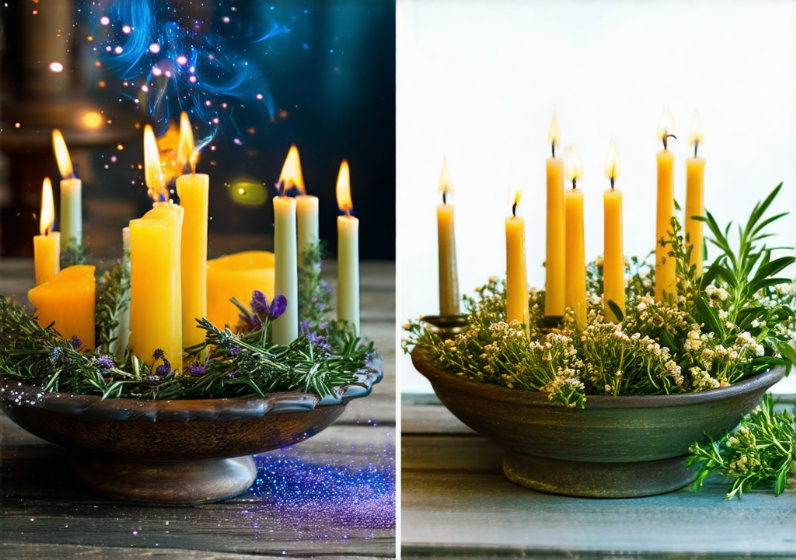
Why Traditional Folk Rituals Beat Fancy Spellwork Every Time
The Wisdom of the Hearth and Hedge
A Meditation on the Enduring Power of Simplicity in Ceremonial Practice
There comes a moment, often after months or years of devoted study, when the ceremonial witch reaches a crossroads. You have memorized the planetary correspondences down to the finest degree of arc minute. Your altar is arranged with geometric precision; your incense blends are balanced according to alchemical ratios; your invocations recite the Theosophical names of the Deities in their original phonetic forms. You understand the architecture of the universe, or at least you believe you do. You have constructed a magnificent cathedral of symbolism in the quiet corners of your own home.
But then, the old ways find you again. A grandmother hands you a sprig of rosemary and tells you to hang it by the door "to keep the ill-humors out." A neighbor sprinkles salt on the threshold because a stranger passed by. You light a candle for an ancestor not because of its color or its specific planetary ruler, but simply because the flame is a witness to your grief. And in these small, unadorned gestures, you find a resonance that your elaborate rituals sometimes lack.
This article explores why traditional folk rituals often outperform fancy spellwork—not because ceremonial magic is wrong or insufficient, but because it operates on a different axis of power. Where ceremony speaks the language of the mind and the cosmos, folklore speaks the language of the body and the home. And for most of what we actually need in daily life—comfort, protection, healing, connection—the folk way holds a distinct and irreplaceable advantage.
The Architecture of Belief vs. The Texture of Experience
To understand why folk rituals can feel more "real" than ceremonial ones, we must first distinguish between two different types of magical operation. Ceremonial witchcraft is fundamentally an architecture of belief. It constructs a model: the universe is structured in layers; each layer corresponds to a planetary body, an element, a name of power, a geometric form. You build this model in your mind with great care and precision, then you invoke it, align yourself with it, and through that alignment, channel force or intention outward. The ritual is a machine, and the operator must understand its gears.
Folk ritual, by contrast, operates on texture of experience. It does not ask you to believe in a model; it asks you to remember a feeling. "Hang rosemary by the door" is not an invocation of the planetary ruler of air or a complex alchemical transmutation. It is a sensory act: you handle the fresh herb, smell its sharp green scent, feel the weight of it in your hand. You place it where everyone will see and smell it. The power lives in the doing, in the repetition, in the small daily interaction between your body and the material world. You do not need to understand why rosemary protects; you only need to remember that it did last year, and the year before that, and your grandmother's mother hung it too.
This distinction is crucial because human beings are not primarily minds. We are bodies first. We feel warmth, smell scents, taste flavors, hear sounds. Folk rituals tap directly into this embodied knowledge in a way that cerebral ceremony often cannot reach. A person who has never studied Thoth Tarot or the Key to the Microcosm may still know instinctively that burning sage clears a room, or that iron nails driven into a wooden stake keep an enemy at bay. The knowledge is not in their head; it is in their hands, their nose, their gut. And this kind of knowledge is far more durable than intellectual understanding. You can forget your correspondences after a few months without review. But you will never forget the smell of bread baking, or the warmth of a candle on a winter night, or the sound of rain on a tin roof. Folk rituals anchor themselves in these sensory memories and therefore persist long after the theoretical framework has faded from memory.
The Economy of Intention
One of the most underrated advantages of folk ritual is its economy of intention. In ceremonial magic, you must hold a complex image in your mind while performing multiple simultaneous actions: tracing a circle with precise movements, pronouncing invocations with correct phonetics, visualizing specific geometric forms or luminous colors, and maintaining a particular emotional state. Any single element that slips—the visualization fades, the pronunciation is off, the body moves out of rhythm—can weaken the entire operation. The system is elegant but fragile. It demands a high degree of cognitive load and sustained concentration over extended periods.
Folk rituals are, by contrast, remarkably low-bandwidth operations. "Sprinkle salt on the threshold." You pick up the bowl, you walk to the door, you scatter the grains. Three simple actions. "Light a candle for the dead." You find the match, strike it, touch the flame to the wick. Two actions. "Tie a knot in a string and bury it under a tree to bind an enemy." You take the string, tie the knot, dig a small hole, place the bundle. Four or five simple physical steps.
The intention is carried by the action itself, not by a complex mental image that must be sustained for ten minutes while you also manage your breathing and your posture. The body does the remembering for you. Your hands know what to do; your legs carry you to the right place; your eyes find the candle. You do not need to maintain a shimmering geometric visualization in your mind's eye while simultaneously pronouncing an invocation with perfect diction. The ritual is the intention, expressed through motion and material. This makes folk rituals far more accessible, more repeatable, and more reliable under conditions of fatigue, stress, or distraction—precisely the conditions under which most people actually need to do their magic.
Consider a mother who has lost sleep for three nights because her child is sick. She needs a protective ritual to be performed at 2 AM when she is half-asleep, in a dimly lit room, with one hand holding a thermometer and the other reaching for what she can find. A full ceremonial working would require candles of specific colors, an altar laid out with precise geometric arrangements, and twenty minutes of sustained visualization. She might manage it, but her concentration will be thin, her body will be aching, and the ritual will feel like one more task in a list that never ends. But if she knows to draw a simple salt line around the child's bed, or to tuck a small cloth bag of dried lavender under the pillow, or to whisper a few words over the child's forehead while pressing her palm there—these are rituals that can be performed in thirty seconds with the tools at hand and no mental acrobatics. And they work, not because they are magically superior to a full ceremony, but because they meet the operator where she actually is: tired, loving, practical, and present.
The Power of Place and Domestic Sanctity
Ceremonial magic often operates in a space that has been deliberately prepared: an altar room, a garden circle, a dedicated studio or temple. You enter this space with a specific mindset; you cross the threshold into a zone where the ordinary rules are suspended and the sacred is made manifest. This is powerful in its own way, but it also creates a boundary between "magic time" and "regular life." The magic happens here, at this altar, during these hours. And then you step back out into the kitchen, the garden, the office, and the magical field recedes.
Folk ritual, on the other hand, is woven directly into the fabric of domestic space. The threshold where salt is sprinkled is also where your shoes go and your mail arrives. The window where the candle burns is also where you water your plants in the morning. The doorframe where the sprig of rosemary hangs is also where you check the weather before leaving for work. The kitchen table where you lay out herbs to dry is also where your children do their homework. Folk rituals do not create a separate sacred zone; they saturate ordinary space with subtle, continuous magical presence.
This has profound practical implications. When protection or healing or blessing is woven into the physical structure of the home, it operates continuously rather than only during ritual time. The salt on the threshold works at 3 AM when you are asleep and no one is performing a ceremony. The candle in the window burns its small vigil through the night. The herbs hanging from the eaves release their scent with every breeze. You have built a kind of ambient magic, a low-level field that hums quietly beneath the surface of daily life. This is not as dramatic or spectacular as a full ceremonial working; you will not see lightning strike or hear voices from beyond the veil. But it creates a background texture of care and attention that shapes the quality of every hour spent within those walls.
This is also why folk rituals are so deeply tied to specific places: your grandmother's kitchen, your childhood bedroom, the churchyard where your family has been buried for generations. The ritual is not portable in the way a ceremonial formula can be; it is of that place. It draws power from the accumulated memory of all the lives lived within those walls. And when you leave that place—when you move to a new city, or grow up and leave home—the folk rituals often fade with it, because they are bound to the specific sensory landscape of that particular location. The salt line in your childhood doorframe does not transfer to your apartment's doorframe. But this is also a feature, not a bug: it means the magic remains rooted, local, and personal rather than becoming an abstract formula you can deploy anywhere without feeling its weight.
The Social Dimension of Folk Ritual
Perhaps the most underappreciated advantage of folk ritual is that it is inherently social and intergenerational. Ceremonial magic, as it has been practiced in the modern Western tradition since the late nineteenth century, tends to be individualistic. You study alone; you perform your workings alone or with a small coven of initiates who have all read the same texts and follow the same system. The knowledge is transmitted through books and teachers, not through shared daily practice.
Folk ritual lives in the body of community. Your neighbors know what herbs to use for a cold because they learned it from their mothers. You learn to make a protective charm not by reading a chapter on alchemy but by watching your aunt do it while she tells you about her garden. The knowledge is passed through demonstration, repetition, and shared memory. And this social embedding gives folk rituals a quality of legitimacy that individual ceremony often lacks: everyone knows this works. You don't have to convince yourself or defend your practice before anyone else; it is simply what people do when they need to protect their home, honor the dead, or seek healing.
This also means that folk rituals carry emotional weight in a way that abstract ceremonial forms rarely do. When you light a candle for an ancestor during a folk holiday, you are not performing a Theurgic invocation of a specific archangel; you are joining a chain of hands stretching back through generations. Every person who has ever lit a candle at this time in this place is part of the ritual. Your action is small, but it is woven into a vast social and historical fabric that gives it depth, warmth, and meaning far beyond what any single individual could generate alone.
For many practitioners, this social dimension is the primary reason they return to folk practice: not because they find ceremonial magic intellectually inferior, but because they miss the feeling of being part of something larger than their own mind. Folk ritual connects you to the people around you and to the people who came before you. It says: you are not alone in this; others have done this same thing when they were afraid or grieving or celebrating; your small act of care is part of a long, continuous thread.
The Question of Power
Now, an honest discussion must address the question that inevitably arises from any comparison between folk and ceremonial practice: which one has more power? And the answer, as with most things in witchcraft, depends on what you mean by power.
If power means the ability to effect specific, large-scale changes in the material world—moving objects, influencing events far removed from your home, healing a stranger's illness at a distance—then ceremonial magic has a structural advantage. Its precise correspondences, its formalized invocations, and its geometric frameworks give it a kind of leverage that simple folk gestures lack. A well-executed Theurgic working can channel force with an accuracy and intensity that sprinkling salt on a threshold simply cannot match.
But if power means the ability to sustain daily practice over years or decades, to provide continuous comfort in ordinary life, to create a home saturated with care and meaning, to connect you to community and lineage, to work reliably even when you are tired or distracted or ill—then folk ritual holds a clear advantage. It is more durable, more accessible, more embedded in the texture of living. And for most practitioners, this is what they actually need most of the time. We are not performing Theurgic invocations every day; we are cooking dinner, washing dishes, walking to work, tending gardens, and caring for people who depend on us. Folk rituals meet us in that ordinary landscape and give our small daily acts a layer of meaning and intentionality that transforms routine into ritual.
This is not to say one should abandon ceremonial practice. The two are complementary rather than competitive. Ceremony gives you the architecture: a map of the universe, a language for speaking with Deities, a framework for understanding your place in the cosmic order. Folk practice gives you the texture: the daily, embodied, sensory experience of being a witch in an actual physical world where you have to eat and sleep and pay rent and love people who are not symbols or archetypes but complicated, messy, mortal human beings. The best practitioners I know hold both in hand simultaneously: they can perform a full ceremonial working with precision and devotion, and then come home and hang rosemary by the door without thinking about it at all.
A Practical Meditation
Consider your own practice for a moment. How much of your time is spent on elaborate workings? And how much of that time could be redirected to simpler acts that would have more lasting impact on your daily life? This is not a criticism; it is an invitation to examine where your energy actually goes and whether those places are the ones that matter most for your particular situation.
If you find yourself spending hours preparing for a working that produces a brief, intense experience but leaves you feeling empty afterward, perhaps some of that time could be spent simply tending your home: sweeping the threshold, burning a small fire in a brazier on the porch, leaving a bowl of water outside for birds, hanging fresh herbs from the kitchen eaves. These are not lesser acts; they are different registers of practice. They speak to your body rather than only your mind. They connect you to the specific place where you actually live rather than an abstract cosmic architecture that may feel distant and impersonal.
And if you find yourself doing only folk rituals because ceremonial magic feels too demanding or too far removed from your experience, perhaps there is value in studying even one or two ceremonial forms—not to replace your folk practice but to give it depth and context. Understanding the planetary and elemental correspondences does not diminish the power of a simple candle; it gives you a language for understanding why that small flame matters in the larger order. And sometimes, when you need to work with specific qualities—heat, cold, light, darkness, movement, stillness—the precision of ceremonial forms is exactly what you need.
The Long View
There is one final quality of folk ritual that I have not yet named and which I believe is its greatest strength: it does not require you to be a good magician in order to work. You do not need perfect visualization, flawless pronunciation, or years of disciplined practice. You only need to show up, do the small physical act, and trust that this has been done before by people just like you, in houses just like yours, with hands just like your own. The ritual works because it is an act of care, not a performance of skill. It asks for presence rather than precision. And in a world that constantly demands we optimize, perform, and produce, the permission to simply do—to handle the herbs, light the candle, sprinkle the salt, speak the few words that your grandmother spoke before her—the simple, unadorned act of showing up for yourself and your home has a quiet, enduring power that no amount of fancy spellwork can replicate.
So here is my advice to you: keep your ceremonial texts on the shelf and return to them when you need structure, depth, or a precise tool for a specific working. But also keep a jar of salt by your door, a small bundle of dried herbs in your kitchen drawer, a candle within reach. And when you are tired, or frightened, or simply need to feel that this life has meaning and texture beyond the mere mechanics of surviving it—do the small act. Light the flame. Hang the herb. Sprinkle the salt. Whisper the words your family has whispered for generations.
That is where the real magic lives. Not in the cathedral of symbols you build in your mind, but in the kitchen, on the threshold, at the window, in the garden, in the ordinary, unglamorous, deeply human act of caring for the small spaces and small people in your life. That is folk ritual. And it beats fancy spellwork every time—not because it is more powerful in some absolute sense, but because it meets you where you are, speaks to what you actually need, and connects you to a long, warm, continuous thread of human care that stretches back as far as anyone can remember.
And that, I think, is enough. That has always been enough.