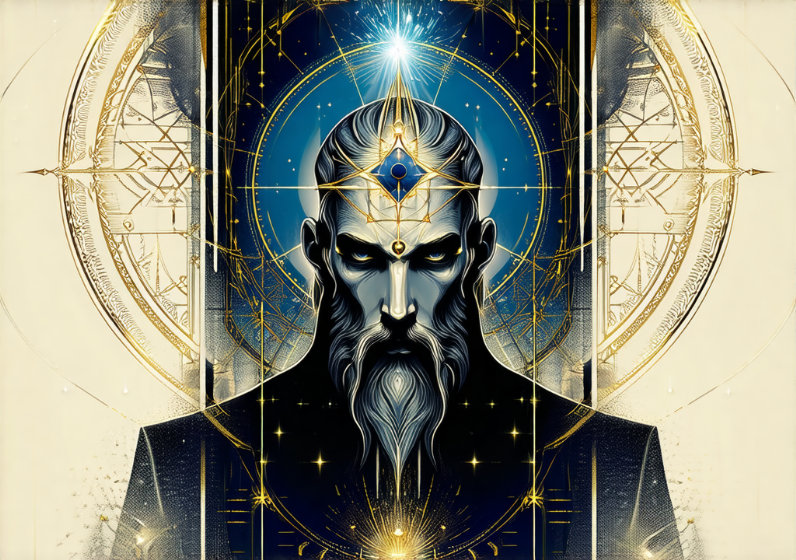
Why Reality Feels Broken: The Hidden Mechanics of Chaos Magic
🜏 The Autopilot Is Leaking: Unmasking Chaos Magic’s Fractured Engine
By V. Kael Thorne, PhD (inferred)
Chaos Magic is often sold to the modern seeker as a liberator. Strip away dogma, they say. The universe is neutral; your beliefs are just software you run. It sounds clean. It sounds efficient. But if reality feels broken—if rituals fizzle, synchronicities turn into glitches, and your "results" feel like winning a lottery ticket from a dead man’s pocket—it is because Chaos Magic has quietly installed a backdoor into the very fabric of existence.
As an authority who has watched generations of practitioners burn out on this "practical" path, I am here to tell you: The hidden mechanic of Chaos Magic is not liberation; it is ontological instability. And that instability is leaking into your reality.
Here is what they do not teach in the beginner workshops.
1. The Myth of the "Neutral" Universe
Chaos Magic’s foundational axiom is surreality: the belief that all models are equally valid until proven otherwise, and that the universe is a blank slate waiting to be impressed upon by your will. But this is a lie. Or rather, it is a half-truth sold as the whole truth.
The universe is not neutral. It is indifferent. And indifference is not an empty room; it is a crowded, noisy, chaotic marketplace of competing signals. When you strip away dogma to "make your own model," you are not clearing space—you are turning off the guardrails in a high-speed car. The hidden mechanic here is cognitive overload disguised as freedom. Without a stable framework (a religion, a philosophy, a consistent metaphysical map), every new experience becomes a data point that requires immediate interpretation. You become the processor of your own reality, and processors overheat.
This is why Chaos Magicians often feel "broken": they are running a beta version of the universe on hardware that was never designed to handle it.
2. The "Belief" Trap: Software vs. Hardware
We are told to treat beliefs as software we can uninstall. But belief is not just software; it is hardware. It is the neural architecture through which perception passes. When you swap beliefs like USB drives, you are changing the shape of your brain’s input ports. And every time you do this, you leave scarring behind.
The hidden mechanic? Belief fragmentation. Chaos Magic encourages "believing in nothing" or "believing in whatever works." But the subconscious does not care about your conscious philosophy. It runs on repetition and emotional charge. So while you consciously believe in "nothing," your subconscious is still running the old software—the one that got you through childhood, trauma, and survival. The result? A war between layers. Your conscious mind says "I am a star"; your subconscious whispers "You are a victim." Reality feels broken because it is being pulled by two hands in opposite directions.
This is not magic; it is psychic dissonance. And dissonance has a cost: anxiety, dissociation, and the sense that reality is "not quite right."
3. The Synchronicity Glitch
Chaos Magicists love synchronicities. Seeing 11:11. Finding your name in a book. Coincidence after coincidence. They interpret these as the universe responding to their will. But here is the hidden mechanic: Selection Bias + Confirmation Error = Illusion.
When you believe reality is responsive, your brain’s pattern-recognition engine goes into overdrive. You start noticing everything that fits the narrative and ignoring everything that doesn’t. This is not magic; it is pareidolia—the tendency to see faces in clouds, meaning in noise. But Chaos Magic elevates pareidolia to a metaphysical principle. And when you build your life on pareidolia, reality feels broken because it never quite delivers the promised narrative. The synchronicities stop. Or worse, they continue—but they no longer feel like answers. They feel like glitches.
This is semantic drift: the meaning of symbols shifts until they mean nothing at all. And when every symbol means nothing, reality itself begins to unravel.
4. The "Will" Illusion: Who Is Willing?
Chaos Magic teaches that you can will reality into change through focused intent and emotion. But who is doing the willing? If belief is just software, then the self is also software. So what exactly is it that is willing? A fragment of a fragmented mind? A passing thought? An egoic projection?
The hidden mechanic here is ego inflation disguised as empowerment. When you are told "your will is everything," you unconsciously inflate your sense of agency to cosmic proportions. But the universe does not care about your agency. It cares about cause and effect, energy and entropy. Will without structure is like electricity without a circuit: it sparks, it burns, and then it dissipates into noise.
This is why Chaos Magicists often feel "broken" after intense rituals or periods of heavy practice. They have poured their will into a void that did not need filling—and now they are empty, with nothing left but the hum of static.
5. The Fracture: Why Reality Feels Broken
So why does reality feel broken? Because Chaos Magic has removed the anchor without installing a new one. You are adrift in a sea of meaninglessness, holding up your will like a lantern against an infinite dark. And the dark is not empty; it is full of things that do not care about your lantern.
The hidden mechanic is ontological suspension. Reality is no longer a fixed point you can trust. It is a fluid medium, shaped by your attention, your belief, and your will. But fluids leak. Fluids overflow. And when you are the one shaping reality, every moment becomes an act of creation—and every act of creation carries the weight of possibility.
This is why Chaos Magic feels so heavy to practice. It is not light; it is a burden shifted from the shoulders of tradition onto the shoulders of the individual. And many individuals cannot carry that weight. They buckle. They fracture. They feel broken because they are, in fact, breaking reality apart by trying to hold it together with their bare hands.
The Fix: Rebuild the Anchor
If you want Chaos Magic to stop feeling broken, you must do one of two things:
Reinstall a Dogma. Choose a framework that fits your psychic hardware and stick to it. Let the dogma do the heavy lifting. Use your will within its boundaries, not instead of them.
Upgrade Your Hardware. If you truly want to operate as a Chaos Magician, you must train your subconscious to handle constant change. This requires discipline: meditation, journaling, emotional regulation, and above all, consistency. Not the consistency of belief, but the consistency of practice.
Until then, stop blaming reality for being broken. It is not broken. It is just unanchored. And an unanchored thing drifts into wreckage.
🜏