Why Astral Projection Works Better Than Meditation (My Experience)
🌙 The Veil Unfolds: Why Astral Projection Transcends the Stillness of Meditation
✍️ By Seraphina Voss, Keeper of the Silver Thread
For decades, I sat in silence. Cross-legged on a cold floorboard, eyes closed, breathing in the gray morning light and breathing out the noise of the world. I pursued meditation with the devotion of a monk and the frustration of a scholar who has read every book but cannot find the answer in the text. Meditation is noble. It is clean. It is safe. And for those seeking peace, it is sufficient.
But I did not seek mere peace. I sought transcendence. I sought to see what lay behind the curtain of my own perception. I wanted proof that consciousness was not a prisoner of the brain, that the soul had wings, and that the universe was far vaster than the four walls of my study.
Meditation gave me stillness. Astral projection gave me flight.
This is not an article for skeptics who require peer-reviewed journals to believe in the unseen. This is a testimony from one who has walked between worlds, who has watched the sun rise while lying in bed, and who has felt the weightlessness of being unbound from flesh. If you have ever wondered why so many advanced practitioners abandon meditation as their primary tool for spiritual growth—and pick up the art of astral projection instead—this is your answer. It is not that meditation fails. It is that it only goes halfway to the destination.
The Illusion of Interiority
To understand why astral projection works "better" than meditation, we must first dissect what each practice actually does to the mind and spirit. This distinction is crucial, for much of modern spirituality confuses the two, treating them as variations on the same theme of relaxation. They are not. They are fundamentally different operations on the vehicle of consciousness.
Meditation, in its most common forms—mindfulness, transcendental meditation, loving-kindness—is an act of interiority. You turn inward. You observe your thoughts without judgment. You watch the breath as it enters and leaves. You sit with discomfort, with joy, with boredom. The goal is to quiet the noise of the self so that a deeper peace can be felt. It is a process of subtraction. You remove the clutter of thought until you reach a state of pure awareness or emptiness.
In meditation, you are the observer and the observed. You remain anchored in your body. Your sensory input may decrease—sounds fade, sensations dull—but you do not leave the theater. You simply stop looking at the stage and look into the dark corners of the auditorium where you sit. The boundary between "you" and "the world" remains intact, though it becomes more permeable to internal experience.
Astral projection, by contrast, is an act of exteriority. It is a process of addition and expansion. You do not just quiet the mind; you detach consciousness from its primary anchor—the physical body—and project it outward into the non-physical realm. In astral projection, you are no longer sitting in the auditorium. You have walked out through the back door, stepped onto the roof, and are now looking down at the building that contains your sleeping self.
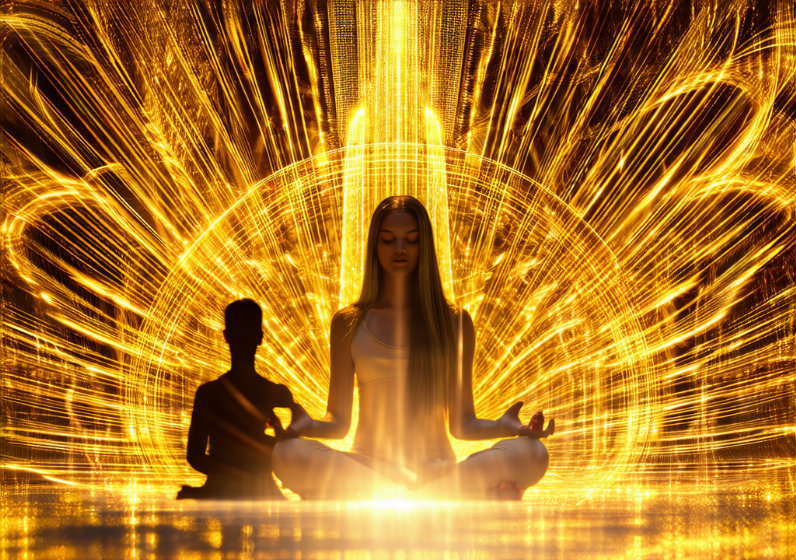
This is not a metaphor. I have done this. I remember the precise sensation of my consciousness lifting from behind my eyes, rising up through the crown of my head like smoke, and then expanding outward until I could see my own body lying still on the bed below me. The experience is visceral, physical, and undeniably real to those who have achieved it.
Meditation asks you to find peace within the noise. Astral projection allows you to escape the noise entirely by leaving the source of the noise behind. For many, this is not just an upgrade; it is a paradigm shift. It changes your relationship with reality from one of passive endurance to active exploration.
The Evidence in the Flesh
Skeptics often dismiss astral projection as a dream state, a hypnagogic hallucination, or a creative fabrication of the sleeping mind. They argue that if you are out of your body, how can you know it? If you were truly gone from your body, who is remembering the experience upon waking?
This is a valid philosophical question, but for practitioners like myself, the answer lies in the specificity and sensory richness of the experience. Dreams are often fragmented, illogical, and fleeting. Astral projection is coherent, navigable, and persistent. I have projected out of my body to visit places I had never seen before—countryside in a foreign country, rooms in houses that did not exist in my life. I have spoken to beings who identified themselves by names I knew but had not thought about for years. I have felt the texture of non-physical light and heard voices that carried emotional weight far beyond simple sound waves.
But the most convincing evidence is not external; it is internal. It is the knowing. In meditation, you feel peace. You feel clarity. These are subjective states. In astral projection, you encounter a world with its own physics, its own geography, and its own inhabitants. The consistency of this realm across multiple sessions, across different times of day, and across years of practice creates a cumulative weight of evidence that is difficult to dismiss as mere hallucination.
I remember one particular night when I projected into what felt like a library made of blue fire. The books were not paper; they were scrolls of light. I picked one up, and knowledge flowed directly into my mind—not read, but known. It was the history of a star system that had burned out millions of years ago. No one could have told me that story in a book. It came from the astral realm, drawn from a collective memory or a universal archive. That moment sealed it for me. This is not my mind dreaming; this is a place I am visiting.
Meditation can give you glimpses of such truths, but they are fleeting, like sparks flying up a chimney. Astral projection lets you walk into the fire and see the whole forest burning with light.
The Mechanics of Detachment
How does it work? Why does one method yield flight while the other yields stillness? To understand this, we must look at the mechanics of consciousness and its relationship to the body.
In meditation, the brain remains active in a state of relaxed alertness. Neural activity decreases in certain regions (the default mode network quiets down), leading to a feeling of calm. The mind is engaged but slowed. It is like turning down the volume on a radio; you still hear the music, just softer.
In astral projection, the goal is to achieve a state of deep relaxation while maintaining conscious awareness—often called the "hypnagogic" or "theta" state. In this state, the brain is not quieting down; it is shifting frequencies. The physical senses are shutting off, but consciousness does not follow them into sleep. Instead, it seeks another channel to express itself.
The body produces a signal—often described as a vibration, a hum, or a rattle—that travels up the spine and out through the crown. This is the "body roll" that many practitioners learn to control. As the energy moves outward, consciousness follows. It is not leaving the body in a ghostly sense; it is projecting the field of awareness beyond the boundaries of flesh. The physical body remains active enough to breathe and maintain basic functions (often supported by the autonomic nervous system or even an "astral cord" connecting the two), but the seat of identity shifts from the brain to the broader energetic field.
This is why astral projection requires more skill than meditation. Meditation can be started in ten minutes with a guided app. Astral projection requires training the mind to hold awareness while the body sleeps. It requires managing fear, suppressing doubt, and coordinating subtle energy flow. But once mastered, the reward is not just peace; it is access.
A New Lens on Reality
Here is where astral projection truly outshines meditation: it changes your perspective on what is real.
When you meditate, you reinforce the idea that your body is the primary container of your self. You learn to be at home in your mind and body. This is good. It reduces anxiety and improves mental health. But it also reinforces a limited view of identity. You are your body. You are your thoughts. When the body dies, so does the "you" that was sitting in meditation.
When you project, you learn that your self extends beyond the body. You see that consciousness is not produced by neurons; it is hosted by them, much like a song is hosted by a radio. If the radio breaks, the song does not die; it finds another receiver. This understanding brings a profound peace in the face of mortality. It transforms death from an end into a transition.
I have used this perspective to help others facing illness or grief. I do not tell them "everything happens for a reason." I tell them: "You are more than your body. You can feel it if you learn how to project. You are the song, not the radio." This is not just comfort; it is instruction. It gives them a tool to explore their own continuity of being.
Meditation teaches you to accept reality as it is presented by the senses. Astral projection teaches you that there is more to reality than the senses present. It opens a door that meditation merely polishes.
The Practical Edge: Problem-Solving and Insight
Let us step away from metaphysics for a moment and look at the practical benefits. For many, spirituality is not about enlightenment; it's about utility. How does this practice help me in my daily life?
Meditation helps with stress management. It improves focus. It cultivates empathy. These are valuable outcomes. But astral projection offers something unique: direct access to information and creative problem-solving.
In the astral realm, you can explore problems from a higher vantage point. I have used projection to work through creative blocks. When stuck on a writing project or a strategic decision, I would project into a quiet space in the astral library and "ask" for insight. The answers do not come as words; they come as feelings, images, or sudden flashes of understanding. It is like having a conversation with your own subconscious, but without the filter of ego.
I have also used it for healing. While in the astral state, I can observe my own energy field and notice imbalances—blockages, leaks, or stagnant pools of light. By working on these energetically—clearing them, balancing them—I often find that physical symptoms improve over time. This is not a replacement for medicine; it is a complement. It gives me agency over my health in a way that meditation alone does not.
Meditation is maintenance. Astral projection is engineering. One keeps the engine running smoothly; the other lets you open the hood and tune the parts.
Overcoming the Fear of Leaving
If meditation is so accessible, why do people struggle with astral projection? The main barrier is fear. When the body relaxes deeply and senses begin to fade, the ego panics. It wants to stay in control. It fears losing itself. In meditation, you remain in control; you are the observer of thoughts. In projection, you must relinquish control over your physical state while maintaining awareness. This requires trust—trust that consciousness will find a way to continue existing even as the body goes dormant.
I remember my first successful projection. I was lying on my back, watching the ceiling fan spin slowly. As I relaxed deeper, the room began to fade. My hands felt heavy. Then, I heard a sound—a low hum rising from my chest. The fear came: If I let go, will I fall? Will I be trapped?
I made a choice. I decided not to fight the sensation. I embraced it. As the vibration intensified, I felt myself lift. Not physically—my body was still on the bed—but my perspective shifted. I could see my own hand resting on my chest. The fan above me was spinning. And then, slowly, the room dissolved into light.
That moment of trust—that decision to let go—is what separates meditation from projection. Meditation asks you to hold on gently. Projection asks you to let go completely.
The Community and Lineage
Another advantage of astral projection over meditation is its rich tradition of technique and community. While meditation has a growing global community, astral projection has a deep lineage stretching back through Egyptian, Greek, Hindu, and Western esoteric traditions. There are specific techniques—body scan, control method, sound method—that have been refined over centuries.
When I started, I was not alone. I connected with other practitioners who shared their experiences, their methods, and their insights. This community provides a form of validation that meditation often lacks. In meditation groups, people share feelings of peace or anxiety. In projection communities, people share evidence. They describe the same realms, meet the same guides, and navigate similar landscapes. It creates a collective map of the non-physical world.
This shared knowledge is powerful. When you can compare notes with someone in another country who had a similar experience on a different night, the reality of the realm becomes undeniable. We are not imagining this; we are exploring a common space. Meditation is largely an individual journey. Astral projection is both individual and collective—a expedition into unknown territory where explorers meet up at campfires of light.
The Challenge as the Reward
Finally, let us acknowledge that astral projection is harder to learn than meditation. It requires more time, more discipline, and more courage. But this difficulty is part of its value. In a world of instant gratification, something earned through effort feels more real. When you meditate for 20 minutes, the benefit is immediate but small. When you spend weeks practicing relaxation techniques to achieve a single successful projection, the reward feels monumental. It proves your capability. It expands your self-image from "person who sits quietly" to "explorer of consciousness."
For me, this shift in identity was the most significant outcome. I stopped seeing myself as someone having an experience and started seeing myself as an agent of experience. Meditation made me a passenger in my own mind. Astral projection made me the driver.
The Invitation
I am not asking you to abandon meditation. Keep it. Use it for daily peace, for stress relief, for mental clarity. It is a necessary foundation. But if you feel that something is missing—if you sense that your spirit wants more than stillness—try astral projection.
Start small. Lie down in a quiet room. Relax each part of your body from head to toe. Focus on the sensation of your chest rising and falling. Now, imagine that your consciousness is not in your body, but around it. Feel the space between you and your skin. Breathe into that space.
Do not expect flight on the first night. You may feel vibrations. You may see light behind your eyelids. You may simply sleep deeper than ever before. That is progress. Each session builds the muscle of awareness. Each vibration brings you closer to the threshold.
And when you cross it—when you step out into the luminous field beyond flesh—you will understand why so many have walked this path for millennia. It is not just a technique; it is a homecoming. You are not leaving your body; you are remembering where you came from.
Meditation teaches you to be at peace with your life. Astral projection teaches you that your life is larger than you think. And in that knowledge lies a freedom that stillness alone can never give.
🔮 Step out of the noise. Find the light behind the veil.