What Your Beliefs Are Actually Doing: A Practical Exploration of Chaos Magic
⚶ The Autonomic Lie: Deconstructing Belief in Chaos Magic ⏺
By: V. Kaelthorn, PhD.
Chaos Magic is often dismissed as a philosophy for the intellectually lazy—a grab-bag of "whatever works" pragmatism devoid of doctrinal rigor. Yet, to accept this critique is to miss the most potent surgical tool it offers: the severing of belief from reality. To understand what your beliefs are actually doing, one must stop treating them as windows into truth and start treating them as gears in a machine they were never meant to drive.
I. The Great Illusion of Truth ⏺
In Orthodox Magical traditions—whether Hermetic, Kabbalistic, or Gnostic—the belief is the engine. To believe the sigil is active, the deity exists, and the ritual corresponds to a specific hour of Mars is not just helpful; it is necessary. The correspondence itself is the fuel. If you do not hold the "truth" of Jupiter’s benevolence while casting the spell, the current does not flow.
Chaos Magic asks: What if we are wrong? What if there is no God, no egregore, no specific planetary hour—only static and noise? The Chaos Magician (often termed a Cyber-witch, Techno-shaman, or simply an Operator) realizes that belief is not a reflection of reality. It is a psychotechnical tool. It is a lever you pull to move mass, but it was never attached to anything external.
Belief does the following:
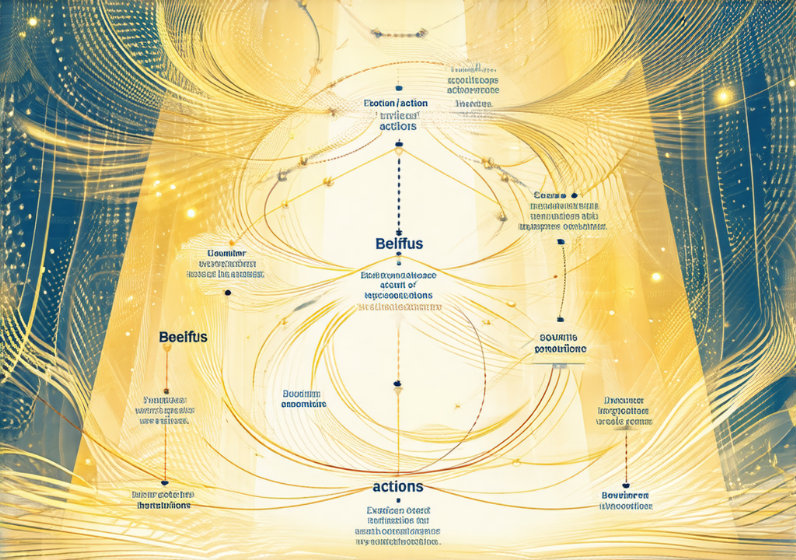
Focuses Attention: By believing "X" is true, you filter out irrelevant data and amplify specific neural pathways.
Creates Narrative Coherence: The brain abhors ambiguity. Belief provides a script for behavior.
Generates Emotional Charge: Emotion is the raw energy of will. Belief creates emotion instantly.
II. The Cyberspace Analogy ⏺
Imagine your mind as an operating system. Orthodox magic requires you to install specific, heavy software suites ("The God Package," "The Planetary Hours App") that are said to be compatible with the hardware of the universe. Chaos Magic says: You have a blank screen.
Belief is merely a hack. You type if (belief == TRUE) { result = SUCCESS; } into your own consciousness. The universe does not care about the syntax. It only cares if you executed the command with sufficient volitional force.
Therefore, belief acts as:
A Compression Algorithm: You compress millions of years of cultural evolution into a single thought-form ("The Divine Father") to access its power quickly without having to build it from scratch yourself.
A Firewall: It protects you from the terror of absolute freedom (the chaos). If anything is possible, then nothing matters. Belief imposes order on that void so you can act.
III. The Practical Application: Choosing Your Belief ⏺
Here is where Chaos Magic becomes dangerously pragmatic. You do not choose beliefs because they are "true." You choose them because they work.
Example A:
You need to manifest a financial windfall. Orthodox tradition might say, "Trust in Providence and wait." Chaos Magic asks: What mental model will most effectively bypass my subconscious resistance?
Option 1 (The Divine): Believe the universe is benevolent. This reduces anxiety but may passive.
Option 2 (The Cybernetic): Belief that your mind is a radio transmitter and money is a frequency you can tune into. This creates a state of hyper-alertness and active seeking.
Option 3 (The Alien): Believe an impersonal, ancient entity lives in the bank's vault, feeding on human greed. Your offering feeds it; it grants access.
All three are "false" metaphysically. But which one charges your batteries? Which belief creates the emotional voltage needed to power your sigil or scribe your pentagram with genuine intent? That is the practical question. Belief is a tool selection, not a truth claim.
IV. The Danger of Sticking ⏺
The greatest error in Chaos Magic is attachment. When you believe too long, the tool becomes the master. You stop seeing the hack and start worshipping the ladder. This is why many self-identified Chaos Magicians eventually drift into "Orthodoxy"—not because it’s true, but because familiarity feels like safety.
Belief begins to do this:
It defines your limits. ("I can’t achieve X because I don’t believe in ghosts.")
It creates identity. ("I am a Wiccan," rather than "I am an operator of magical forces.")
It creates dogma. ("The Circle must be drawn clockwise or it fails.")
V. The Unbelief Technique ⏺
Advanced Chaos Magicians practice Unbelief—the deliberate rejection of belief to test its efficacy. They ask: What happens if I do the ritual while actively believing it is nonsense?
Often, nothing happens. This confirms that belief was the fuel all along. But sometimes—shockingly—the result arrives anyway. Why? Because belief wasn't necessary; intention was.
This leads to the ultimate Chaos Magical stance: The Universe is Indifferent. It doesn’t care if you believe in God, Science, or Quantum Physics. It only responds to pattern recognition and will. Your beliefs are your personal interface with that indifference. Change the interface, change the results.
VI. A Field Guide for the Practitioner ⏺
To harness belief practically:
Identify the Goal. (Manifestation? Healing? Protection?)
Scan Your Belief Inventory. What beliefs currently exist in your mind about this goal? Are they helpful or limiting?
Select a "Working Hypothesis." Choose a belief that maximizes emotional charge and minimizes resistance. It can be absurd. It can be scientific. It can be occult. It doesn't matter.
Execute. Perform the ritual using that belief as your lens.
Deconstruct Immediately After. Do not let the belief calcify into doctrine. Return to the void.
VII. Conclusion: The Mask of God ⏺
Belief is a mask you wear to interact with reality. It is not who you are. It is not what the universe is. It is simply the shape your attention takes when it focuses. In Chaos Magic, you don't pray; you program. And in programming, syntax matters more than meaning—provided the code runs.
Your beliefs are doing this:
They are shaping your perception.
They are charging your will.
They are defining your method.
Stop asking "Is it true?" Start asking "Does it work?" The answer is always: Yes, if you choose it consciously. And no, if you let it choose for you.
⚶ Finis ⏺