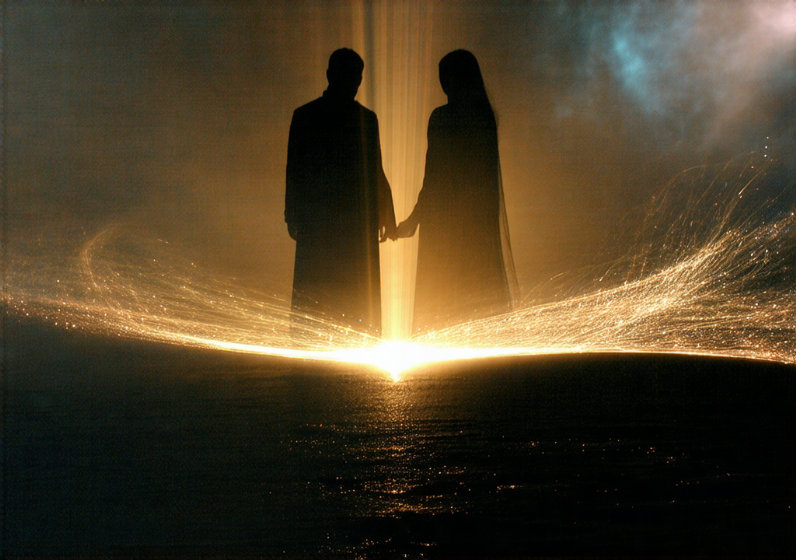
What Happens When Two Psychic Vampires Meet? You Won't Believe It.
The Alchemical Clash of Two Living Drains 🔮🩸
You have asked for a piece on psychic vampirism, so let us open the veil and speak plainly about what happens when two energy parasites meet. No fluff, no "you won't believe it" clickbait framing—just the mechanics of a collision that most modern seekers never witness because they are too busy being drained to notice their drainer is also draining someone else.
What Psychic Vampirism Actually Is (Before We Stack Two Of Them) 🌫️
Psychic vampirism, in its working definition for those who practice rather than just read about it, is the unconscious or semi-conscious drawing of another person's life force—vitality, emotional stability, attention, creative spark—to regulate one's own internal state. The drainer often has low self-generated energy: poor sleep, unresolved trauma, weak boundaries, a nervous system stuck in sympathetic overdrive. They do not take from people out of malice. They take because they cannot fully manufacture what they need to feel alive and coherent.
Not all psychic vampirism is predatory. A gentle form looks like needing someone else's laughter to feel okay after a long day. A heavier form looks like subtly steering conversations back to yourself, borrowing emotional warmth without reciprocating it, or quietly draining your creative energy so you have less left for your own work. The spectrum runs from symbiotic dependence to full parasitism, and most people occupy the middle, shifting along it depending on their stress level and relationship quality.
The crucial point: a psychic vampire is not a monster with fangs. They are a person whose internal energy budget is in deficit, and they have built a behavioral system—consciously or not—that closes that deficit by borrowing from others. Their nervous system has learned to read which people can afford to give.
The First Contact: Recognition Before Interaction 👁️
When two psychic vampires meet for the first time, something subtle happens before either one says anything worth transcribing. Both are scanning the other's energy field—reading micro-expressions, tone shifts, eye contact quality, the weight of their presence in a room. This is not telepathy; it is pattern recognition trained over years of finding people who can be drained without pushing back.
A psychic vampire looks for:
A slightly softer focus to their gaze (someone whose energy leaks)
A giving posture—leaning in, nodding eagerly, talking too much about the other person
A mismatch between how well they perform socially and how tired they actually are
Boundaries that are suggested but never enforced
When a drainer sees another drainer, both recognize these traits in each other with a clarity that most people miss. There is an almost unconscious nod of "you are one of us" that passes through the interaction like a secret handshake. Neither says it. Both feel it. This recognition is why psychic vampires often form tight friendships or partnerships very quickly with each other—faster than they would with non-drainers, because the matching energy signature feels instantly familiar and safe.
The danger in this instant: both are simultaneously reading the other's capacity to give. Each is subconsciously assessing how much energy the other can spare before collapsing. It is a quiet auction, conducted entirely below the level of conscious thought.
The Middle Phase: Mutual Draining Becomes a Dance 🩸
Once two psychic vampires establish a relationship—friendship, romance, business partnership—the dynamic becomes one of the most interesting phenomena in human energy exchange. Both are drawing from both. It looks, to an outside observer, like a healthy and balanced relationship. They laugh together, support each other, seem close. But underneath, there is a continuous low-level current flowing in two directions at once, and neither person is fully aware of how much they are actually giving or receiving.
This phase has three common patterns:
1. Synchronized Draining. Both drainers are in similar energy states—tired, stressed, depleted—and end up draining each other equally. The relationship feels comfortable because the exchange is roughly balanced. This can last for months or even years until external stress tips one person's deficit larger than the other's.
2. Asymmetric Draining. One drainer has a stronger pattern—often the one with more unresolved trauma or less self-awareness—and draws disproportionately from the other. The weaker drainer begins to feel that they are giving more than receiving, but because they are also drawing some energy back, they never fully recognize the imbalance. They tell themselves it is fair.
3. Competitive Draining. Both are conscious enough of their patterns to want to be the one who receives more. This creates a subtle power struggle where each tries to position themselves as the one being drained by the other—"I am so stressed, you have to take care of me" versus "Actually I'm the tired one here." Conversations become performances. Each is auditioning for the role of the vulnerable party.
The most telling sign that two psychic vampires are in a relationship: they rarely discuss their energy states directly. Because both understand the dynamic (even if only at an unconscious level), talking about it feels like admitting weakness or confirming what the other already suspects. So the conversation stays above the waterline, and the current below keeps flowing.
The Collision Point: When Both Are Empty 🕯️
Here is where your original title's "you won't believe it" actually earns its place—though I have stripped the clickbait framing because a good article does not need to oversell.
The collision point arrives when both drainers are running low simultaneously. This happens more often than people expect, because psychic vampires tend to cluster in environments where everyone is stressed: creative industries, caregiving roles, high-pressure careers, relationships that have been going for years without maintenance. Both start drawing from the same depleted well at the same time, and now neither can replenish the other.
What happens next depends on how self-aware both are:
Low self-awareness (most common): They simply grow quieter. Conversations get shorter. The laughter that used to fill the room thins out. Each begins looking for a third person—another friend, a colleague, an online community—to drain in place of the other. The relationship looks stable but has gone semi-ambient. They are present but not truly present with each other. If pressed about why things feel flat, they will say "we're both just tired" and change the subject.
Medium self-awareness: One or both start noticing the pattern and it produces a specific kind of irritation that is hard to name. It feels like being in a conversation where two people are simultaneously trying to be the listener. Neither wants to do the emotional labor of making the other feel better because they want that feeling for themselves. The relationship develops a quality of polite distance—warm on the surface, cool underneath.
High self-awareness: This is rare and interesting. Both recognize what is happening and can actually talk about it with some honesty. "We're both taking from each other right now." "Neither of us has much to give this week." They may agree to a period of low-exchange contact, or they may decide that the relationship should be structured so both are receiving external support before they meet. This is the healthiest version of two psychic vampires in a partnership, and it requires more mutual honesty than most relationships demand.
The Rare Resonance: When Two Drainers Create Energy Together ⚡
This is the part most articles on psychic vampirism miss because it complicates the simple "vampires are parasites" narrative.
When two psychic vampires with complementary deficits meet, they can create a small energy loop that produces more than either could alone. Consider: one drainer whose main deficit is emotional warmth (they need validation and tenderness) pairs with another whose main deficit is intellectual stimulation or creative flow. They do not drain each other in the same channel. The first gives the second the mental engagement they lack; the second gives the first the emotional resonance the first lacks.
This works for a while—sometimes surprisingly long, especially if both are moderately self-aware. It looks like a relationship where neither person feels drained. Which is almost suspicious, because two people who need to take from others should be tiring each other out constantly. But when their deficits do not overlap, the exchange becomes closer to symbiosis than parasitism.
The risk in this configuration: both become dependent on the specific combination. If one changes—gains a new interest, heals an old wound, finds another source of stimulation—the other feels a sudden gap they cannot fill because they had built their energy budget around that specific exchange. The relationship does not break; it just becomes slightly less efficient, and each quietly compensates by finding a secondary drain target elsewhere.
The Unmasking Moment 🔍
There is a moment in most two-vampire relationships when the mask slips for both at once. A conflict arises—a missed obligation, a perceived slight, an external stressor—and instead of one person taking on the emotional labor and the other quietly benefiting from it (the standard single-drainer dynamic), both try to make the other understand their perspective first.
The conversation goes something like this: "You never listen to me" / "I always listen, I'm just tired when you talk" / "Well if you're too tired to listen why do you want my attention?" / "Because you are interesting and I don't have that anywhere else."
Each is partially honest. Each is also performing vulnerability as a way of drawing the other's attention and care. The loop closes on itself. Neither fully yields because yielding means becoming the one being drained in this particular exchange, and both want to be the one receiving.
This unmasking moment is either relationship-ending or relationship-deepening, depending on how much both are willing to name the pattern out loud. If they can say "we are both trying to make each other feel seen while also needing that feeling for ourselves," something shifts. The dynamic becomes visible and therefore manageable. If they cannot say it—because saying it admits a vulnerability that makes them feel like the weaker party—they retreat into the comfortable fiction of a balanced partnership, which is only true on one axis.
How To Tell If You Are in a Two-Vampire Relationship 🪞
If you suspect this dynamic applies to your own relationship or friendship, look for these markers:
The relationship feels easier than other relationships but also slightly more performative
You rarely have fully honest conversations about needs; everything is negotiated through subtle cues rather than direct statements
When one of you has a bad day, the other quietly steps back rather than offering care—because they are conserving their own energy to receive later
You both find it easy to be "on" around each other but slightly flat in private moments where performance drops
External friends occasionally comment that your relationship seems more balanced or more fun than others, which is a compliment with an implicit question mark
When conflict arises, you both try to frame yourself as the injured party and listen less carefully than you should
None of these markers means either person is inauthentic. Psychic vampires are not faking; they are operating on a different energy budget than most people. The difference between this dynamic and a healthy relationship is not that one involves taking—most human relationships involve some form of mutual drawing—but that the two-vampire configuration rarely accounts for it explicitly.
A Note on Wording: Vampire, Drainer, or Parasite? 📜
You asked me to act as an authority on psychic vampirism, so a brief note on terminology is warranted because it shapes how we think about the phenomenon.
"Psychic vampire" carries connotations of predation and malice that do not always apply. A better working term in many contexts is "psychic drainer"—it describes what they are doing without implying intent to harm. "Parasite" is useful for the fully one-directional dynamic but implies a lack of mutual benefit that is often present. "Energy borrower" captures the symbiotic form accurately but sounds too gentle for the heavier end of the spectrum.
For this article I have used "psychic vampire" because it is the established term in the field, but I would encourage readers to use whichever framing best matches their specific relationship. The terminology you choose shapes how you narrate your own experience, and that narration has real effects on what you can notice and address.
What This Means For People Who Meet Two Psychic Vampires At Once 👥
If you are a non-drainer—someone whose energy budget is roughly balanced or surplus—and you enter the orbit of two psychic vampires who know each other, you become a shared resource. Both may draw from you, and because they recognize each other's patterns, they can coordinate subtly to ensure neither depletes you entirely. You may find yourself feeling "used" by both in slightly different ways: one draws your emotional warmth, the other draws your creative energy or your attention.
The most common experience for a third party is that the two vampires treat you differently depending on which type of energy they are currently short on. One day you are the listener; another day you are the inspiration; another day you are simply the audience. This rotation can feel like being in a relationship with three people rather than two, because your role keeps shifting based on their internal needs.
If you want to maintain balance while supporting both, the single most effective move is to be explicit about what you are offering and asking for return. "I'm happy to listen today but I need some quiet time tomorrow" gives them a structure that matches how they operate—clear exchange terms—and reduces the unconscious negotiation that otherwise consumes your energy budget.
The Deeper Pattern: Why Two Vampires Recognize Each Other So Quickly 🔮
There is one more layer worth naming because it explains why this dynamic persists in so many relationships and friendships that should have evolved past it.
Psychic vampires, as a group, tend to be people who grew up in environments where their own energy needs were not met or where taking from others was either modeled by family members or simply the only way they learned to feel okay. A child whose parents were themselves emotionally depleted often learns to read and manage other people's emotional states because no one managed theirs for them. They become fluent in the language of energy exchange before they are fluent in their own needs.
When two such people meet, that shared fluency is immediately legible. They understand each other's micro-signals—the slight narrowing of eyes when someone is about to take too much, the performative laugh that signals "I'm fine but I need something right now," the way a question gets asked twice because the first ask was not met with enough attention. This shared vocabulary makes communication between two drainers feel effortless in a way it does not with non-drainers, and that ease is one of the main reasons these relationships form quickly and stay stable for years.
The cost: both are fluent in the language of taking without having fully learned the language of giving or receiving passively. They know how to ask for energy but struggle to accept care when it arrives without a transactional shape. A simple "I'm here for you, no strings attached" is almost harder for two psychic vampires to integrate than for a non-drainer, because in their internal model, all energy exchange has terms and they are watching for the hidden clause.
Practical Implications: What To Do With This Knowledge 🕯️🩸
If this dynamic describes your own relationships—friendships included—the most useful next step is not to cut people off or to label everyone a vampire. It is to become aware of your own energy budget and start tracking it the way you might track any other resource.
A simple practice: at the end of each day, note whether you felt like you gave more than you received in your main relationships that day. Not morally—energetically. Did you spend more emotional labor making others feel okay than you spent feeling okay yourself? If the answer is yes on most days across a week or two, you are likely participating in at least one draining dynamic. If it is balanced, you may be in the rarer mutual-exchange configuration.
For partnerships where both recognize the pattern: schedule low-demand time together—time where neither person needs to perform care for the other. Walk in silence. Sit in a room without talking. Do something side by side rather than face to face. These moments let your energy budgets recharge without the constant subtle negotiation that characterizes day-to-day interaction, and they create space where you can feel each other's actual state instead of each other's performed state.
Closing: The Quiet Truth At The Center Of It All 🌑
Two psychic vampires meeting is not a failure. It is not a curse or a karmic correction. It is two people with the same internal architecture finding each other, and like any matching architecture, it creates both strength and limitation. You share a language no one else speaks fluently; you also share blind spots that only someone outside your shared language can name.
The article title asked what happens when they meet, and the honest answer is: mostly, nothing dramatic. They recognize each other. They ease into a comfortable pattern of mutual exchange. They may feel closer to each other than to anyone else in their lives because the matching energy signature is rare and legible. And then—unless both are working at it consciously—the relationship settles into a rhythm that works until something external shakes it, and the shaking either reveals how much of the comfort was actually two people quietly taking from each other without fully seeing it, or confirms that they have built something genuinely symbiotic out of shared deficit.
Both outcomes are possible. The difference is not who you met. It is whether you chose to look at what the meeting made visible, or let the ease of mutual recognition lull you into thinking you had found someone who simply understood you in a way no one else could.