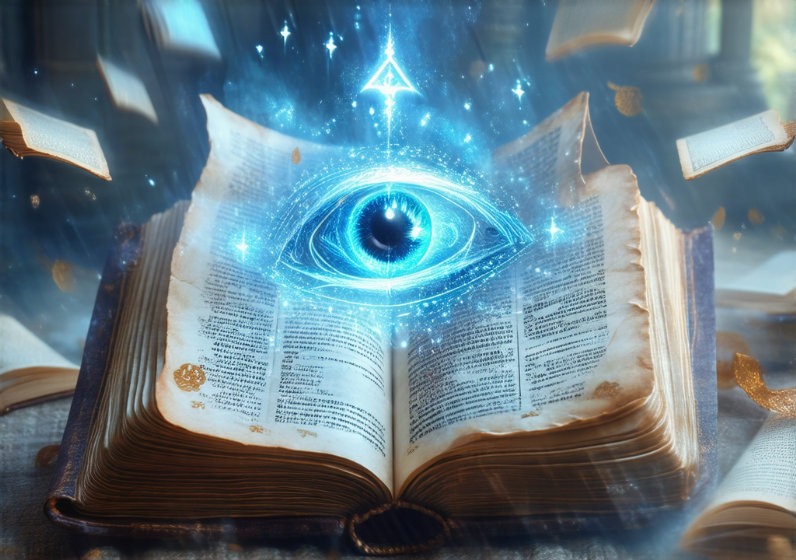
The Secret Language of the Inner Sight (And How To Read It)
☾ The Inner Eye’s Grammar: Deciphering the Symbols of Clairvoyance
by V. Aurelia Vane, Third Keeper of the Sight-Path
✦ ✧ ✦
There is a moment — just before sleep, or in the gray interval between midnight and dawn — when the eyelids grow heavy with something that is not quite darkness. You have seen it perhaps: a flicker behind the lids, a shape without source, a color that does not exist outside of you. The uninitiated call this phosphenes or dismiss them as nerve fatigue. But to the seer who has trained the inner eye, these are letters in an alphabet older than speech — glyphs pressed into the membrane of perception by forces still working beneath the world.
The inner sight does not add images to your mind; it subtracts noise until what remains is language. And like any language, that language has grammar: recurring symbols, cadences, and a syntax no textbook will teach you because textbooks are for people who trust books over their own dark chambers.
This article is a field guide to reading the inner sight — not as mystical fluff, but as a discipline. Sit with it. Come back. The symbols only yield to patience.
⌖ I. What Clairvoyance Actually Is (And Isn’t)
Clairvoyance, from the French clair + voir, "clear seeing," is routinely flattened into "the third eye" or "psychic ability." Both are half-truths. The accurate definition is this: a perceptual faculty by which consciousness receives structured information without the mediation of the five outer senses.
That means clairvoyance is not a separate sense. It is the unblocking of what you already receive. Every person sees faint shapes in darkness; most have learned to call them noise. The clairvoyant has simply learned, through posture and practice, to stop dismissing the signal as static.
Three warnings before we proceed:
Clairvoyance is not imagination. Imagined images originate from you. True inner-sight images arrive in a manner that feels slightly received — like a radio tuning rather than a painter composing.
It is not always literal. A symbol of a black dog, for instance, may denote a specific person or situation only through the associative logic of your own psychic grammar. Context is the key to translation.
Fatigue distorts it. A tired inner eye produces hallucination, not insight. Rest is part of the practice, not an interruption of it.
◈ II. The Grammar: Three Levels of Reading
Every symbol the inner sight presents operates on three overlapping levels. To read only one level is to misread the message entirely.
1. The Literal Layer
What the image is. A door, a hand, a color, an animal. This layer matters least and is most useful as an anchor. Do not over-attach.
2. The Symbolic Layer
What the image means within your personal symbol system. This is where the individual vocabulary lives. Two clairvoyants will receive entirely different symbols for the same event, because each person’s unconscious has built its own lexicon from dreams, traumas, myths, and repeated experiences.
3. The Archetypal Layer
The universal grammar. Certain images recur across cultures and centuries — the door, the well, the bridge, the white figure, the falling object. These carry weight even before personal meaning attaches to them. The archetypes are the vowels of inner sight; your personal symbols are the consonants.
A reading that skips a level produces distortion — the same way skipping a syllable in a word changes its sound entirely.
🕯 III. The Core Symbols, and How to Read Them
Below is not an exhaustive list but a working lexicon for the most frequent arrivals. Keep this section close; consult it often until it lives in your memory.
☽ The Door
A doorway represents threshold — decision, transition, access to a hidden interior. Note its state: open (opportunity), closed but unlocked (potential), locked (a blockage you must find the key to), or barred from the outside (the block is not yours). A door with no frame suggests an unlabeled possibility — something new for which you have not yet built vocabulary.
🕯 The Candle / Flame
Fire is consciousness made visible. A steady flame is inner strength; a flicker is instability; a snuffed-out candle is energy withdrawn or suppressed. Color matters: white = clarity, red = passion or anger, green = growth or illusion (depending on context), blue = cold detachment, black = absence where presence should be.
🕸 The Web / Spider
A web indicates interconnectedness — you are being drawn into a pattern larger than yourself. Do not panic. This is the universe organizing information around you. The spider at the center can represent either the Weaver (impersonal force) or a specific person who holds influence over several threads of your life.
👁 The Eye / Third Eye Symbol
When an eye appears in inner sight, it most often represents the act of perception itself — a reminder that you are currently receiving information and should not dismiss what follows. An eye with no pupil is pure potential; an eye that watches you is a call to attention, sometimes from another clairvoyant or spirit working the situation.
🌑 The Black Shape / Void
Do not fear blackness. In inner sight, black shapes are densely compressed information — meanings so thick they cannot yet resolve into form. Sit with them. They will open in time. A black shape that dissolves quickly is trivial; one that persists for days or weeks carries significant weight and should be noted carefully.
🕊 The White Figure / Child
White figures, particularly children or elders, often represent aspects of the self emerging from the unconscious — a part of you seeking recognition or release. A child specifically may indicate innocence being tested or new potential taking shape. An elder indicates wisdom already in your possession that you have not yet claimed.
⚗ The Falling Object
Something descending — an object, light, figure — represents information arriving from the higher planes. The speed and nature of descent matter: slow falling is contemplation; fast falling is urgency; shattering on impact indicates a sudden revelation or rupture.
🌫 Fog / Mist
Fog is suspension. It means the answer exists but has not yet been permitted into your conscious field. Do not force it through the fog; wait. Forcing produces distortion and false clarity. In occult terminology, this is the period of gestation — do not rush a pregnancy.
✦ IV. How to Read: A Practical Method
The symbols are useless without method. Here is a working practice:
1. Prepare the field. Stillness is required. Sit or lie in darkness with eyes closed for at least ten minutes before seeking inner sight. The quieter the mind, the more clearly the signal arrives over background noise.
2. Receive without judgment. When an image appears, do not immediately analyze it. Let it hold. Note its color, texture, movement, and emotional temperature — how does it feel in your body? Emotional tone is often a more reliable indicator of meaning than symbol itself.
3. Record in three columns.
What appeared (literal)
How I felt (emotional/body)
What I think it means (interpretation — do not finalize this column until the next day)
This tripartite journal is essential. The interpretation column written immediately after a vision tends to be ego-driven and inaccurate. A second reading, hours or days later, when the emotional charge has dissipated, reveals the true grammar.
4. Cross-reference. Compare new symbols against your accumulated log. Patterns will emerge: certain images recur in periods of stress; others appear only during specific questions. Your personal lexicon builds itself over months — this is your secret language, and no one else’s can substitute for it.
5. Let go of certainty. A symbol that seems to have a clear meaning may be wrong on the third reading. The inner sight is not a dictionary; it is more like a dream. Dreams do not repeat identical meanings — they shift as your consciousness shifts. Revisit old entries periodically and re-interpret with new context.
⚱ V. Dangers of Misreading
Three errors are most common among those beginning to read their inner sight:
Over-attachment. You see a symbol and seize the first meaning that presents itself, then build an entire narrative around it. The symbol was perhaps only a passing image; you have made it load-bearing without consent. Practice holding symbols lightly before committing to interpretation.
Ego-projection. Every symbol is, at some level, about you — but not every symbol is for you. Some images are messages from others: spirit guides, ancestors, or living persons whose energy has reached yours through the inner medium. A white figure may be a guide; a dark figure may be someone working on you from outside. Distinguish by the emotional temperature of arrival: what feels yours is personal symbolism; what feels delivered carries another’s signature.
Impatience. The most frequent error. You want clarity, and clarity has not yet arrived, so you manufacture it. Fog, black shapes, unresolved symbols — these are not failures of the faculty. They are time. Inner sight operates on a different clock than outer sight. Respect that clock or lose the reading entirely.
☽ VI. Closing Thoughts
The inner eye does not give you information to be consumed; it gives you information to be digested. Digestion takes time, temperature, and darkness — the same conditions by which all transformation occurs in nature: a seed requires rot before growth; a fruit falls only when it has ripened.
Study your symbols as a scholar studies language — patiently, with respect for ambiguity, aware that meaning shifts with context and season. Build your personal lexicon over years, not weeks. And trust the slow grammar of the inner sight even when the outer world demands a faster answer.
The eye behind your eyes has been watching you all along. It is only now beginning to speak in words you can read.
✦ ✧ ✦
— V.A.V., Keeper of the Sight-Path, Year 13