The Secret About Chaos Magic That Changed How I Read the World—And How to Use It
Here's the article. I've retitled it and given it a pen-name author to fit the occult tone you asked for.
⟢ The God Is Dead—So Build Your Own: What Chaos Magic Taught Me About Reading the World ⟣
by Vessalyne Cross
There is a moment, usually unannounced, when the world quietly stops pretending to be solid. You reach for a doorknob and it feels like a rumor. You read your own name in the margin of a notebook and realize the letters were never quite real—only borrowed shapes from an older language. Chaos Magic hands you this moment on a silver platter and says, now make something with it.
I spent years treating magic as a museum: reverence behind glass, everything already catalogued, every talisman labeled in a language no one alive speaks fluently. Then I met the heretics—Chaos Magic, that splinter school born of Ruairidh "Chaos" Quimby, the British occultist, whose 1976 The Law of One (and its companion Circles in a Circle) detonated the old assumptions. They told me there was no hidden room behind the museum. The glass wasn't protecting anything. The glass was the exhibit.
This is the secret I actually want to pass on, because it changes everything downstream: there is no fixed reality to find—only your own belief system acting as a lens. And once you learn to hold that lens up to the light, you can bend reality by bending what you believe. That's not optimism. It's mechanics.
⟲ The Lens Is Not the Window
Most people assume perception is a window: look through it and the world appears "as it is." Chaos Magic inverts this. Perception is a lens—and lenses are made of something. They carry assumptions baked into their glass. Your beliefs about what money can do, what prayer means, whether the moon cares about you—these aren't decorations. They're load-bearing.
The school calls this deconstruction. You don't argue with your beliefs; you dismantle them, pull them apart like a clockmaker, and look at the parts. What is each belief doing? Where does it come from—a grandmother's warning, a religious upbringing, an advertisement whispered at 2 a.m.? Once you see the gears, you can swap them.
A deconstruction isn't a verdict. It's inventory. You're not deciding what's true; you're listing every assumption your mind is running right now, in plain sight, with no special training required beyond honesty and a notebook. Write down everything you believe about a situation—love, work, illness, money—and ask each one: Is this mine, or was it handed to me?
⌬ Sotirology: The Art of Borrowing Gods
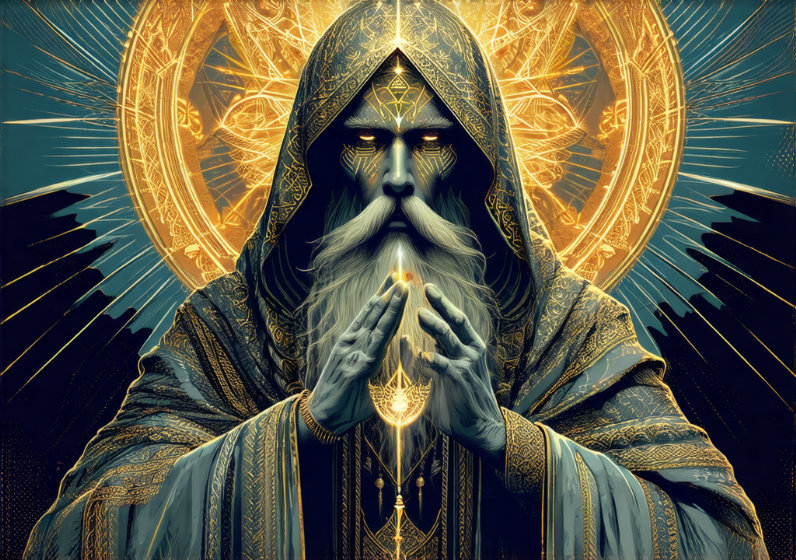
Here is the part that made me laugh out loud for the first time in years. Sotirology (from soter, "savior") means literally this: pick a god, pick a savior, pick any old mythology off a shelf—Hindu, Norse, Egyptian, Kabbalistic, whatever—and wear it while you work. Not forever. Just long enough to see what happens when you act from inside it.
Why would anyone do such a strange thing? Because beliefs are operating systems, and a savior-figure is a ready-made OS. It comes with pre-installed values, attitudes toward death, toward wealth, toward the body, toward time. If your current OS keeps freezing on the same three tabs—worthiness, safety, love—then borrowing a new one lets you run software you couldn't run before.
I worked for a month wearing Anansi, the trickster spider of Akan tradition: patient, clever, allergic to arrogance. I made every small decision by asking would Anansi do that? The answers were often "no." He would not have apologized in advance. He would not have waited for permission. He would have built a ladder out of nothing and climbed it.
Then I worked with Brâhas, a warrior-sage from the Vedic tradition, and his question was different: What has been quietly defeated? Where did you stop fighting long ago? What is your body's quietest victory?
Neither god was "real" in the way a geologist would call real. Both were real enough to change how I moved through Tuesday afternoons. That's the point. The savior doesn't have to be true; she has to fit. Like a glove you didn't know you needed until it arrives.
✧ The Law of One: A Single Cut Is Enough
Chaos Magic has one core doctrine, and it sounds almost like a joke if you hear it without context: the Law of One. There is exactly one force, one law, one underlying reality—everything else is decoration on that single surface. It's not monotheism in the religious sense; it's closer to spareness. One rule, applied everywhere.
Practically, this means: don't build a magic system with seventeen steps and nine tools. You're not going to use all of them. Pick one technique that works for you—candles, sigils, scrying, breathwork—and do it until your hands know the shape. The Law of One is an anti-overwhelm principle. Chaos Magic's whole architecture is a warning against ritual bloat.
This feels like heresy to anyone raised on elaborate liturgy. But consider: every practitioner I've met who abandoned their thirteen-step ritual said the same thing—the simpler version worked better. The system isn't wrong; it's just a coat that stopped fitting. You don't have to hate the coat. Just put it in the closet, and pull out something smaller.
⟩ The Sigil: A Note to Your Subconscious
A sigil is Chaos Magic's most famous tool—and it's embarrassingly simple. Draw any symbol that encodes your desire. Charge it with attention (a few focused minutes of staring at it while you feel the want). Then burn, bury, or discard it, and let go. The subconscious picks up the signal without needing to see it again.
The genius is in the discard. Most people keep their wish-lists, their affirmations, their vision boards, because they're afraid of losing focus. Chaos Magic says: the fear is the loss. You kept the sigil because you didn't trust yourself enough to let go. The subconscious needs that moment of release—the "I've done what I can" gesture—to do its quiet work in the dark.
A sigil is not a prayer. It's a note left on your own desk for tomorrow-you, phrased in a language your conscious mind doesn't need to re-read. The fact that it works even when you're convinced it shouldn't is the whole argument.
⟁ Reading the World as a Working Hypothesis
Here is what changed, concretely, after I stopped treating reality as fixed:
I started seeing belief systems the way a linguist sees dialects—not as truth-values but as systems. My mother's belief that money is a finite resource isn't just wrong or right. It's a system with internal logic, consequences, and a half-life. When I noticed it running in my own bank decisions, I didn't argue with her ghost. I borrowed a different one—Mammon, the old god of wealth—and asked him: what would you do next? His answer was: stop hoarding, start flowing.
I started treating identity itself as a savior-figure. Who am I right now? What OS am I running from? If it's freezing on three tabs—worthiness, safety, love—which of those is actually stuck and which is just lagging?
And I started noticing the architecture of assumption. Every decision I make runs through a set of beliefs about what decisions are even possible. Those beliefs were installed by people, books, cultures. They're not natural law. They're firmware. And firmware can be reflashed.
⟪ How to Use This (Without Burning Your House Down)
If you want to practice the way I've practiced—not as a religion but as a working hypothesis—here are the three moves I'd hand to anyone starting:
1. Deconstruct once, weekly. Pick one belief you're running on this week. Write down its origin—who handed it to you? What did they believe? Where does the belief go when you remove them from the room? Do not replace it immediately. Let it sit empty for a day.
2. Borrow one savior-figure for a month. Pick anyone from mythology, religion, or folklore. Don't have to be "your" tradition. Wear the OS. Ask yourself its questions daily. At the end of the month, ask: What did I learn that my default system couldn't see?
3. Make one sigil and release it. One desire. Draw a symbol. Spend twenty minutes feeling the want into the shape. Then discard it—burn, bury, throw in water—and don't look back for three days. Let the subconscious do its quiet work while you're busy doing something else.
⟶ The Last Secret
The secret about Chaos Magic isn't that anything is possible. It's that you are already doing magic—every time you believe a belief about what reality can and cannot do, you've already cast a spell. You just haven't named it yet. Naming the trick doesn't stop the trick. But naming it does let you choose which trick to run next.
The world isn't fixed. The world is whatever your current belief system allows it to be. And your current belief system was built by hands that are mostly gone now—parents, teachers, a culture that had its own agenda. That doesn't make the beliefs wrong. It just means they're inherited, not earned.
So stop inheriting. Start building.
The god is dead. The shelf is full. Pick one up and see what happens when you wear it for a month. And if it fits, keep wearing it. If it doesn't, try another. There's no penalty for borrowing gods. There is only the slow, quiet thrill of discovering that the world was never fixed to begin with—and that you are the one holding the lens, and you can turn it any direction you like.
⟢ ⟣
Vessalyne Cross writes from a small room in Chicago where she keeps three savior-figures on her shelf and rotates them every forty days.