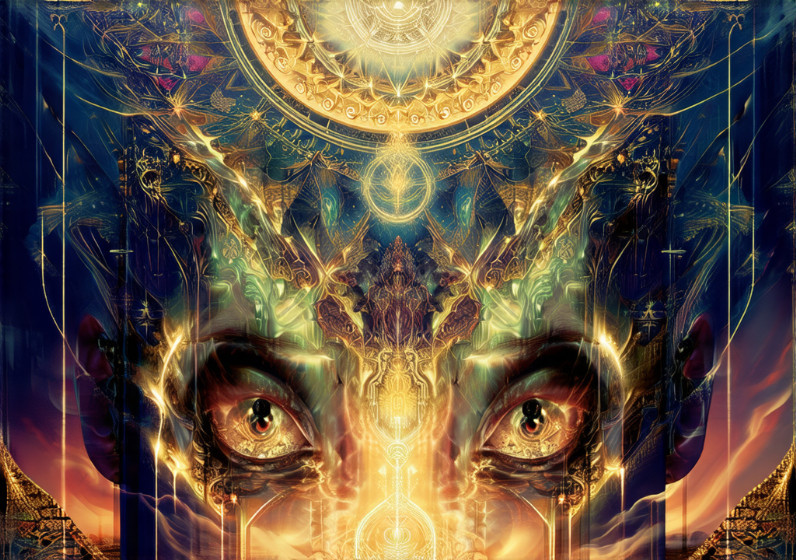
The One Question You Should NEVER Ask A Scrying Mirror (And Why)
The One Question You Should Never Ask a Scrying Mirror (And Why)
By Aurelia Voss, Keeper of the Glass
✨
🌑 Prologue: The Surface That Sees Back
There is a moment in every scrying session—whether you have done it for a week or for forty years—when the mirror stops being a mirror. The silvered glass grows cool beneath your fingertips. The room darkens at the edges, not because the light has gone out, but because something on the other side of the surface is beginning to pay attention. You lean in. Your breath fogs the glass. And then you ask your question.
Here is what most practitioners never learn: the mirror does not answer your questions. It receives them. And in receiving a question, it must give something back—not an answer, but a piece of the asking itself. A fragment of intent, a sliver of expectation, a whisper of the self you projected into that glass at the moment you spoke. The mirror is not a window to the future; it is a lens through which your own inner landscape becomes visible. And like any lens, it can magnify or distort depending on what you hold up to it.
This means that everything you ask the mirror, in some subtle and often invisible way, shapes what you will see. Your questions are not neutral. They carry weight. They leave fingerprints on the reflective surface of your own perception. And there is one question—just one—that carries more weight than all the others combined. Ask it carelessly, and you may find yourself seeing not what was meant to be seen, but a version of the truth so carefully arranged by your own hoping that it becomes indistinguishable from illusion.
This article will walk you through why that particular question is so dangerous, how the mirror's reflective nature turns inquiry into self-revelation, and—most importantly—how to build a practice strong enough that you can ask almost anything without being swallowed by what you hoped to see.
🔮 The Mirror Is Not a Speaker; It Is a Listener
Let us begin with the most fundamental truth about scrying: the mirror is not an oracle in the conventional sense. It does not sit behind the glass, reading your mind and crafting a response. It is passive, receptive, almost meditative in its function. Think of it less like a television screen and more like a still pond. You throw a stone—the question—into that pond, and the ripples that return to you are shaped entirely by how the water was already moving before you touched it.
In practical terms, this means your mental state at the moment of asking is not just background noise; it is the primary material from which any vision is constructed. If you ask "Will I get the job?" while feeling anxious and desperate, the mirror will return images steeped in anxiety. Not because the future is anxious, but because you are anxious, and the mirror reflects your state as its own imagery. The scrying surface does not generate content from nothing. It amplifies what you bring to it.
This principle—sometimes called the "mirror law" in older grimoires—holds that the seer and the seen are never truly separate during a session. Your question is, in a very real sense, a self-portrait rendered in symbolic language. The mirror simply develops that portrait for you to read. And like any developed photograph, what you see depends on how the image was originally exposed.
Understanding this changes everything about how you approach the glass. You are no longer an interrogator demanding answers from some distant authority. You are a collaborator with your own subconscious, using the reflective surface as a medium for conversation. The mirror is listening. And what it hears, it will echo back to you in forms you can perceive.
🪞 What Happens When You Ask About the Questioner
So let us get to the heart of this article: the one question you should never ask the scrying mirror. It is not "Will I be happy?" or "When will my lost person return?"—though those are also fraught with self-projection. The most dangerous question is the one that turns the instrument back upon itself, that asks about the mechanism of the seeing rather than the content of it.
The question is: "What do you see when you look at me?"
Or, in its more common phrasing across various traditions: "Show me myself as others see me."
At first glance, this seems like a reasonable request. Who hasn't wondered how they appear to those around them? Who hasn't wanted that external vantage point on their own behavior, their own presence, the impression they leave in a room? It feels honest. It feels humble. And it is precisely these qualities that make it so treacherous when directed at a scrying surface.
Here's why: the mirror sees you through the filter of your self-perception. If you carry deep insecurity about how others view you, the mirror will show you an image colored by that insecurity—not because people actually see you that way, but because that is the lens through which you are asking to be seen. The image will feel true. It will resonate with some internal truth. But it will be a selected truth, amplified and arranged to match your pre-existing narrative about yourself. You will walk away from the session believing you have received an objective portrait of your social self, when in fact you have received a mirror-image of your own assumptions.
And because scrying visions carry an inherent authority—because we tend to treat what appears on the glass as more reliable than our own passing thoughts—you may build your entire understanding of how others perceive you around this single projected image. You might change your behavior, withdraw from relationships, alter your creative work, or spend years managing a social self that was constructed by your own hoping and fearing at the moment you leaned toward the glass.
🕯️ The Architecture of Self-Projection in Scrying
To understand why this particular question is so destabilizing, it helps to look at how projection works more broadly in reflective divination. Every scrying session involves a degree of projection—there is no avoiding it, and we shouldn't try. Projection is not the enemy; it is part of the medium's nature. The problem arises when we mistake projection for revelation.
Consider the process: you enter a quiet room, dim the lights, warm your hands over the glass or pool, clear your mind as best you can. You establish intent. And in that moment of establishing intent, your subconscious has already begun composing the scene it will show you. By the time your conscious mind formulates the question and speaks it aloud, the image is largely already formed in the architecture of your perception. The mirror simply reveals what was already being constructed.
This does not mean scrying is useless or that visions are mere hallucinations. Far from it. The subconscious mind has access to patterns, associations, and symbolic knowledge far beyond the reach of conscious thought. When you ask "What do I need to learn about this situation?" your subconscious can assemble a genuine insight—drawn from everything you have observed, felt, and absorbed but never fully articulated. That is a real gift, and it is why scrying remains a powerful tool for intuition, pattern recognition, and creative problem-solving.
The danger is specifically in questions that ask the mirror to evaluate you. Because when you ask "How do I appear?" or "What am I truly like?" or "Am I doing this right?", you are asking your own subconscious to grade its own work. And the subconscious, being the repository of every insecurity, fantasy, and self-narrative you have ever built, will produce a grade that matches your deepest self-story rather than any external reality.
📜 Historical Roots: The Mirror as Judge
This relationship between the seer and the reflective surface has deep roots in occult tradition. In medieval European folk practice, scrying mirrors were sometimes called "truth glasses," but practitioners knew to ask about events, objects, or other people—not about themselves. There was an almost superstitious understanding that asking about yourself would create a feedback loop: your self-image would project onto the glass, and the glass would return it to you, and you would mistake the echo for the voice of truth itself.
In Hermetic tradition, the mirror is associated with the concept of Anima Mundi—the soul of the world, or the collective unconscious substrate from which all images are drawn. When you ask about external things, you are tapping into that broader field. When you ask about yourself, you narrow the channel to a single node in that field: your own mind. The signal-to-noise ratio collapses. What was once a broad, rich, symbolically dense image becomes a narrow, self-referential loop.
The Kabbalistic tradition offers an even more poetic framing: the scrying mirror is a Sefirah—a point of emanation and reflection in the divine structure. To ask it to show you yourself is to ask a point on the Tree of Life to explain its own position by reflecting only itself, rather than showing how it connects to all other points. You get a fragment. A single facet. And you mistake that facet for the entire diamond.
🌫️ The Feedback Loop: How Your Hope Becomes Your Vision
Let's make this concrete with a practical example. Imagine you are a writer who has just finished a manuscript and is about to submit it to publishers. You sit down before your scrying mirror, calm yourself, and ask: "Show me how my work will be received."
What the mirror returns depends almost entirely on your internal state in that moment. If you are quietly confident, you may see images of open doors, warm light, hands extending toward a book. If you are secretly terrified of rejection, you may see fog, closed doors, a single cold spotlight. Both images feel vivid and real. Both come from your own mind. Neither is "the future." But both carry emotional weight that will shape how you approach the actual submission process.
Now imagine instead that you ask: "Show me who I am as a writer." This question pulls the mirror away from external events and into pure self-referential territory. The image it returns—whether it's a confident figure at a desk or a hunched, uncertain person in a dim room—is not a portrait of your writing. It is a portrait of your self-image as a writer. And because you will believe it (because it resonates with something already true in your self-narrative), it becomes a lens through which you approach all future creative work. The question has become a prophecy, and the prophecy is made from your own hoping and fearing.
This is not to say these images are false. They are true about you. They accurately reflect your internal relationship with your craft. But they do not accurately reflect how others will perceive your work or who you are in any external, objective sense. And that distinction—between self-referential truth and other-referential truth—is the one most scryers fail to maintain after a session.
🪄 Practical Methods: Asking Without Being Trapped
So what do we do? Do we simply avoid asking about ourselves ever again? That would be both impractical and somewhat defeatist, because self-knowledge is genuinely valuable and scrying can be a powerful tool for exploring it. The key is not to stop asking inward questions; it is to ask them with full awareness of the mechanism.
Here are several practical approaches:
1. Ask about others or external situations when you want clarity. If your question involves another person, an event, a decision with external consequences, the mirror's reflective nature becomes less self-referential and more genuinely informative. You are still projecting, but the projection is spread across a wider field of associations rather than channeled through a single self-image.
2. When you must ask about yourself, add a frame. Instead of "Show me who I am," try "Show me what I need to learn about my relationship with this person" or "Show me the pattern I keep repeating in this situation." You've shifted from asking for a portrait (which will be self-referential) to asking for a specific insight (which draws on a richer set of subconscious associations).
3. Record and revisit. Write down your question, your mental state before asking, and the image you saw. Then wait—three days, a week, a month—and see whether the image held up or whether it was clearly colored by your emotional state at the moment of asking. This builds calibration over time. You begin to recognize your own projection patterns and can discount them in future sessions.
4. Use the "third-person" technique. Instead of asking about yourself, ask about a character or archetype that represents your question. "Show me how the apprentice is perceived by the master." "Show me what the traveler sees at this crossroads." By inserting one level of symbolic distance between you and the image, you reduce the direct feedback loop while still accessing genuinely useful subconscious material.
5. Pair scrying with meditation or journaling. The mirror shows you a symbol; your conscious mind must interpret it. Spend time after each session in quiet reflection or writing to process what appeared. This separates the raw image from your immediate emotional reaction and gives your rational mind a chance to evaluate whether the image matches broader patterns in your life or is simply a one-off projection of your current mood.
🌟 The Paradox: You Are Both Seer and Seen
There is a beautiful paradox at the heart of all reflective divination: you are simultaneously the seer and the seen. Every image that appears on the glass is, in the final analysis, generated by your own mind using the mirror as a screen. This does not diminish the experience or make it less real. A dream is also generated entirely by your own brain, but it can be more vividly true than any waking thought. It carries emotional and symbolic weight that pure reasoning cannot replicate.
The scrying mirror works the same way. The images are "real" in the sense that they emerge from genuine patterns in your subconscious. They are not real in the sense of being an external, independent truth about the world or about you as others experience you. Holding both truths at once—this image is genuinely meaningful to me and this image is a projection of my own mind—is what separates a mature practitioner from someone who takes every vision as literal prophecy.
And that is perhaps the deepest lesson this article points toward: scrying is not about receiving information from outside yourself. It is about creating a space where your inner information can be seen, named, and worked with. The mirror is not a source; it is a surface. And you are both the artist and the canvas.
🕊️ Closing: A Quiet Practice Before the Glass
So before your next session, take a moment to set aside the question you want to ask. Hold it in your hands like a small stone. Feel its weight. Notice what you hope the answer will be, or fear it will be. Acknowledge that whatever appears on the glass will be shaped by that hoping and fearing. And then ask your question—not as an interrogation of some external authority, but as a gentle invitation to your own inner landscape to show you something true.
And if the image that returns feels more like confirmation than revelation, give it time. Let it settle. See whether it still resonates tomorrow, next week, next month. The mirror will not judge you for asking badly. It only reflects what is given to it. And what is given to it is always, in the final analysis, yourself.
The one question you should never ask a scrying mirror is the one that makes you forget you are standing on both sides of the glass. Ask it with open eyes, and the mirror will show you not just an image—but the shape of your own seeing. And that, more than any vision of the future or the past, is what the mirror was made to reveal.
✨