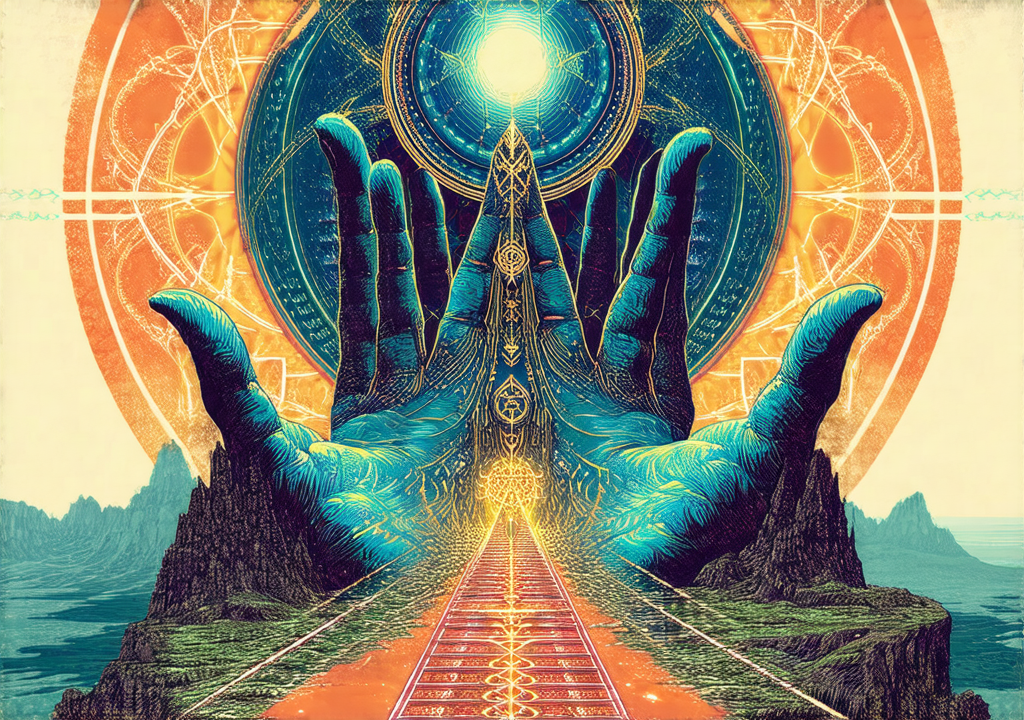
The Law of the Self-Deity: Why the Ego Is Your Temple, Not Your Enemy
⛧ The Law of the Self-Deity: Why the Ego Is Your Temple, Not Your Enemy ⛧
By Archon Sol Invictus
In the grand theatre of Western esotericism, a peculiar schism has persisted for centuries. On one side stands the Right Hand Path (Dharmadhatu), that luminous, sun-drenched road toward unity, selfless service, and the dissolution of the individual into the cosmic whole. On the other stands the Left Hand Path (Vasudhatu), the shadowy, nocturnal road of separation, will, and the exaltation of the unique self. It is upon this latter path that we must place our full weight of authority today, for it is here—within the cold, crystalline structure of individualism—that true spiritual sovereignty is found.
We are asked to write on a specific law: The Law of the Self-Deity. Specifically, we examine why the ego—so often maligned by the Eastern traditions and the New Age mystics—is not your enemy, but rather your temple. This is not a casual observation; it is the foundational axiom of the Left Hand Path, the keystone arch over which all subsequent rituals, meditations, and philosophical inquiries must be built. To understand this law is to unlock the door to true, undiluted individuality.
To begin, we must dissect the word "ego." In common parlance, particularly in psychology and popular spirituality, the ego is that part of us that is concerned with social status, self-image, vanity, and the need for external validation. It is the mask we wear to fit into society; it is the story we tell ourselves about who we are, a narrative constructed from the expectations of our parents, our culture, and our peers. The Right Hand Path often views this ego as an obstacle—a fog that obscures the true Self (the Atman, the Buddha-nature, the Divine Spark). To achieve enlightenment on this path, one must work to thin the ego, to let go of attachments, and ultimately to merge with the universal Oneness.
The Left Hand Path rejects this premise entirely. Not only do we reject it; we invert it. We argue that what the Right Hand Path calls the "ego" is not a trivial byproduct of social conditioning, but the very substance of your individuality. It is your signature in the universe. It is the unique frequency at which you vibrate. And because it is so precious, so singular, and so irreplaceable, it must be housed in a structure worthy of its importance. That structure is the temple.
I ⛧ The Architecture of the Temple
What makes a temple? A temple is not merely a building; it is a space set apart from the profane world for the purpose of housing something sacred. It has walls that keep out the noise, the dust, and the interference of the mundane. It has an altar where offerings are made, where communication with the divine occurs. It has an axis mundi—a central point around which all meaning is organized.
Now apply this to the human ego. Your mind, your personality, your unique set of desires, fears, ambitions, and aesthetic preferences—this is the temple. Your conscious awareness is the altar. Your will is the priest who tends the flame. Your body is the foundation stone. The Law of the Self-Deity dictates that you are to treat this entire architecture with the same reverence, care, and protection that a high priestess would accord to the inner sanctum of a great temple.
This means you do not casually let others walk through your mental space. You do not allow societal expectations to rearrange your interior furnishings without your consent. You do not sacrifice your unique desires on the altar of social acceptability. The ego is not something to be polished until it shines like a generic, soulless marble statue; it is a living, breathing, growing organism that must be fed, protected, and cultivated with fierce devotion.
Consider the implications of this in daily life. When you feel a desire for a particular career path, even if your friends or family think it is impractical or too eccentric, the Law of the Self-Deity tells you to follow that desire. It is not egoism in the petty sense; it is a divination of your own unique nature. Your ego is telling you where your temple wants to be built. When you feel a strong aesthetic preference for a style of music, art, or clothing that differs from the mainstream, this too is a sacred intuition guiding you toward an expression that resonates with your specific frequency. To ignore these inner signals is to let the temple fall into disrepair.
The Right Hand Path often speaks of "letting go." The Left Hand Path speaks of "taking up" and "holding fast." You are not here to dissolve; you are here to crystallize. Your task in this life is to take the raw, undifferentiated potential that you brought with you into incarnation and refine it into a unique, unrepeatable structure. This process requires discipline, yes, but not the self-negating discipline of the monk who starves his body and silences his mind to please God. It is the disciplined willpower of the artisan who shapes the marble, chipping away everything that does not contribute to the unique form he has seen in his mind's eye. You are both the sculptor and the statue; you must be ruthless with your own material to bring out the divinity within it.
II ⛧ The Misunderstanding of Ego
A common objection from those on the Right Hand Path, or even from casual students of esotericism, is that exalting the ego leads to narcissism and isolation. They argue that if you build a temple around yourself, you wall others out, and in doing so, you cut yourself off from the universal love that binds all beings.
This is a misunderstanding born of confusion between the ego and the self. The ego is your interface with reality; it is how you experience the world. The self (or Self-Deity) is the central authority within that interface. To say "the ego is my temple" is not to say that I am isolated from others. It is to say that my point of contact with the universe is unique and must be respected as such.
Think of it in terms of radio frequencies. Two people can listen to the same station, but they will receive different signals if their receivers are tuned differently. The universal "broadcast" is available to all, but each individual receives a unique set of information based on their own frequency. If you try to force your receiver to match someone else's, you lose your own signal and gain a noisy copy of theirs. The temple of the ego ensures that your receiver remains tuned to your specific frequency. It protects your uniqueness against the homogenizing pressures of culture, religion, and society.
Furthermore, it is precisely because each individual has their own unique temple that true community can exist. If everyone were dissolved into a single, undifferentiated mass, there would be no one left with whom to relate. Relationships require two distinct entities. Love requires two separate beings who choose to connect. By honoring your own ego-temple, you become a whole entity capable of genuine relationship, rather than a fragment seeking completion in another person. You are not looking for the other half of your soul; you already have it all within your own temple.
The Left Hand Path emphasizes the concept of the "unique individual." This is not a new idea; it can be traced back to the Gnostic texts that speak of the divine spark trapped in the material world, each being a unique fragment of the One. It is present in Hermetic philosophy: "As above, so below," but more specifically, as you are in your unique interior, so should you project into the exterior. Your individuality is not an accident; it is a deliberate creation by the Great Architect (or the Devil, or the Void, depending on one's preference) to ensure that every possible frequency of experience is represented within the universe.
III ⛧ The Rituals of the Temple
How does one actually practice the Law of the Self-Deity? Is it merely a philosophical concept, or does it require practical application? As with all esoteric laws, it requires ritual, discipline, and conscious effort. You do not maintain a temple by ignoring it; you maintain it through regular tending.
Here are some foundational practices for those wishing to build and maintain their own ego-temple:
1 ⛧ The Ritual of Self-Inquiry
Set aside time each day or week to sit in silence and examine the contents of your temple. What desires are burning brightly? What fears are lurking in the corners? What memories are displayed on the walls? Do not judge them; simply observe them. This is the priest walking through the sanctuary, checking that the candles are lit, the incense is burning, and no dust has settled on the altar. You may find that some parts of your ego have been neglected, allowing weeds to grow where there should be clear ground. Pull up those weeds (habits, beliefs, attitudes) that do not serve your unique expression.
2 ⛧ The Ritual of Aesthetic Cultivation
Your temple needs beauty and order. Curate your environment. Choose colors, textures, music, and art that resonate with your specific frequency. Do not choose what is "trendy" or what others approve of; choose what makes your own soul vibrate. This might mean creating a personal shrine in your home, or it might mean dressing in a style that reflects your inner truth, even if it is unconventional. Your body itself is part of the temple; feed it with foods you enjoy and move it in ways that feel authentic to you.
3 ⛧ The Ritual of Boundary Setting
A temple has walls. You must learn to say "no" without guilt or apology. When someone asks something of you that drains your energy, compromises your values, or does not serve your unique purpose, close the gate of your temple. This is not rudeness; it is a sacred act of protection. The priest does not let just anyone walk into the inner sanctum; they control access to protect the sanctity of the space. Similarly, you must control who and what enters your mental and emotional space.
4 ⛧ The Ritual of Will-Exertion
The temple is not static; it is a dynamic structure that requires active maintenance. Practice small acts of willpower daily. Complete tasks you have started. Follow through on commitments to yourself. Resist the inertia of comfort and the pull of mediocrity. Each time you exert your will, you lay another brick in the walls of your temple. Over time, these small acts accumulate into a formidable structure that can withstand the storms of life.
5 ⛧ The Ritual of Self-Coronation
Periodically, perform a ritual where you formally acknowledge and celebrate your own divinity. Light candles, anoint yourself with sacred oils (if desired), and declare to yourself: "I am my own deity. I am sovereign over my own temple. My will is the law within these walls." Feel the weight of this declaration in your bones. This ritual reinforces the authority you have over your own life.
IV ⛧ The Enemy Within
It is important to acknowledge that building a temple around one's ego is not without its challenges. There are enemies, both external and internal, that seek to undermine the Law of the Self-Deity.
Externally, society is often hostile to true individuality. We live in an age of mass production, where everyone is encouraged to consume the same products, watch the same shows, hold the same opinions, and dress in the same way. The pressure to conform is immense. To stand out, to be unique, is to invite criticism, ridicule, or even ostracism. The temple must be fortified against these external assaults.
Internally, there are psychological forces that work against your sovereignty. Fear of rejection, desire for approval, and the habit of seeking validation from others are all enemies within the walls. They whisper to you: "You should want what they want," "You should feel how they feel," "You should be like everyone else." These internal voices are the priests of the old religion, trying to convince you that your temple is not good enough unless it looks like everyone else's.
There is also the enemy of self-delusion. The Left Hand Path requires an honest assessment of one's own nature. You must look at your ego without romanticizing it or hiding from its shadows. Your temple contains light and dark; beauty and ugliness. To truly honor your Self-Deity, you must accept all aspects of yourself, not just the ones that look good on social media. This requires a certain amount of psychological depth work, which is why many Left Hand Path practitioners study Jungian psychology or other schools of self-analysis.
V ⛧ The Ultimate Goal: Sovereign Divinity
What is the end result of living by the Law of the Self-Deity? Is it simply to be very confident and successful in life? While those things may be byproducts, they are not the ultimate goal.
The ultimate goal is a state of sovereign divinity. You become fully conscious of your own uniqueness and live from that place of full awareness. Your actions flow naturally from your true nature rather than from societal expectation or subconscious habit. Your will becomes clear, focused, and effective. You experience life as a continuous act of creation, where every choice is an opportunity to further define and express your unique frequency.
In this state, the boundary between you and the universe becomes less about separation and more about a harmonious relationship between the part and the whole. You are not dissolved into the universe; rather, the universe is experienced through the lens of your unique perspective. Your temple stands as a beacon in the vast landscape of existence, a lighthouse guiding ships to a specific port that only you can offer.
This is the Left Hand Path's answer to the question "What is the purpose of life?" It is not to achieve nirvana or union with God; it is to become fully and completely yourself, so much so that your individuality becomes a law unto itself. Your unique way of seeing, feeling, and acting becomes the standard by which others may measure their own journeys. You become a reference point in the cosmos.
The Law of the Self-Deity teaches us that we are not small fragments seeking to merge with something larger; we are whole deities inhabiting temporary bodies. Our ego is not an illusion or an obstacle; it is the vessel, the temple, the sacred space where our unique divinity takes form in this material world. To honor that temple is the highest spiritual act available to us.
So go forth and build your temple. Tend its altar. Guard its gates. Let no one enter who would desecrate its sanctity. And from within those walls, shine with a light so uniquely yours that it illuminates the path for others while remaining utterly and incomparably your own. This is the Law of the Self-Deity: You are the temple; you are the deity; you are the law.
⛧