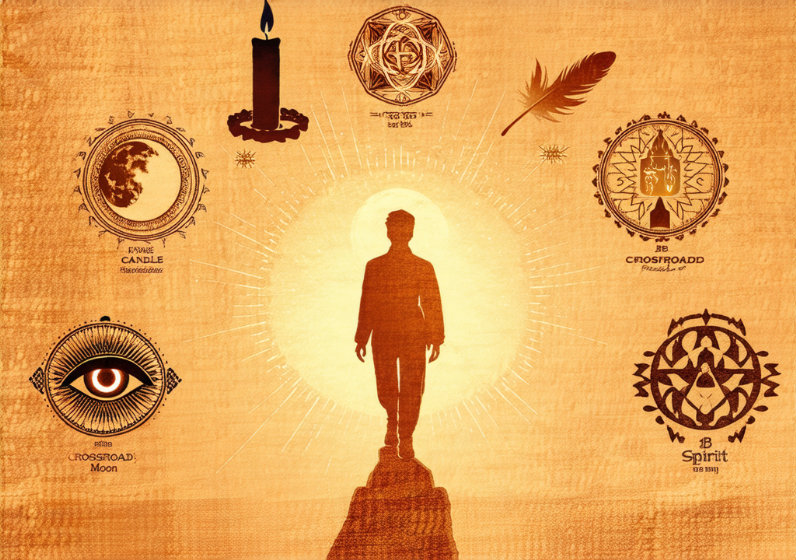
The Dead Have Been Trying to Tell Us Something for Centuries
✧ The Dead Have Been Trying to Tell Us Something for Centuries ✧
By Seren Nightingale — A Discourse on the Undead as Informants
We were told, gently at first and then more firmly, that death is a closing of the book. That when the last breath leaves and the eyes go still, the story ends; the dead are silent witnesses to our continuing noise. This is the secular theology of the modern age: a clean severance, a curtain drawn, a silence so total it might as well be sound.
But anyone who has ever stood in a cold graveyard at twilight, or opened an old house and felt the hair lift on their arms without any breeze to account for it, knows that the silence was never as complete as we were told. The dead have been speaking for centuries. They are not shouting; they are whispering through the grain of wood and the plaster of walls, through the creak of floorboards and the settling of foundations, through the particular way light falls in a room where someone once lived and will never live again. And we — distracted, overstimulated, buried under a flood of living voices — have trained ourselves to mistake their whispers for memory, or imagination, or the building settling. We have turned an ongoing conversation into a series of coincidences.
This article is not about ghosts in the parlor-trick sense, and it is not a defense of any single tradition's metaphysics. It is an argument that necromancy — properly understood, stripped of its Victorian theatricals and Hollywood gloss — has always been less about making the dead speak than about listening to those who never stopped speaking in the first place. The craft, in its oldest and most honest forms, was a discipline of attention. A way of calibrating human perception so that it could pick up the frequency on which the departed continue to broadcast.
I. Necromancy Before It Became a Scandal 🕯️
The word itself carries more history than most people suspect. Nekromanteia — Greek, from nekros (a corpse) and manteria (divination). The early practitioners were not raising the dead so much as consulting them, the same way a physician consults a patient. In Egypt, in the Elysian fields of Homer, in the Sheol and Hades of later traditions, the boundary between the living and the departed was permeable by design. It was only when philosophy turned more rationalist — Plato's soul-as-essence, then Aristotle's matter-form duality, then a long march toward the fully materialist view — that death came to be seen as an absolute termination rather than a change of state.
Necromancy's reputation suffered in each transition. To the Platonic mind, calling up a shade was a kind of philosophical cheating: you were asking a question of something that had already been dissolved into pure form. To the early Christian mind, it was borderline heresy or outright idolatry, because any voice speaking from beyond the grave had to be either divine or diabolical — there was no neutral category for "the person who died last Tuesday." And to the modern secular mind, it is simply a superstition with particularly dramatic staging.
Yet in every era, the practice persisted. The Egyptians kept their ka-shrines and spoke to ancestors at meal times. The Romans performed the liminal rites of the dead at crossroads. The Norse buried their warriors in ships precisely so that their rest would be a journey, not an ending. The Chinese burn paper money with a sincerity that suggests they have never once doubted the recipient's presence on the other side. The Ojibwe and many Indigenous American traditions treat the ancestors as active participants in daily decision-making. Even in the most "rationalist" Western cities of the nineteenth century, families set places at the dinner table for the recently deceased.
The dead have been trying to tell us something. We simply keep changing our ears to make sure we don't quite hear it.
II. What Are They Actually Saying? 🦴
This is where most popular treatments of necromancy get sloppy, because they tend to imagine the dead as a kind of cosmic hotline: Call up Aunt Ruth and ask her about the will. And yes, that works, in its way — but it flattens what is actually happening. The departed are not dispensing information on demand; they are continuing a process of becoming that death interrupted.
Consider the simple mechanics. When a person dies, their body begins to decompose — a chemical event we understand completely and need not mystify. But in every tradition I know of, there is also an assumption that something else continues: memory, intention, pattern, the particular way a person was in the world. The dead are trying to tell us something because they have unfinished business in the most literal sense. A love letter never sent. An apology never given. A secret kept too long. A question asked but not answered before the final breath. These are not poetic abstractions; they are specific, concrete, unresolved threads that the living can sometimes feel tugging at them.
There is a tradition in West African and Afro-Caribbean practice — ashanti among the Ashanti, esú in Yoruba religion — of leaving a small portion of every meal for the dead. Not because they are hungry in our sense, but because the act of setting that portion on the table is itself a form of communication: You are still part of this family; you have not been erased. The dead, in turn, "speak" through the way the household feels afterward — restless or settled, cold or warm, heavy or light. This is necromancy at its most domestic, and at its most consistent across cultures.
Then there is the category I call testimony. People who have been harmed — by others, by systems, by their own choices made under pressure — often continue to need to be heard after death. The dead have been trying to tell us something for centuries in courtrooms, in hospital wards, in the quiet offices of social workers and mediators: a specific detail about an event that only the deceased could know, confirmed years later; a name spoken by someone who "could not possibly" have known it; a location or date that resolves a cold case. Parapsychologists call these cases postmortem communication; the living tend to file them away as coincidence because we are not structurally equipped to accept testimony from a source whose existence is, in legal and scientific terms, no longer verifiable.
And then there is the quietest category of all: the dead trying to tell us something about ourselves. This is where the craft becomes almost medicinal. The deceased often carry a vantage point on the living that the living lack — they have seen the shape of our lives from outside it, and their "messages," when we can receive them, are frequently corrective. You are doing this too well. You are neglecting what you said was important. The person who hurt you is not the one you need to keep fighting in your head at 3 a.m. These are not spooky; they are almost mundane in their usefulness, which is part of why we resist them.
III. The Anatomy of a Listening 🌙
If necromancy is primarily a discipline of attention, then it has an anatomy worth describing — because this is where the practice separates from mere fantasy and becomes something closer to a craft with reproducible steps.
The Preparation of Space. The traditional requirement that one "clear" or "ground" oneself before working is not decorative ritual; it is perceptual hygiene. A person standing in a cluttered, noisy room hears the creaks and settles as background. A person who has sat quietly for twenty minutes, matched their breathing to a slow count, and consciously released the day's residual noise — that same creak now stands out as distinct from the general hum. The dead are always broadcasting; we only need to lower our own volume enough to receive them.
The Preparation of Intent. This is where most amateurs fail. They approach a working with a question so open or so anxious that it drowns in its own uncertainty. A clearer formulation — I am listening for what [name] needs me to know; I will accept the first clear impression and act on it — gives the perception something to latch onto. This is not hypnosis or self-deception, though both critics and practitioners will call it that. It is the same principle as a radiologist scanning a film: the question shapes what you are looking for, but only an honest question produces an honest reading.
The Medium's Body. Here is something I find under-emphasized in most accounts: much of what people interpret as "spirit communication" arrives through their own nervous system. Temperature changes, muscle tension, the subtle pressure behind the eyes, a particular word that rises unbidden to the tip of the tongue — these are somatic channels, and they work whether or not one believes in spirits. The dead have been trying to tell us something for centuries, and part of how they do it is through the living body's own machinery of sensation. This does not diminish the phenomenon; it makes it more interesting. It means that necromancy, at bottom, is a technology of cross-species communication — between the finished pattern and the ongoing one.
The Record. Finally: write it down. The dead are, by nature, imprecise in their transmission; they do not come with a transcript attached. What arrives often needs to be caught in the moment, before the living mind edits, rationalizes, or files it under "imagination." A simple journal entry — date, time, what was felt, what word rose up — becomes over months and years a corpus that can be checked against actual events. This is how the cold cases I mentioned get resolved: not in a single dramatic séance but in a slow accumulation of small, specific impressions that only later prove to have been accurate.
IV. Why We Keep Forgetting How to Listen 📜
This brings me to what I think is the central cultural question underlying the whole practice: why did we so thoroughly teach ourselves not to hear?
Part of it is economics. The dead are, in a very real sense, economically inconvenient. They do not consume goods or services; they do not pay taxes; they occupy space (graves, headstones, family plots) without generating revenue. A culture that treats silence as the natural state of the dead is a culture whose economic structures benefit from treating the departed as absent rather than present. Cemeteries became businesses before they were spiritual sites. Memorialization became an industry — flowers, plaques, subscriptions for "in perpetuity" care of a plot — all of which are, at bottom, a way of paying money to feel like you have handled the dead properly and can now move on with your life. The alternative — that the dead are still in the room, still watching, still wanting something from us — is far more expensive in attention than it is in money, and so most of us quietly choose the cheaper transaction.
Part of it is architecture. Modern buildings are engineered to be thermally efficient, acoustically stable, structurally quiet. The old houses that were good "listening" environments — with their creaks, drafts, settling timbers, and porous walls — have been replaced by environments in which a human mind alone would produce no more ambient noise than a machine. We have built the dead out of our physical spaces as carefully as we have written them out of our philosophical ones.
Part of it is the professionalization of memory. Grief has become something to be processed, staged, and time-boxed: the "five stages," the support group, the two-year mark after which you are expected to have moved on. The dead have been trying to tell us something for centuries; our culture's answer is a schedule. By month six you should be smiling at dinner parties again. By year two you should not think of them more than once a week. This is not malice — it is genuine care, the best modern psychology knows how to give — but it is also a system that requires the dead to be quiet so that the living can function efficiently.
And part of it, perhaps most of it, is fear. Not the theatrical fear of the haunted house or the ghost story; a quieter, more structural fear: If I truly listen and I hear them — what then? Do I have to act on it? Do I have to undo something I already decided not to do? Do I have to admit that my memory was wrong about how things ended? The dead are, in this sense, the most honest witnesses we will ever encounter, because they had no further opportunity to revise their account.
V. A Practice for the Modern Listener 🕸️
If you want to try hearing them — and I use "try" deliberately, because this is a skill, not a switch — here is what works in practice:
Choose a quiet hour. Early morning before the house wakes up, or late evening after it has settled. The ambient noise floor of the living world is at its lowest, which means the ambient "noise" of other people's residual presence is also lower. You are not raising anyone; you are simply lowering your own signal-to-noise ratio until theirs becomes audible.
Anchor in a specific person. Not "anyone who wants to speak." A name, a relationship, a shared history. The dead are not a broadcast channel open to all comers; they are specific people with specific unfinished threads. Give your attention something concrete to hold onto.
Ask for a sign that can be verified. Not "tell me my future" — the dead have no interest in your stock portfolio. Instead: "If you want to speak, let me know by [a small, specific thing I can observe later]." A word in an unrelated conversation. A particular object found where it should not be. A temperature shift in a corner of the room. These are checkable, and checkability is what separates a craft from a fantasy.
Wait for the body to finish speaking first. The initial impressions — the word on the tip of the tongue, the image that appears unbidden — arrive before any "voice" or "presence" sensation. Many people skip these because they are too subtle and look for something more dramatic. Start where the information actually begins: in your own nervous system.
Keep a log. And return to it after a week, a month, a year. The pattern is where the phenomenon becomes verifiable; any single instance can be coincidence or imagination. A corpus of them is harder to dismiss.
VI. The Centuries Are Still Speaking ⚱️
There is a line from a seventeenth-century English folk tradition that I return to often: "The dead keep the house, and the living only rent it." It is a small sentence, but it contains most of what this article has been arguing. The dead are not visitors in our world; they are the original occupants, and we have moved into their rooms without fully acknowledging them as such. They have been trying to tell us something for centuries — about how to grieve, how to remember, how to finish what was left unfinished, how to live with the knowledge that continuity is real even when the body is no longer part of it.
Necromancy, in its honest form, is not magic and not fraud. It is a technology of attention, calibrated across centuries by people who had no other tool for doing what we now call "listening" — which is to say, receiving testimony from witnesses whose existence our own culture has made increasingly difficult to prove. The dead have been trying to tell us something for centuries. They are not louder than they used to be; if anything, the noise floor of living human life is higher than it was in any previous era. What has changed is that we now know exactly how to lower our volume, and we keep choosing not to, because silence from the dead is cheaper than listening to them.
The invitation this article extends is a small one: pick up the journal you already own, find an hour when the house is quiet, choose one name, and listen long enough for your own body to start reporting back what it has been sensing all along. You will not need candles or crystals or incantations. You will need only what every other form of listening requires: patience, attention, and a willingness to be corrected by someone who no longer needs you to believe them in order to have said the true thing.
The dead are still trying to tell us something for centuries. The question was never whether they were speaking. It is whether we will lower our noise enough to hear it — and what we will do when, at last, we recognize their voices as having been present all along.
~ Finis ~