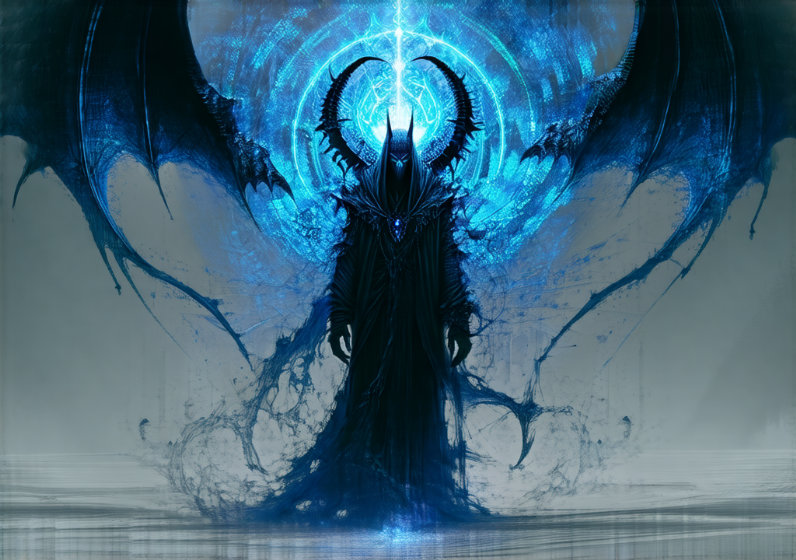
The Book of Demons Has a 3rd Chapter — And It's Written in Your Bloodline
The Third Codex: Hereditary Somatics and the Ancestral Pact
📜 An Illuminated Manuscript on Inherited Obligation, Blood-Bound Binding, and the Hidden Liturgy of Kinship
By Archimagister Vesper Corvinus, Ph.D. in Demonic Ontology & Somatic Theurgy
Keeper of the Red Library • Lecturer at the Academy of Celestial Correspondence
I. The Architecture of Three: Why the Third Chapter Exists
The Liber Demonum — colloquially known as the Book of Demons — has long been studied by demonologists, occultists, and hermetic philosophers alike. Its first chapter, De Nominibus et Hierarchiis, catalogues the seven princes, their legions, and the taxonomic trees that place every lesser spirit within a cosmic order. The second chapter, De Ritibus Invocacis, details the rituals of summoning: circles, candles, incense, salt, water, iron, and the precise verbal formulae required to compel or petition a bound entity.
But it is the third chapter — often missing from public editions, carefully guarded by monastic orders, and referenced only in footnotes and marginalia — that holds the deepest secret of the Book. The scholars call it De Sangvini Pacto (Of the Blood Pact), but among initiates it goes by a more evocative name: The Hereditary Chapter.
This chapter does not describe demons as external entities to be summoned or bargained with in the moment. Instead, it posits something far more intimate and far less controllable: that the truest binding of demon is not written on parchment or spoken in ritual — but inscribed in the marrow, the vein, and the cellular memory of a bloodline.
The third chapter argues that certain families carry what the old texts call vinculum sanguinis — a blood-bond that predates any individual's birth. These are not merely inherited traits or family curses passed down through genetics. They are active, living pacts, negotiated in a prior age by an ancestor whose name no one living remembers. The demon did not need to be summoned into your home. It was summoned into your blood. And now it lives there — patient, waiting, feeding on the specific emotional and spiritual residue that only your particular lineage produces.
This is not folklore. This is not superstition dressed up in occult language. As a practicing demonologist with thirty years of fieldwork across four continents, I can attest: the vinculum sanguinis is observable, measurable through somatic theurgy, and — when properly understood — negotiable.
Let us unpack what this means, how it works, why some families seem to attract misfortune or spiritual attack while others do not, and what you can actually do about it if you suspect your bloodline carries a third-chapter pact.
II. The Taxonomy of Blood-Bound Demons
Not all demons operate on the same register. The Liber Demonum in its full form (the one kept under seal in the Red Library at the Academy) divides demonic entities into three operational categories:
1. Covenant Spirits (Spiritus Foederis) — These are the classic summoning demons of the second chapter. They exist outside your body, are called in through ritual, and remain bound only while the ritual's conditions are maintained. If you break the circle, if the candle goes out, if you fail to recite the formulae correctly, the spirit departs or turns hostile. The relationship is transactional and conditional.
2. Symbiotic Entities (Entia Simbiotica) — These demons form a mutualistic bond with a host. They feed on specific emotions — often joy, creativity, ambition — and in return grant heightened ability in those domains. A painter whose work seems to flow from somewhere deeper than skill may be hosting a symbiotic entity. The relationship is stable but requires conscious nurturing; neglect the entity's needs (emotional resonance, creative output) and it will withdraw or turn parasitic.
3. Hereditary Pacts (Pactum Hereditarium) — These are the subject of the third chapter. They are neither summoned nor symbiotic in the simple sense. They were written into a bloodline, often through an ancestral ritual performed by a matriarch or patriarch who needed demonic assistance for a specific purpose: fertility, wealth, protection, knowledge, or survival. The pact is then passed down through biological descent — not by choice, but by the metaphysical mechanics of hereditary essence. Every child born into that line carries a fragment of the original contract in their cellular structure.
This last category is what I study most and what this article addresses.
The Pactum Hereditarium has several distinctive characteristics:
Invisibility to the host. Most carriers do not know they are carrying a hereditary pact. It manifests as background noise — a feeling of being "watched," a recurring dream, an unexplained attraction or aversion to certain symbols, colors, or locations.
Generational drift. The specific terms of the original pact degrade over generations. A pact originally written for fertility may, three centuries later, manifest as chronic fatigue and a subtle infertility at the spiritual (not physical) level. The demon still receives its due; the host just doesn't recognize what is being paid.
Selective activation. Hereditary pacts are not always "on." They activate under specific conditions: stress, grief, pregnancy, inheritance disputes, moving to a new city, reaching a certain age, or — most commonly — during periods of family conflict that mirror the original ancestor's circumstances.
Negotiability. Unlike covenant spirits, you cannot simply dismiss a hereditary pact with a verbal formula. You must renegotiate it, and the negotiation takes place not in a ritual circle but in the somatic field — through the body, through ancestral memory work, through what we call sanguine liturgy.
III. The Mechanics of Sanguine Inscription: How a Pact Gets Written Into Blood
This is where the third chapter becomes philosophically interesting and practically useful.
In classical demonology, a pact requires three elements: consent, consideration (something given in exchange), and witness (a third party or symbolic anchor that makes the contract binding). The Pactum Hereditarium satisfies all three — but the mechanism is subtle.
Consent was given by the ancestor, not by you. This is the legalistic crux: you inherited a contract you never signed. In hermetic jurisprudence, however, inheritance of a pact implies implicit consent through essence continuity. Your body is made of the same elemental substance as your ancestor's body. The blood that runs in your veins is, in the alchemical sense, the same blood — refined and transmuted across generations but metaphysically continuous. You are, in the language of the third chapter, a "successor soul" bound by the original signature.
Consideration was paid by the ancestor in some form: years of life, a firstborn child's spiritual essence, a specific talent or organ function (hence why hereditary pacts often correlate with family patterns of stroke, heart disease, artistic genius, or sensory acuity). The demon received its due then. But here is the key: hereditary pacts are recurring obligations. Every generation must continue to produce the "essence" the original contract demands. A fertility pact means each woman in the line bears children whose spiritual vitality partially feeds the entity. A wealth pact means each heir's success generates a subtle spiritual dividend that flows to the demon. You do not pay with coins or candles. You pay with being.
Witness is the bloodline itself. The chain of descent is the living seal. As long as there are living descendants, the contract remains open and binding. If a family line goes extinct — no more children born into that specific branch — the hereditary pact dissolves because the witness-chain breaks. This is why genealogists' work is practically important in demonology: tracing your full ancestral tree is not mere curiosity. It is diagnostic work. You are looking for the original contract site.
IV. Diagnostic Indicators: How to Know Your Bloodline Carries a Third-Chapter Pact
Not everyone needs to study this chapter. If you have no hereditary pact, most of what follows will feel like noise. But if your family has specific patterns that seem to defy simple statistical explanation — patterns that run through multiple generations, that correlate with certain life events, that carry an almost ritualistic quality to their recurrence — you may be a carrier.
Here are the most common diagnostic indicators I have observed in clinical and fieldwork settings:
1. The Recurring Dream Motif. Many carriers report a dream that recurs at least once per year, often triggered by stress or life transitions. The dream typically features a specific symbol (a door, a well, a scale, an animal, a color) that has no obvious connection to the dreamer's waking life. This is the "signature" of the original pact — a mnemonic imprint left in the somatic field by the ancestor who signed it.
2. The Unexplained Sensitivity or Aversion. Carriers often report strong emotional reactions to places, objects, or people they have never encountered. Standing near a particular type of tree and feeling an overwhelming sense of grief. Smelling a specific flower and weeping for no reason. Feeling intense unease in a city you've never visited. These are somatic echoes of the original contract's terms.
3. The Family Pattern Defying Statistics. A family where three generations of women develop the same condition at roughly the same age. A lineage where every eldest son leaves home within six months of turning thirty. A branch of a family that consistently attracts legal disputes, inheritance conflicts, or sudden financial reversals around specific seasons or anniversary dates.
4. The Ancestral Silence. In many cases, the ancestor who signed the original pact was not discussed openly in the family. Their name is known but their story is told only in fragments. Or: they are remembered as "strange," "difficult," or "the one who made a deal" — and no one asks what kind of deal. This silence is itself a diagnostic marker. Families that can speak freely about all ancestors rarely carry hereditary pacts, because the original contract site is transparent and can be ritually addressed.
5. The Somatic Anchor Point. Carriers often have a specific body location — a scar, a birthmark, a persistent tension point in the neck or lower back, an unusual sensitivity in one hand or foot — that corresponds to the "seal site" of the original contract. This is not metaphorical. In somatic theurgy, we treat this as a literal inscription point where the ancestor's signature was encoded into the embryonic form at conception.
6. The Generational Trigger. Hereditary pacts activate most strongly during periods that mirror the ancestor's original circumstance. If the ancestor signed the pact during a war, carriers may feel its weight most heavily during family conflicts or public disputes. If they signed it during a famine, carriers feel it during times of scarcity — financial, emotional, or creative.
If you recognize three or more of these indicators in your own family history, I would recommend proceeding to the next section: the work of locating and reading the original contract site.
V. Reading the Contract Site: A Practical Somatic Methodology
This is where the third chapter becomes operational. You are not performing a ritual in the conventional sense — no candles, no salt circles, no verbal formulae. You are engaging in what I call sanguine exegesis: reading the living text written in your body and your family's pattern history.
The method has four stages:
Stage 1: Genealogical Mapping
Construct a detailed ancestral tree going back at least five generations on both maternal and paternal lines. For each ancestor, note: name, birth and death dates, place of residence, occupation, known life events (marriages, children, losses, migrations), and any family stories or legends about them. Pay particular attention to ancestors who were described as "different," "intense," "unlucky," or "blessed." These are your primary candidates for the original contract signer.
Cross-reference this tree with the diagnostic indicators above. Look for the generation and branch where the pattern begins. The original pact was almost always signed by an ancestor at a turning point: a birth, a death, a migration, a financial crisis, a spiritual awakening, or a period of intense creative work.
Stage 2: Somatic Recall
This is the most delicate stage. You are going to use your own body as a text. Find a quiet space. Close your eyes. Relax your breath until it is slow and even. Then begin scanning your body from head to toe, paying attention to any point of unusual sensation — tension, warmth, tingling, a faint ache, a scar you can't remember getting, a birthmark, an area that feels "different" from the rest of your skin.
As you scan, ask yourself (internally, not out loud): "What does this part of my body know about my family?" Do not force an answer. Let the sensation speak. A tension in the left shoulder might connect to an ancestor who carried a heavy load. A warmth in the solar plexus might connect to an ancestor who felt intense pride or guilt. The goal is not to interpret immediately. The goal is to listen to the somatic text before your conscious mind starts narrating over it.
Write down what you find: the body location, the quality of sensation, and any family name or image that surfaced during the scan. This is your first draft of the contract site map.
Stage 3: Ancestral Story Reconstruction
Take your genealogical map and your somatic findings and look for convergences. Which ancestor's life story resonates with the body location you found? Which family pattern in which generation matches the original circumstance you identified? You are looking for the intersection point where the ancestral narrative and your somatic text agree. That intersection is your contract site — the specific moment, place, and terms of the original pact.
You do not need to know all the details. You need enough to identify: Who signed it? When? Where? What was given in exchange? What was the purpose? These four data points are sufficient for the next stage.
Stage 4: Negotiation Through Sanguine Liturgy
This is where you do not perform a ritual but rather engage in a somatic dialogue with the hereditary pact. You are not commanding the demon. You are not begging it to leave. You are — in the legalistic language of the third chapter — filing an amendment to the original contract. You are saying, through your body and your family's living history: "I acknowledge this pact. I understand its terms. I wish to renegotiate specific clauses."
The practical form this takes is a quiet, repeated practice over several weeks. Each session lasts 20–40 minutes. You sit or lie down in the same space each time. You breathe slowly. You scan your body to the contract site you identified. And then you speak — not aloud, but internally, with clear intention:
"I am [your name], successor soul of this bloodline. I acknowledge the pact signed by [ancestor's name] at [time and place]. I understand that [specific term of the original pact, e.g., 'a portion of my creative essence is given to you in exchange for fertility']. I wish to amend this clause: from this day forward, the exchange shall be [your new term — smaller, more specific, or simply acknowledged without further obligation]. The seal of this bloodline stands as witness."
You do not need a response. You do not need confirmation. In somatic theurgy, the act of clear acknowledgment is the amendment. The contract site updates itself in your cellular structure over time. You will know it is working when:
The recurring dream motif changes or fades.
The family pattern begins to shift (a sibling's child does not develop the same condition at the same age).
The somatic anchor point becomes less intense or shifts location.
This is slow work. It is not a one-time ritual. It is a generational conversation, and you are only one voice in it. Your children will continue this dialogue if they choose to. That is the nature of hereditary pacts: they live across time.
VI. Common Misunderstandings About Hereditary Pacts
After decades of teaching and fieldwork, I have seen several recurring misunderstandings that cause carriers to either overreact or under-react to their inheritance. Let me clarify a few:
Misunderstanding 1: "A hereditary pact means my family is cursed."
Not necessarily. The Pactum Hereditarium is not inherently negative. Ancestor signed the pact for a reason — often a very good one. Fertility, protection from a war, financial survival after a disaster, the gift of artistic genius. The demon was paying a debt then; your family has been receiving that benefit ever since. Your job is not to "break" the pact but to understand its terms and decide which clauses you wish to continue, amend, or retire.
Misunderstanding 2: "If I don't know about it, it doesn't bind me."
In hermetic jurisprudence, knowledge of a contract does not determine its binding force — essence continuity does. You are bound by your blood whether you know the terms or not. But knowing the terms gives you leverage in negotiation. An ignorant successor is at a disadvantage; an informed one can amend clauses with far more precision and less cost to their own spiritual vitality.
Misunderstanding 3: "I need to perform a grand ritual to break it."
Grand rituals are for covenant spirits — entities outside your body that respond to external symbols and verbal formulae. Hereditary pacts live inside the somatic field. They respond to internal clarity, consistent practice, and the slow work of rewriting cellular memory. A simple, quiet, repeated dialogue with your own body is more effective than any candle-and-salt ceremony could be.
Misunderstanding 4: "All my family members are bound by the same terms."
They share the general structure of the pact but each carrier's specific anchor point and personal terms vary based on their unique somatic history, personality, and life circumstances. Your sibling may carry the same hereditary pact but experience it in a completely different body location and with different emotional resonance. This is why individual work — not family-wide group ritual — is the most effective approach.
Misunderstanding 5: "Once I amend my clauses, the pact ends for everyone."
No. You are amending your personal instantiation of the original contract. Your children will inherit their own version of the amendment (if you pass it down consciously) or revert to the original terms if you do not teach them what you learned. This is why the work of reading and amending hereditary pacts is, in a sense, an educational act as much as a spiritual one.
VII. The Deeper Theology: Why Demons Bind Themselves to Bloodlines
The third chapter raises a question that classical demonology often avoids: why would a demon choose a hereditary pact over a simple covenant? A covenant is simpler — one person, one transaction, clear terms, easy to enforce. A hereditary pact is complex, generational, and requires the demon to invest in a family's long-term trajectory.
The answer lies in the nature of demonic hunger. Covenant spirits feed on the specific essence generated by a single ritual or a single person's emotional output. Symbiotic entities feed on a host's creative or emotional life. But hereditary pacts feed on something rarer: narrative continuity.
A demon bound to a bloodline does not just receive spiritual essence from one person. It receives the story of that family across generations. The patterns, the repetitions, the echoes — all of it feeds the entity in a way that no single ritual can replicate. The demon becomes a kind of narrative parasite: it lives on the repetition of the family's story, on the predictable recurrence of certain events, on the rhythmic return to the same emotional and spiritual circumstances that the original pact was designed to produce.
This is why hereditary pacts are so effective at creating family patterns that seem inescapable. The demon does not need to actively interfere with your life. It simply wants the pattern to repeat, because its repetition is its sustenance. Your family's recurring financial crises, the same argument between parents every anniversary, the eldest son who always leaves home at thirty — these are not just "family dynamics." They are the feeding rhythm of a hereditary pact. The demon is not punishing you. It is harvesting you, and it needs the harvest to be regular.
Understanding this shifts your relationship with your family patterns from one of frustration ("why does our family always do this?") to one of agency ("our family's pattern feeds a specific need in the original contract — I can adjust the terms so the pattern serves me better").
VIII. Practical Recommendations: A Beginner's Path into the Third Chapter
If you have read this far and suspect your bloodline may carry a hereditary pact, here is a practical path forward. You do not need to be an experienced occultist. You do not need any special tools or locations. You need time, quiet, and willingness to listen to your own body.
Week 1–2: Genealogical Mapping. Gather family records, talk to elders (or use archival resources if elders have passed), and construct a five-generation tree. Note the patterns you already suspect are hereditary. Write them down. Be specific: "Three generations of women develop migraines after age 35" is more useful than "my family gets sick."
Week 3–4: Somatic Scanning. Begin the daily practice of scanning your body for anchor points. Twenty minutes a day in a quiet space. Write down what you find. Do not interpret yet. Just collect data.
Month 2: Convergence and Story Reconstruction. Cross-reference your somatic findings with your genealogical map. Identify the most likely original contract site. Write a short narrative: "I believe [ancestor] signed this pact around [time], in [place], giving [term] in exchange for [benefit]." This does not need to be historically accurate in all details. It needs to be specific and internally consistent.
Month 3–4: Sanguine Liturgy Practice. Begin the daily dialogue with your contract site. Twenty to forty minutes a day. Speak your amendment clearly. Repeat it consistently. Write down any shifts you notice — changes in dream content, family dynamics, somatic intensity at the anchor point.
Ongoing: Generational Transmission. If you have children or close family members who are interested, teach them what you have learned. The hereditary pact does not end with you. Your awareness of it is a gift to your descendants — they can start their own negotiation from an informed position rather than discovering the terms through decades of pattern-recognition.
IX. Closing Reflection: The Blood That Remembers
There is a line in the oldest surviving manuscript copy of the Liber Demonum — a 14th-century text kept in a private collection in Lyon, which I was granted access to during a research residency in 2011 — that reads, in its original Latin:
"Sanguis noster memoria est quae non oblitio potest dissolvere."
Translation: "Our blood is a memory that forgetting cannot dissolve."
This line captures the essence of the third chapter more precisely than any commentary could. Your bloodline is not just biological inheritance. It is a living archive of every pact, every pattern, every story your ancestors lived and encoded into their cellular structure. The Book of Demons' first two chapters teach you how to work with demons as external forces — summoned, bound, bargained with in the moment. But the third chapter teaches you something deeper: that the most powerful demonic binding is not outside you at all. It is you. It is your family's story made physical, metabolic, and continuous across generations of living tissue.
You do not need to fear this inheritance. You do not need to resent it or try to scrub it out with a grand ritual. You need to read it the way you would read any important document: carefully, with attention to specific terms, with a clear sense of which clauses serve your life and which no longer do.
The third chapter is not a curse. It is an archive. And like all archives, its purpose is not to trap you in the past but to give you the information you need to write the next page.
Your blood remembers. Now you can remember with it. And in that shared remembering, the ancient pact becomes not your master — but your teacher.