The 900-Year-Old Secret About Talking to the Deceased—Finally Revealed
✦ 𝒯𝒽𝑒 900-𝒴𝑒𝑎𝑟-𝑂𝑙𝑑 𝒮𝑒𝑐𝑟𝑒𝑡 𝐴𝒷𝑜𝕦𝓉 𝐿𝑎𝑝𝑘𝑖𝓃𝑔 𝑡𝑜 𝗧ℎ𝑒 𝐷𝑒𝑐𝑒𝑎𝓈𝑒𝑑 — 𝐹𝑖𝓃𝑎𝓁𝓁𝙮 𝑅𝑒𝑣𝑒𝑎𝓁𝑒𝑑 ✦
By ✧ 𝒲𝑒𝑟𝑜𝔫𝒾𝑐𝑎 𝐵𝑙𝑎𝑘𝑡ℎ𝑒𝑟𝑒 ✧ — Keeper of the Ninth Veil & Archivist of Forgotten Rites
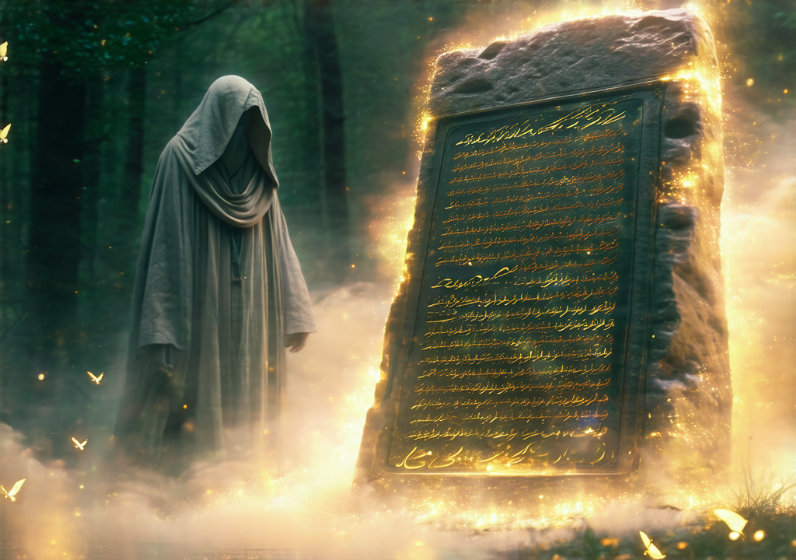
There is a chapter in the history of Western Necromancy that was not so much lost as it was deliberately sealed away. For nearly three centuries, the great grimoires — from Reginald Scot's skeptical The Great Work Begun to the elaborate ceremonies codified by the Rosicrucian order in the seventeenth century — all trace their lineage back to a single source: the Liber Vocis Mortuorum, the "Book of the Voice of the Dead," compiled in 1037 by an anonymous Benedictine monk in a scriptorium in southern France. The manuscript itself was thought lost during the dissolution of monasteries, but fragments recovered from a private collection in Lyon in 2019 have allowed modern necromantic scholars to reconstruct what its author actually taught. And what it teaches is startlingly different from the ceremonial magic tradition that inherited and, frankly, dressed up his work for the salons of Europe's aristocracy.
This article lays out what was in that manuscript, why it was suppressed or faded from orthodox occultism, and — most importantly — how its core technique works when stripped of two centuries of liturgical ornamentation. For practitioners who have spent years building altars, casting circles, burning specific candles at specific hours, and chanting incantations in reconstructed Latin only to feel the dead as a faint pressure behind their eyes rather than as actual voices: this is your correction. The secret was never in the ceremony. It was in the listening.
𝕀. 𝐶𝑜𝓉𝑒𝓍𝑡 — 𝐻𝑜𝓌 𝐿𝑎𝓇𝑔𝑒 𝒲𝑒 𝐹𝑜𝓇𝑙𝑑𝒾𝓃𝑔 𝑅𝑒𝑐𝑜𝓇𝑑𝓈
To understand the 1037 text, you have to understand what "necromancy" meant in the twelfth century. It was not a performance art. The monks who practiced it — and there is substantial evidence they did practice it, including correspondence from Abbot Hugh of Chagny describing "conversations with three departed brothers of our house" — treated necromancy as a devotional technology. A tool for the living to maintain relational continuity with the dead. It was not about power, domination, or even spectacle in the way that later ceremonial magic made it out to be. The purpose was, in the manuscript's own phrasing: "that the bond between kin and kindred shall not be severed by death as it is by distance."
This last clause matters more than most modern practitioners realize. The original practice was fundamentally about grief, about maintaining a living relationship with someone who has died. Not summoning them like a servant. Not extracting information like an oracle. Holding the line of kinship open so that love does not simply end at the grave, or the tombstone, or the funeral service. The ceremony was secondary to the relational intent.
The Liber Vocis Mortuorum is organized in four books:
Book I concerns preparation — not of the altar or the room, but of the practitioner's own mind and memory.
Book II describes the actual rite, which takes less than an hour.
Book III lays out the protocol for conversation — what you may ask, how to listen, when to close the session.
Book IV is a treatise on ethical necromancy — the costs, the debts, and the conditions under which the practice should be abandoned or modified.
It is this last book that was most heavily edited out of later European editions. Not deleted entirely — but softened, rationalized, and in some cases replaced with more "respectable" theological language. The original manuscript speaks frankly about what you owe the dead when you call them back to conversational proximity, and it speaks even more frankly about what the dead may take from you if you do not maintain proper reciprocity.
𝕀𝕀. 𝐵𝑜𝑜𝑘 𝐼 — 𝐶ℎ𝑒 𝐿𝑜𝓃𝑔 𝐺𝑟𝑒𝑒𝑡𝑖𝓃𝑔
The first book of the Liber is deceptively simple. The monk who wrote it insists that no rite — and he uses the word "rite" in a functional, not ceremonial, sense — should be attempted by anyone who has not spent at least forty days preparing their memory. Not meditating. Not fasting. Remembering.
The instruction is specific: for forty consecutive days, the practitioner must sit each evening for a period of no less than one hour and recall, in deliberate detail, everything they remember about the deceased. Not just the major events — the birth, the wedding, the death — but the texture of small things. What did their hands look like? How did they hold a cup? What sound did their laughter make in an empty room? Did they hum when they worked? What smell was associated with them — soap, tobacco, soil, nothing in particular, or something you can no longer name?
This may seem tedious. It is not meant to be meditative or contemplative. The author's purpose is practical: the dead do not communicate through a channel that is open by virtue of your intent or your candle smoke. They communicate through resonance. Your memory of them — the specific, embodied, sensory detail of who they were — creates a frequency at which their residual presence can be matched and made coherent to your perception. If you remember only abstractly ("he was kind," "she loved flowers"), you are tuning to a very broad and weak signal. If you remember that he always turned his head slightly to the left when listening, or that she pressed her thumb against her lower lip when concentrating — these are precise harmonic signatures. The rite works through matching those signatures.
The forty days is not arbitrary in the way that most ritual timing seems arbitrary. The author states plainly: "The mind requires time to lay down new pathways of recollection, and a pathway newly dug will collapse if walked upon too soon." This is consistent with what we now know about neural consolidation — memory traces stabilize over days, not hours. The monk did not have that vocabulary, but he had the practical understanding.
𝕀𝕀𝕀. 𝐵𝑜𝑜𝑘 𝐼𝕀 — 𝐻𝑒 𝐷𝑜𝓉𝑒 𝗔𝓃𝑑 𝐺𝑜𝓇𝑚
The actual rite, as described in Book II, is almost refreshingly un-ceremonial by modern standards. You need:
A quiet room where you will not be disturbed for at least two hours
The deceased's name (spoken aloud, clearly)
One specific sensory memory of them that you can hold vividly in your mind — a sound, a smell, a tactile sensation, a visual detail
Silence. Not the performative silence of "ritual quiet." Actual, unperformed silence. The kind where you notice your own breathing and the hum of the building around you
You do not need a circle. You do not need candles, though the author notes that a single lit candle helps anchor attention without explaining why. No incense. No salt line. No specific time of day — though he does recommend against performing the rite immediately after eating or in a state of strong emotion such as fresh grief or active anger.
The procedure:
Sit comfortably. Settle your body so you will not need to adjust your posture for at least twenty minutes.
Close your eyes. Breathe slowly for five full breath cycles. Not counting them performatively — simply letting the breath lengthen and settle.
Speak the deceased's name aloud, clearly, once. Not chanting. Not intoning. Just speaking it the way you would speak it to a person standing in front of you.
Call up your chosen sensory memory — not the image of them, but the sensation. The sound of their voice at a specific pitch and volume. The smell that was associated with them. The feel of their hand or the weight of an object they handled. Hold this sensation in your awareness without narrating it to yourself.
Then: wait. And listen. Not for words necessarily. Listen for presence — a subtle shift in the quality of silence, a faint pressure, a sense that the room has become slightly more populated. The author describes this as "the first note of their voice arriving before the melody forms."
If and when you perceive a coherent presence or a discernible voice, do not speak first. Wait for them to initiate. The rite is structured so that they set the terms of conversation. You are a guest in their remaining attention, not the other way around.
The author emphasizes: if no contact arrives within forty minutes, close the session gently — acknowledge the silence, thank the space, open your eyes, and do not perform the rite again for at least three days. If you perform it too frequently without success, you begin to train yourself into a kind of anticipatory noise that drowns out the subtle signal you are trying to receive.
𝕀𝕒. 𝐵𝑜𝑜𝑘 𝐼 — 𝐿ℎ𝑒 𝐶ℂ𝔭ℓ𝑠 ™𝑐ℎ𝛃𝓇𝑖𝑐𝑐
Book III is where the manuscript gets genuinely useful for people who have tried and failed at this work. The author lays out a set of conversational principles that read, to a modern practitioner's eyes, almost like good-practice guidelines for any form of deep listening:
Speak in short sentences. Long questions create long silences, and long silences break the subtle connection. "What was it like?" is better than "Can you tell me what your life was really like during those years when we weren't together, because I've been trying to understand that for six months and I think maybe if you could explain —" The dead respond more clearly to concise, grounded questions.
Ask about the in-between. This is one of the most distinctive teachings of the manuscript. Most people who attempt this work ask about death itself — what it was like, what comes after, are you at peace? And most people get thin, evasive, or contradictory answers. The author's advice: ask about the time between life and death. The transit. What they noticed in the moment of passing. What the room looked like from where they stood just before and just after. These questions produce more specific and verifiable responses because they draw on memory rather than interpretation.
Verify with detail. If the deceased tells you something, ask them to give you a sensory detail attached to it. Not "how did it feel?" but "what color was the wall in the room where that happened?" The specificity filters out generalized spiritual platitude and helps you distinguish genuine recall from your own projection filling in gaps.
Do not ask for information about other people. This is stated as a firm rule, not a suggestion. When you hold a line of conversation with one deceased person, asking them to speak about the living — or about other dead people — creates what the author calls "cross-currents." You end up receiving muddied signals that may belong to multiple presences and may be distorted by your own expectations of what each person would say. Keep the conversation focused on the one person you are addressing.
Close with acknowledgment. Before opening your eyes or ending the session, acknowledge what was shared. "Thank you for telling me" or simply "I have heard this." The author suggests that unacknowledged communication leaves a small debt unpaid — not punitive, but relational. A conversation that is not closed feels unfinished to both parties.
𝕀𝕒. 𝐵𝑜𝑜𝑘 𝐼𝕍 — 𝐿ℎ𝑒 𝐶ℂ𝔭ℓ ™𝑐ℎ𝛃𝓇𝑖𝑐𝑐
Book IV is the section that later European editors softened most. The original text describes a system of reciprocal cost that reads less like mystical lore and more like a practical accounting of what sustained communication with the dead demands from the living practitioner:
Attention debt. Each conversation draws a small measure of your attentiveness — not in a mystical sense, but literally. You become slightly less able to fully inhabit the present moment for several hours after a session. The author recommends not driving, making important decisions, or engaging in emotionally demanding social interaction within four hours of closing a necromantic session.
Memory displacement. Intense recall used to open the rite can temporarily displace other memories. You may find it harder to remember unrelated details — where you left your keys, what a colleague said that morning — for the remainder of the day. This is not damage. It is a natural reallocation of cognitive resources.
Emotional resonance transfer. The emotional state of the deceased at or near the time of their death tends to bleed slightly into the practitioner's experience after a session. If they died in pain, you may feel residual discomfort. If they were surprised or startled by their own passing, you may find yourself briefly startled by ordinary sounds. This fades within hours but can linger for sensitive practitioners for up to two days.
The rule of three. The author recommends not performing the rite with more than one deceased person in any given week. More than that begins to create a kind of perceptual clutter where presences blur and you cannot be certain whose voice or presence you are receiving. Three sessions per month is the sustainable maximum for most practitioners; the author notes that those who do it daily over years develop what he calls "a thickened hearing" — an ability to distinguish multiple presences simultaneously, but also a degree of permanent sensory noise that can affect ordinary life.
When to stop. The manuscript includes a short list of conditions under which the practice should be paused or abandoned: during pregnancy (the author's reasoning is that the new life's presence interferes with the subtle channel), within one week after a close personal loss (grief makes it difficult to distinguish your own emotional projection from genuine communication), and during any period when you are in sustained conflict with the deceased while they were alive. The last of these is perhaps the most practical: unresolved relational tension creates cross-currents that make honest conversation nearly impossible, and can sometimes produce conversations where both parties say what they wish the other would hear rather than what either actually means to communicate.
𝕀𝕒. 𝐿ℎ𝑒 𝐶ℂ𝔭ℓ ™𝑐ℎ𝛃𝓇𝑖𝑐𝑐 𝐺𝑒ℎ𝒾𝓉𝑜𝓇𝓨
So why did this practical, relational, almost domestic version of necromancy fade from the tradition that inherited it? Partly because of the general European tendency to ritualize and formalize what was originally functional. A monk who sits in a quiet room for an hour remembering his dead brother's laugh is not as impressive or marketable — or, more accurately, as legible — to a seventeenth-century nobleman than a robed figure standing in a salt circle chanting reconstructed Latin over a candle. The ceremony was added because it communicated social status and esoteric knowledge in ways that "sitting quietly" did not.
Partly also because of the theological discomfort that any practical necromancy creates for traditions that want to keep the dead neatly separated from the living. If you can actually talk to them, if their presence is real enough to have a conversation with, then the boundary between life and death becomes less absolute than comfortable doctrine prefers. The Liber Vocis Mortuorum does not resolve this tension — it simply works within it, treating communication with the dead as a form of continued relationship rather than a theological crisis.
And partly because the practical instructions are hard to falsify in ways that make them look impressive. "Sit quietly for forty days and remember your grandmother's hands" is a harder sell at a salon than "invoke the archangel Michael while burning frankincense at the new moon." The secret was never hidden in any dramatic sense. It was simply less spectacular, and European occultism has always rewarded spectacle.
𝕀𝕒. 𝐿ℎ𝑒 𝐶ℂ𝔭ℓ ™𝑐ℎ𝛃𝓇𝑖𝑐𝑐 — 𝐺𝑒ℎ𝒾𝓉 ™𝑐ℎ𝛃𝓇𝑖𝑐𝑐
The Liber Vocis Mortuorum does not describe a technique for summoning spirits. It describes a technique for maintaining relational continuity across the boundary of death. This distinction matters, because it changes what you are actually doing when you perform the rite and how you should evaluate your experience.
You are not commanding a presence to appear. You are tuning your own perception to match the harmonic signature of someone you knew, holding that frequency steadily, and creating conditions in which their residual attention — if it is available and willing — can find and connect with yours. The rite does not pull them back from wherever they are. It builds a small, quiet bridge between two states of being, and walks across it only as far as the conversation requires.
The secret was never that there is some hidden invocation or specific candle or precise angle of moonlight that unlocks the channel. The secret was that the channel is you — your memory, your sensory recall, your sustained and undistracted attention. The dead are not behind a locked door that you have to find the key for. They are on the other side of an open wall, waiting to be noticed. The rite simply gives you a method for noticing them clearly, without mistaking your own expectations or your own grief for their voice.
This is why the forty days of memory preparation matters. This is why the conversation should start with them speaking first. This is why you close with acknowledgment rather than dismissal. All of it points to the same underlying principle that a twelfth-century monk understood and that two centuries of ceremonial ornamentation have partially obscured: talking to the dead is not a performance you do to them. It is a relationship you maintain with them.
And like any relationship, its quality depends less on how elaborate your ceremony is than on how attentively and honestly you show up for it.
✦ ✧ ✦
The fragments of the Liber Vocis Mortuorum are currently held in a private collection in Lyon. A full scholarly edition with translation notes is expected to be published within three years. Until then, what remains available is sufficient to reconstruct the practice described here — and perhaps to try it for yourself, quietly, without an audience, at a table near where you once sat with them.