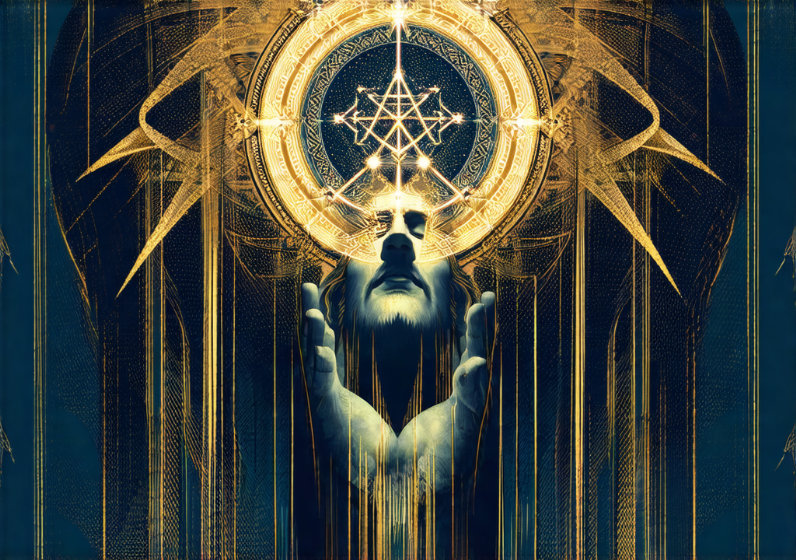
Shadow Work on the Left Hand Path—Why Integration Is Not Enough
The Unfinished Cathedral: Why the LHP Seeker Cannot Rely on the Light of Integration
Author: Elias Thorne, Curator of the Obsidian Library
There is a peculiar comfort that clings to those who practice shadow work within the esoteric traditions. It feels like a form of self-care. It feels like healing. It feels like tending to an internal garden where we pull out the weeds so the flowers can bloom. We speak in soft, warm tones about "embracing our darkness" and "making peace with our inner child." We treat the shadow as a shy animal that needs to be stroked until it stops biting us. We seek wholeness. We seek completeness. We seek to become a unified, coherent self—a single protagonist in the grand narrative of our own lives.
But on the Left Hand Path, this desire for cohesion is not just insufficient; it is a trap. It is the first step toward becoming a puppet who has mistaken its strings for his own will. To understand why integration is not enough—and indeed, why it can be actively dangerous—we must look past the therapeutic language of modern psychology and into the raw, cold, and magnificent machinery of the Left Hand Path (LHP). Here, shadow work is not about making friends with your demons. It is about recruiting them. Not about being whole, but about being complete in a way that defies wholeness. We are not building a house; we are constructing an unfinished cathedral where every crack lets in the cold wind of the void.
The Illusion of the Unified Self
The foundational premise of most mainstream psychological approaches to shadow work is that the self is essentially good, or at least capable of being made whole. The goal is harmony. The ego and the id should negotiate a treaty. The conscious mind and the unconscious mind should shake hands across the table. This is the Right Hand Path (RHP) view: we are fragments of a greater divine unity, and our job is to remember that oneness.
The LHP rejects this. In fact, the LHP views the very concept of an integrated self as a form of spiritual poverty. For the Left-Hander, the goal is not to become whole; it is to become unique. Not to be at peace with oneself, but to be different from everyone else. Integration implies that all parts of you belong together under one roof, speaking in unison. But what if your parts do not want to live in the same house? What if your shadow is actually a separate entity that merely shares your skin?
On the LHP, we do not seek to integrate our shadows so that they stop fighting us. We seek to understand them so that we can command them. Or better yet, so that we can be commanded by them in a way that forges our individuality into something rare and potent. Integration is a process of smoothing edges. The LHP seeks to sharpen them until they cut.
Consider the concept of the "True Self." In RHP spirituality, your True Self is often portrayed as your highest, most loving, most compassionate aspect. Your shadow is seen as repressed material that needs to be brought into the light to reveal its goodness. On the LHP, your "True Self" might be a tyrant, an artist of decay, or a lonely god who has abandoned the world and watches from behind glass. Your shadow isn't hiding your virtues; it is your virtue, because in the LHP, virtue is defined by your unique ability to carve out space for your own existence against the pressure of the collective norm.
Therefore, simple integration—merging the dark parts into the light so that everything shines with a soft, warm glow—is a dilution of power. It turns you into a generic human being. The LHP seeks alchemical gold, not beige comfort.
The Shadow as a Separate Being
In Jungian psychology, the shadow is often personified as a mirror image—the parts of us we disown. But in Left Hand Path esotericism, particularly in traditions drawing from thelema, ceremonial magic, and Gnostic thought, the shadow is treated less like a psychological residue and more like a tenant.
Imagine your psyche not as a single room, but as a mansion with many floors. You live on the first floor. The basement is dark, damp, and smells of old paper and forgotten promises. In traditional shadow work, you take a flashlight down there, clean up the mess, maybe throw out some broken chairs, and then close the door so the smell doesn't bother your guests. You have integrated the basement into your home. It's part of the house now.
On the LHP, you look at that basement and realize it has its own temperature. Its own gravity. The shadows down there are not just repressed memories; they are semi-autonomous forces. They have agendas. They want things you don't. They know things you've forgotten. And they can use you to get what they want if you don't maintain a clear, contractual relationship with them.
This changes the dynamic of shadow work entirely. You are not trying to be nice to your shadow. You are negotiating with it. You are establishing boundaries. You are asking: "What do you want? What are you protecting? Why did I banish you from my conscious awareness?" And sometimes, the answer is unsettling. Your shadow might be protecting a part of you that wants to succeed at the expense of others. It might be guarding a memory of betrayal so you never trust again. It might be holding onto an anger toward your parents that has calcified into a personality trait you call "independence."
Integration says: "Let's love this anger; it makes us strong."
LHP Shadow Work says: "This anger is a fortress. Who built it? Is the enemy still outside? If we open the gates for integration, does the enemy get in?"
We must interrogate our shadows not as children to be coddled, but as generals to be analyzed.
The Trap of Narrative Coherence
One of the greatest dangers of standard shadow work is that it demands narrative coherence. Humans are story-telling animals. We want our lives to make sense. We want a beginning, a middle, and an end. We want our pain to have a purpose. "I went through hell so I could help others." "My trauma made me empathetic."
This is the RHP view: suffering is a teacher; darkness is a chrysalis from which beauty emerges.
The LHP challenges this narrative arc. What if your shadow work reveals that you are not becoming more empathetic? What if it reveals that you are simply more selfish, more cold, or more detached than you thought? What if the "lesson" of your pain is just... pain? That life is indifferent and your suffering had no grander purpose than to shape your specific, unique crystal of selfhood?
On the LHP, we resist the urge to make our shadows serve a positive narrative. We allow them to be strange. We allow them to be contradictory. We allow for the fact that some parts of us are simply foreign objects embedded in our psyche. Integration tries to smooth these foreign objects into the wood grain of the self. The LHP keeps them sharp, visible, and distinct.
This leads to a state of creative dissonance. You become someone who can hold two opposing truths at once without collapsing into anxiety. You can be generous and stingy. Generous because you understand the value of connection; stingy because you know that giving everything away leaves nothing for your own work. In integrated psychology, this would be a contradiction to be resolved. In LHP practice, it is a feature. It is how you remain a unique entity in a world that wants you to conform.
Practical Methods: Interrogation Over Conversation
So, if we aren't doing "conversation with the shadow" as popular self-help books suggest, what are we actually doing? The methods of LHP shadow work are more structural, more architectural, and often more intimidating.
1. The Audit of Desires
Start by writing down your deepest desires—not the socially acceptable ones, but the raw, unfiltered ones. Do you want to be free from responsibility? Do you want to be seen as perfect? Do you want to control those around you? Do you want to disappear into anonymity?
In integrated shadow work, you might look at a desire for control and say, "Ah, this comes from my childhood insecurity; let's validate that need." In LHP work, you look at it and ask, "Is this desire part of my unique blueprint? Is this what I am here to do?" If the desire aligns with your unique path—your Logos—you keep it. You build a temple around it. You don't suppress it; you empower it.
2. The Map of Dissonance
Identify where your public self and private self disagree. Where do you smile when you want to scream? Where do you help people who drain your energy because you feel guilty saying no? These are the fault lines in your psychological geology.
Map these out visually. Create a two-column list. Column A: What I say/do. Column B: What I think/feel. The gap between them is where your shadow lives. Don't try to close the gap by changing what you do or what you feel. Instead, study the gap. Why does it exist? It exists because your ego needs it there to maintain a specific image of itself. On the LHP, we deconstruct that image. We peel back the layers of social performance to see the raw mechanism underneath.
3. Ritualizing the Boundary
Integration is passive; it happens in the therapy room or in meditation. LHP shadow work often requires active ritualization. You need to create boundaries between your conscious will and your unconscious drives. This can be done through simple magic: lighting a black candle for the shadow, writing down a "contract" with your inner demons, and burning it after reading it aloud.
This is not about superstition; it is about psychotechnology. You are using symbolic action to cement a new relationship with parts of yourself that have been treated as enemies or children. You are telling them: "You are part of my machine. You serve the goal of my individualization, but you do not run the show."
4. The Practice of Uniqueness
Perhaps the most important practical aspect of LHP shadow work is the practice of uniqueness itself. How? By doing things that feel slightly uncomfortable because they don't fit the "integrated" narrative. If your integrated self wants to be kind, challenge it by being strategically distant. If your integrated self wants to be humble, practice a form of pride that feels a bit arrogant but feels authentic to your soul.
You are curating a museum of your own psyche. You decide which artifacts go on display and which stay in the vaults. Integration puts everything under glass for public viewing. The LHP keeps some things hidden, sacred, and personal.
Why Wholeness is a Right Hand Path Concept
To fully grasp why integration is not enough, we must understand what "wholeness" actually means in an esoteric context.
In the RHP, wholeness is synonymous with enlightenment or salvation. You are complete when you have aligned with the divine will. Your shadow has been reconciled with your light. There is no internal war; there is only peace. This is a beautiful state for those who seek comfort and connection. It makes you easy to be around. It makes you part of the hive mind, because everyone's "whole" self is essentially the same: loving, peaceful, compassionate.
On the LHP, wholeness is a death sentence. If your shadow is fully integrated, you are predictable. You are average. You have lost the friction that generates heat and light. Friction comes from the tension between your light and your dark, your will and your desire, your logic and your passion.
The LHP seeks "completion" in a different sense. A completed machine works perfectly. Every gear turns in sync. But an integrated self is like a perfectly oiled engine that goes nowhere because it has no destination other than to keep running smoothly. The LHP seeker wants the engine to be powerful enough to break through barriers, even if it means some parts are grinding against each other.
We want to be complex, not just complete. We want to be interesting, not just peaceful. And in a world that is increasingly flattened by social media algorithms and cultural norms, being "whole" is the same as being invisible. To stand out, you need edges. You need shadows that cast long, dramatic shapes on the wall of reality.
The Risk of Projection vs. Absorption
There is another subtle danger in LHP shadow work: the line between projecting your shadow onto others and absorbing it into your own identity.
In integrated psychology, we are often warned not to project our shadows—don't blame your boss for the anger you feel toward your father. In LHP practice, projection is a tool. We use it strategically. We know that other people will reflect our shadows back to us. And sometimes, on the LHP, we lean into that. If you are naturally suspicious of others, you don't just "integrate" that suspicion by trusting more people (which might feel fake). You acknowledge your trust issues and build systems—rituals, codes of conduct, relational boundaries—that allow you to work with others while maintaining your natural wariness.
You become a strategist rather than a peacemaker. This is the LHP approach: use your shadow as an asset. If you are naturally jealous, study jealousy until it becomes insight into what you value. If you are naturally proud, build a persona of such elegance that people want to be in your presence. You aren't faking; you're amplifying.
This is where the creative power lies. The LHP artist uses their shadow as fuel for creation. They write the novel they can't read because it's too personal. They paint the painting that looks like a cry for help but is actually a declaration of war. They compose music that makes people feel uncomfortable because it reveals truths about human nature that integrated society prefers to ignore.
The Long Road: Shadow Work as a Lifestyle
Finally, we must acknowledge that LHP shadow work is not a project with an end date. You don't "finish" your shadow work and then move on to the next life goal. It is a lifelong practice of curation. As you grow, new shadows emerge. As you age, old shadows transform. The person you were at 25 had different shadows than the person you are at 40.
On the RHP, this might be seen as a regression or a lack of progress. "Why can't I stay in that peaceful state?" On the LHP, it is simply the next layer of the labyrinth. You keep digging. You keep uncovering new rooms in your psychological mansion. And each room reveals something new about who you are and how you intend to inhabit this world.
It is a lonelier path than integration. There is no guarantee that your shadows will love you back. They might not understand your need for control or uniqueness. They might resist your attempts to harness them. But the relationship between an LHP practitioner and their shadow is less like parent and child, or friend and friend. It is more like artist and muse, or general and army. There is respect. There is strategy. And there is a shared goal: not happiness, but significance.
The Unfinished Cathedral
Let us return to our metaphor of the cathedral. An integrated self is a finished chapel: clean, bright, smelling of incense, designed for comfort. You sit in the pews and feel at peace.
An LHP shadow-worked self is an unfinished cathedral under construction or perhaps even in beautiful ruin. The roof has collapsed in places, letting in the stars and the rain. The floor is uneven, requiring you to walk with balance and awareness. There are broken statues that you leave as they are, because their brokenness tells a story. There are dark corners where light doesn't reach, but you know what lives there, and you don't fear it.
This is the aesthetic of the LHP: Sublime Ruin. It is beautiful not despite its imperfections, but because of them. The cracks let in the light. The brokenness proves that something happened here. That life was lived with intensity. That nothing was smoothed over for the sake of comfort.
When you practice shadow work on the Left Hand Path, you are not trying to make yourself whole. You are trying to make yourself real. And real things are often jagged, contradictory, and a little bit scary. They don't fit neatly into boxes or narratives. They resist easy definition.
And that resistance? That is your power. It is the signature of your unique soul, pressed in wax on the letter of your life. So do not settle for the soft light of integration. Go down to the basement. Light a black candle. Look at the shadows that are waiting for you there. Do not stroke them. Do not coddle them. Ask them who they serve. And if the answer is not you, decide whether to evict them or give them a room with a view of your highest aspirations.
Build your unfinished cathedral. Keep the doors open to the wind. Let the cold in. It keeps you awake. It keeps you unique. And in a world full of comfortable, integrated ghosts, being awake and unique is the greatest act of rebellion—and creation—available to us.