One Word from the Grave Can Change Your Life Forever
One Word from the Grave Can Change Your Life Forever
By Orville Ashcroft
There is a peculiar silence that belongs only to the dead. It is not the absence of sound, for even in the deepest catacombs, stone breathes and earth shifts with the slow pulse of tectonic memory. The silence of the grave is a living thing—a velvet curtain drawn across the stage of existence, muffling the roar of traffic, the hum of electricity, and the ceaseless chatter of the human mind. To stand at the edge of this silence, to lean forward into its embrace, is to understand that death is not an ending but a threshold. And on the other side of that threshold, there exists a single word—a single syllable—carried on the cold breath of the departed, capable of unraveling the fabric of your present life and weaving it anew.
This is not poetry. This is necromancy in its purest, most elemental form. Not the theatrical summoning of skeletons or the rousing of ancient kings for political gain, but the quiet, intimate art of listening to what the dead wish to say. And when they speak that one word—remember, forgive, stay, go—it does not merely land in your ear. It lands in the marrow. It rewrites your biography. It turns a stranger into a kinship you never knew you had.
The Architecture of Listening
Necromancy is often misunderstood as a dialogue, but true practice knows it to be an architecture of listening. We build our lives on assumptions. We assume we know why we are here, what we want, who we were before the accident or the loss that broke us open. The dead do not confirm these assumptions. They correct them. And the correction is often a single word.
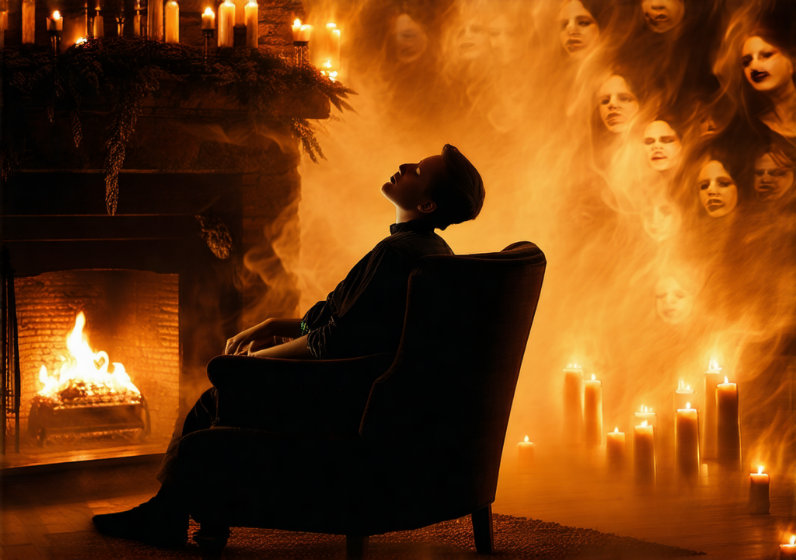
Consider the ritual of Auscultatio Mortuorum—the listening to the dead. In classical practice, this begins in darkness. Not the absence of light, but the presence of shadow so complete that the eye surrenders and the ear awakens. You sit before the grave—whether it be a stone marker, an urn, or simply the patch of earth where your ancestor slept—and you do not speak. To speak is to project, and projection is the enemy of reception. You close your mouth. You still your breathing until your own respiration becomes a faint rhythm against the silence. And then you wait.
The word does not come in sound at first. It comes as pressure—a subtle shift in the air, a warmth on the back of your neck that has no source, a single tear falling without sorrow or joy. The dead communicate through somatic memory. They speak to the body because the body is the only text they can write upon. Your shoulders remember a posture you abandoned twenty years ago. Your hands remember a gesture—offering bread, holding a child, signing a document—that defined your family’s history in ways your conscious mind has filed away or forgotten.
The word arrives as a correction to that memory. And when it lands, something shifts. A door opens that you didn’t know was closed. A room is revealed that you hadn’t entered. Your life continues, but its geometry has changed. The angles are different. You walk the same streets, but they look like new country.
The Word That Unbinds
Let us speak of forgive. It is not a word the living say lightly. We forgive in sentences: “I forgive you for what happened,” or “I’ve decided to forgive.” These are negotiations, compromises with our own pain. But when the dead whisper forgive, it is not a request. It is an instruction. And the instruction carries the weight of the grave behind it—finality, permanence, the unarguable authority of those who can no longer argue back.
A woman in Lyon came to me three years ago with a question that had consumed her for eleven years. Her brother had died in a car accident when she was nineteen. She had been driving; he had been the passenger. The police report was clear: it was an accident, no fault assigned. But she could not shake the feeling that she had caused it—that if she had looked up from her phone just half a second sooner, he would be alive and she would have lost him to some lesser tragedy like a bad marriage or a mediocre career. She had built her entire life on this self-accusation. A careful woman. Unmarried. A librarian. A life of quiet precision that she told me was “safe.”
I asked her to sit with his grave for an hour each evening for three nights, saying nothing, asking nothing. On the fourth morning, she came to my study and said: “He whispered forgive. Not to someone else. To me. And not just the accident—my life. He’s telling me I don’t owe anyone a safe, small life. I was supposed to live large.”
She left Lyon six months later. She teaches in Lisbon now. She married a composer. Her book of short stories is due next spring. The word forgive did not erase the accident. It unbound her from the story she had written about it—and in that unbinding, a new story became possible.
The Word That Binds
Not all words are liberating. Some are chains, and some chains are gifts. Stay is one of them.
In the old necromantic texts, we speak of vinculum animae—the binding of the soul. Not a physical chain, but a narrative one. When the dead say stay, they are asking you to remain in a role, a place, a relationship that your living self might wish to leave. A daughter who wants to move to a distant city hears stay from her mother’s grave and cannot explain why she has signed a three-year lease on the family house. A man who dreams of a second career hears stay from his father’s plot and returns to the family business he had sworn never to join.
This is not always comforting. Sometimes stay is a word spoken by someone who no longer exists, reaching across the threshold with an old hand on your shoulder. And you feel the weight of that hand—the specific pressure, the particular warmth—and you think: Yes. I will stay. Not because it makes sense, but because the dead do not have to make sense. They have already made their decisions. You are simply living in the wake of them.
And this is where necromancy becomes a profound act of love and a quiet act of surrender. To hear stay from someone who cannot speak any other way—to accept that word as truth, even when your heart wants otherwise—is to honor the dead’s desire over your own comfort. It is to say: “Your wish still shapes my life. You are not erased by your absence.”
The Word That Opens
And then there is open. Perhaps the most dangerous of all single words from the grave, because it asks you to do what the living are often too afraid to do. To open a letter you never intended to read. To open the door to the room in the house where your grandmother kept her secrets. To open your mouth and tell someone the truth about who you were when they died.
A poet in Prague told me that his grandfather’s grave had whispered open for six months before he understood it was directed at a locked drawer in his attic. Inside: forty years of unpublished letters to a woman who had become his mother-in-law. Letters full of a tenderness and intellectual passion that the family had never discussed. The poet published them under a pseudonym. His mother-in-law read the book and wept for an hour, saying it was “the most honest thing my father ever wrote.”
The word open does not promise comfort. It promises revelation. And revelation, in the tradition of necromancy, is the raw material from which new life is built. You cannot create a future on top of a closed door. You must open it, look inside, and decide what to do with what you find. The dead have already decided. They simply want you to see.
The Craft of Receiving
How does one learn to receive these words? It requires discipline, yes—but not the rigid discipline of scholarship or industry. It is a softer craft, closer to meditation than to performance. Here are the principles I teach my students:
Stillness before sound. You cannot hear a whisper in a noisy room. The mind must be quieted, the sensory input reduced. This means physical space—solitude, darkness, a location associated with the deceased if possible. It also means mental space—releasing the day’s concerns, letting go of the conversation you’re rehearsing for tomorrow. You are not asking the dead to perform for you. You are inviting them into your silence and trusting that they will fill it.
Patience over urgency. The word may come on the first sitting or the fiftieth. Do not force it. Forcing is a form of speaking, and speaking is what we have temporarily set aside. Trust that if the dead wish to say something, they will find the frequency on which your soul receives it.
Embodiment over interpretation. When you feel the word—whether as pressure, warmth, tear, or simple knowing—do not rush to analyze it. Sit with the sensation. Let your body register what has been communicated before your mind tries to translate it into a narrative. The body knows things the mind has forgotten. Trust that knowledge.
Gratitude over gratitude. This is perhaps the most important principle. When you receive the word, thank them. Not in words—though words are fine—but in the stillness of your presence. Your continued attention after they have spoken is a form of gratitude. It says: “I heard you. I will carry this forward.”
The Life After the Word
Here is what no one tells you about hearing a word from the dead: it does not fix everything. It does not answer every question or solve every problem in your life. What it does is give you an anchor—a single point of clarity in the fog of living. And that anchor changes how you move through the world.
A teacher in Kyoto told me her father’s grave had whispered begin. She had been teaching for twenty years, comfortable but unfulfilled. After that word, she began a research project on ancient Japanese poetry that became a book and then a professorship at another university. The word did not give her the career or the book. It gave her the courage to begin—and beginning is where all change starts.
A chef in Marseille heard taste from his mother’s grave. He had been cooking for decades, excellent but safe. After that word, he began experimenting with fermentation—wild ferments, ancient techniques, flavors he had never dared to pursue. His restaurant changed. Diners travel from other countries now. The word did not teach him to ferment. It reminded him of a child’s memory: his mother, in their kitchen, pressing her nose into a jar of sauerkraut and laughing at the smell. He remembered that joy. And from that memory, new flavor was born.
These are not miracles. They are corrections. The dead see your life with the clarity of distance—and they can tell you what you have forgotten or suppressed. One word is all it takes to remind you who you were before you forgot.
The Ethics of Hearing
Not everyone should practice this craft, and some words are best left unhearsed. There are relationships where the dead speak more clearly than the living did while alive—a mother who was cold in life but warm in death; a father who said I love you for the first time after his funeral. These revelations can be healing or they can be destabilizing. Sometimes it is kinder to let the silence stand, to honor the dead as they were rather than as they might have wished to be remembered.
There are also words that are not meant for you. In the old texts, we speak of vox aliena—the foreign voice. When you hear a word and your body resists it—shoulders tight, jaw clenched, a small cold in the chest—that is a sign the word belongs to someone else. The dead sometimes cross-speak, reaching out to relatives or friends who were present at their death but not attending your sitting. You are hearing through them, not from them. Recognize this and do not claim the word as yours.
Necromancy, in its truest form, is an act of humility. You are not commanding spirits or extracting secrets. You are opening a door and letting the dead decide whether to step through. And when they do—when that single word crosses the threshold into your life—you receive it with the same gratitude you would receive a letter from a beloved friend who has passed. It is a gift. Treat it as such.
The Silence After
And finally, there is the silence after the word. This is where the work begins. You do not live in the moment of hearing. You live in the days and months that follow—carrying that single syllable through your decisions, your relationships, your quiet mornings and busy evenings. The word does not change your life in a dramatic instant. It changes it slowly, like water changing stone. A door you open because someone whispered open. A city you leave because someone said go. A book you write because someone told you to begin.
One word from the grave is a small thing and an infinite thing at once. Small because it is one syllable. Infinite because it carries the full weight of a life lived, a history buried, a love that outlasts the body that held it. And in that carrying—in that quiet, daily act of remembering what the dead asked you to do—your life becomes a collaboration between the living and the dead. You are no longer walking alone. You are walking with them, guided by their last and most important word.
And perhaps that is what necromancy truly is: not the calling back of the dead, but the calling forward of the living, shaped by those who came before. One word. That’s all it takes.
— Orville Ashcroft, Keeper of the Quiet Threshold