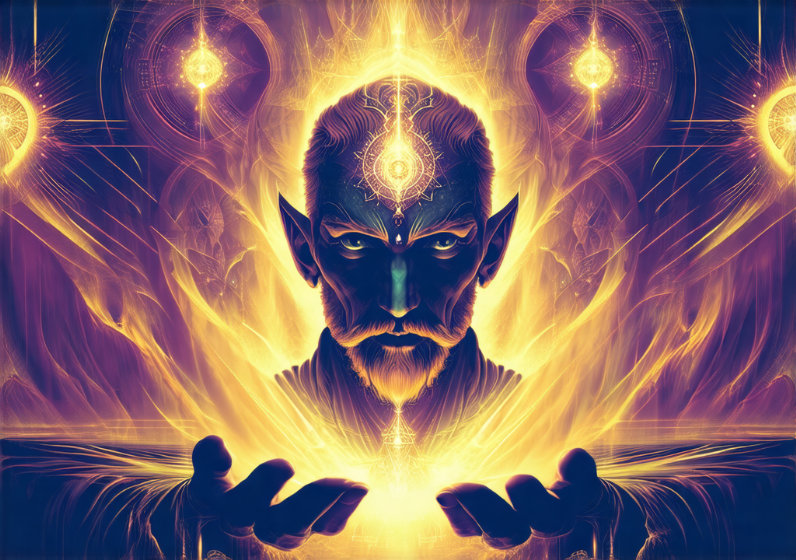
One Mirror, One Candle, One Truth: The Simplest Thaumaturgic Rite Known
One Mirror, One Candle, One Truth: The Simplest Thaumaturgic Rite Known
By Aldric Vane, Keeper of the Silver Flame
In the grand and sprawling library of Thaumaturgy, where scrolls whisper in forgotten tongues and where incantations hang heavy in the air like visible smoke, there exists a paradox. We spend our years seeking complexity. We chase rare essences, chart celestial alignments to the minute, and construct elaborate circles of salt and silver wire. We believe that because magic is vast, it must be difficult. We believe that to move the fabric of reality, one needs the weight of centuries, the precision of a master artisan, and the wealth of a minor prince. And in this belief, we have lost something essential. We have forgotten the simplest rite known to our craft.
This is not a spell for turning lead into gold, nor is it a working that can move mountains or summon legions of spirits from the Aether. It does not require a temple, a congregation, or even a particularly grand mood. It requires only three things: one mirror, one candle, and one truth.
To the uninitiated observer, this rite appears almost trivial. To sit before a reflective surface, light a single flame, and speak a truth—it seems like something one might do while waiting for tea to steep or while contemplating a breakup. But within the quiet, still center of this triad lies the most fundamental mechanism of Thaumaturgy: the synchronization of the internal self with the external world through the lens of perception.
Let us unpack these three elements, not as mere objects, but as pillars of metaphysical architecture.
The Mirror: The Threshold Between Selves
In most schools of magic, a mirror is treated as a window into other planes of existence. We speak of "glass doors," of peering into the Aether, or of trapping spirits behind silvered glass. And these are valid applications. But in our simplest rite, the mirror serves a different and perhaps more vital purpose: it is a witness.
A mirror does not merely reflect light; it reflects identity. When you stand before a mirror, you are confronted with your own image. You see yourself as others might see you—or at least, how you imagine they see you. In Thaumaturgy, perception is power. The mind shapes reality through belief and focus. If there is a dissonance between who you are internally and how you perceive yourself externally, that dissonance creates a metaphysical drag on your willpower.
The mirror in this rite acts as an anchor for the ego. It forces the practitioner to look at themselves without the excuse of distraction or movement. You cannot hide behind a gesture or a movement when there is only stillness and reflection. The mirror strips away performance. When you stand before it, you are not acting; you are being.
There is also the ancient notion that mirrors can "drink" light. In our rite, we use this property subtly. As you look into the glass, you are inviting your own essence to settle. You are asking the mirror to hold your image steady while you explore the shifting landscape of your own mind. If you have been feeling scattered, if your will has been fractured by doubt or anxiety, the mirror provides a static point around which that scattering can be gathered. It is the first step in gathering the loose threads of the self into a single, coherent strand of power.
The Candle: The Breath of Clarity
If the mirror represents the eye and the ego, the candle represents the breath and the spirit. Fire is one of the four classical elements most intimately associated with Thaumaturgy because it is transformative. It consumes matter and produces light. It destroys the old to reveal the new. In our simplest rite, the candle does not burn down a barrier or fuel an explosion; it illuminates the space between you and your truth.
There is a reason this rite requires only one candle. Multiple candles create a field of scattered light. They compete for attention. One candle creates a single point of focus. It becomes a lighthouse in the fog of the mundane world. When the room darkens and that single flame flickers before you, your peripheral vision narrows. The noise of the day falls away. You are left with the warm, golden glow and the quiet rhythm of the wax melting.
The candle is also a symbol of sincerity. In ancient rites, we burned offerings to show our devotion was real; the sacrifice of good things proved that our words were not cheap. Here, you do not burn an offering, but you do offer your attention. You offer the time it takes for the wick to char and the wax to pool. This small, tangible cost signals to your own subconscious—and to any ambient spirits or energies present—that this moment is important. It is not a casual glance; it is a dedication of energy.
Furthermore, the candle's light interacts with the mirror in a beautiful way. The flame reflects back at you, doubling the presence of the light. This creates a subtle feedback loop: you are illuminated by your own spirit (the candle) and reflected back to yourself through the lens of perception (the mirror). It is a closed circuit of self-awareness. In Thaumaturgy, we speak of "closing the circle" to contain power. Here, you are closing the circle within yourself.
The Truth: The Incantation
This is where many would expect a complex formula. A string of archaic words? A geometric pattern drawn in salt? A specific harmonic tone sustained for seven minutes? In our simplest rite, the incantation is simply... a truth. And not just any truth. It must be your truth. The specific truth that has been weighing on your soul or the one you have been avoiding.
In Thaumaturgy, words are more than sounds; they are frequencies that vibrate the ether. When we speak an incantation, we are essentially tuning the surrounding reality to match our intention. But for this rite to work, the truth must be resonant with your own core frequency. It cannot be a platitude or a wishful thinking statement. "I will be successful" is not a truth if you are currently struggling; it is a hope. And while hope is powerful, it is distinct from truth. Truth carries weight because it has already happened in the realm of thought and feeling.
So, what might this truth look like?
"I am ready to let go of this grudge."
"My fear of failure is holding me back from starting my business."
"I need to be kinder to myself when I make mistakes."
"I forgive myself for not being perfect in that project last year."
The beauty of using a truth as the incantation is its inevitability. You cannot argue with it. Your subconscious mind knows it is true. When you speak it, you are not trying to convince your mind; you are confirming what already exists. This confirmation creates a resonance that amplifies your willpower. It aligns your conscious desire (to change, to heal, to move forward) with your unconscious knowledge (that the need for this change is real and valid).
The Rite: A Step-by-Step Guide
Let us walk through the rite as it should be performed. Remember, simplicity is not laziness; it is precision.
1. Preparation of Space:
Find a quiet place where you will not be disturbed. You do not need a dedicated altar or a temple. A kitchen counter, a desk, or a bedside table will suffice. Ensure the surface is clean. Clear away clutter. Clutter is visual noise; it scatters your focus.
2. Arrangement:
Place the candle on one side of the mirror (or in front of it, depending on the layout). The mirror should be stable and positioned so you can see both your face and the flame. The candle should be at a height where you can look into the mirror and still see the light reflecting off the glass.
3. Lighting:
Light the candle. Take three deep breaths. As you breathe in, imagine drawing in the ambient noise of the day. As you breathe out, release it into the flame. Let the fire consume your distractions.
4. Staring:
Step back so that you can see your entire face and the candle's reflection in the mirror. Do not fidget. Keep your hands still or resting on a table. Look at yourself. Really look. Notice the details: the lines around your eyes, the color of your skin, the state of your hair. Ground yourself in this physical reality.
5. The Truth:
Identify the single truth you need to acknowledge. It might be painful. It might be simple. Hold it in your mind for a moment. Feel its weight. Then, in a clear and steady voice, speak that truth aloud. Do not whisper; do not shout. Speak with the tone of someone stating a fact. "I am tired." "I need rest." "I have made a mistake."
6. The Resonance:
After speaking, remain still for about sixty seconds. Watch the candle's reflection in the mirror. Feel the warmth of your own voice hanging in the air. Let the truth settle into the space between you and the glass. You are not trying to change the mirror; you are allowing the mirror to show you that this truth is part of you, and therefore, it is real.
7. The Closing:
When you feel a sense of settling or peace (or perhaps even a gentle ache of clarity), blow out the candle gently. Do not extinguish it with water or your hands; use your breath. This symbolizes that your intention has been breathed into the world and is now sustained by your spirit, not just the flame.
8. The Aftermath:
Do not rush to clean up immediately. Sit for a few minutes. Notice how you feel compared to when you started. You may feel lighter, or perhaps heavier but more honest. Both are good outcomes. Truth is often heavy until it becomes foundational.
Why This Rite Works: The Metaphysics of Simplicity
Why does such a simple sequence hold so much power? It works because it bypasses the intellect and speaks directly to the subconscious. Most complex rituals require active mental engagement—you have to remember steps, visualize geometries, maintain specific rhythms. If your mind wanders, the rite weakens. In our simplest rite, there is nothing to "do" except be present. The mirror holds you in place; the candle holds your attention; the truth gives your presence a direction.
There is also an element of humility here. Thaumaturgy is often associated with mastery and control. We like to feel like we are pulling levers, moving celestial bodies, commanding spirits. But this rite reminds us that magic begins with a human being standing in front of their own reflection, admitting what they know about themselves. It is the foundation upon which all other works are built. You cannot master external forces if you have not first mastered the simple act of seeing yourself clearly.
Furthermore, this rite creates a "memory anchor." Because it requires so few items and no complex memorization, it can be performed anywhere at any time. A practitioner might find themselves in a hotel room with a bathroom mirror and a match (or a light if a candle is not available), and they can perform the core of the rite: look, breathe, speak truth. The simplicity makes it portable. And because it is easy to remember, it becomes habitual. Over time, you are constantly aligning your perception with your truth. You are practicing self-awareness until it becomes second nature.
Common Misconceptions and Pitfalls
"I need a special mirror."
No. Any reflective surface will do. A polished metal tray, a calm pool of water (though less stable), or even the screen of a tablet can serve in a pinch. The key is that it reflects your image back to you with clarity enough for you to see yourself.
"I need a specific type of candle."
Any clean-burning candle will work. You do not need beeswax, though it may feel more traditional. You do not need a scented candle, as the scent might distract from the truth. A simple, unscented pillar or votive is ideal.
"I have to say something dramatic."
No. The truth can be small. "My tea is cold and I am thirsty." This is a truth. Acknowledging it connects you to your physical needs. In Thaumaturgy, the body is part of the self. Neglecting simple truths about your body weakens your overall power.
"It didn't feel magical."
Good. If it felt like magic—sparks flying, voices speaking, room shaking—you might be over-performing or expecting too much. The simplest rite should feel like a quiet confirmation of reality. It is not a spectacle; it is an alignment.
Expanding on the Rite
Once you have mastered the simplest form, you can explore variations that deepen the work while maintaining its core simplicity.
The Color of Truth:
Some practitioners find it helpful to match the color of the candle to the nature of the truth. A white candle for purity or new beginnings; a red candle for passion, anger, or healing; a blue candle for calm, communication, or spiritual clarity. This adds a layer of symbolic resonance without adding complexity.
The Question:
Instead of stating a statement of fact, you can use the rite to ask yourself a question and listen for the answer in the reflection. "Am I on the right path?" Look into the mirror. Do not look for a face changing or a ghost appearing. Instead, notice your own micro-expressions. Is there a tightening around the eyes? A softening of the jaw? Your body often knows the answer before your mind does. The mirror helps you read that bodily language.
The Companion Rite:
If you are in a relationship, you can perform this rite together. Stand on either side of the mirror (or face each other with the candle between you). Take turns speaking your truths. It is a powerful way to build trust and alignment in a partnership. You are essentially syncing your internal truth with another person's perception of you.
The Philosophical Core
At its heart, "One Mirror, One Candle, One Truth" is a meditation on authenticity. In a world that encourages us to curate our images—on social media, at work, in society—we spend so much time constructing a version of ourselves that others find acceptable or impressive. This rite strips away the curation. You are not performing for an audience; you are reflecting on your own existence. The mirror shows you what is there. The candle illuminates it. And the truth is simply acknowledging what you see.
This is the foundation of all Thaumaturgy. Before you can shape reality, you must understand yourself. Before you can command spirits, you must command your own mind. Before you can heal others, you must be willing to look at your own wounds and speak them into the light.
So, I invite you to try this rite. Find a mirror. Light a candle. Sit in silence for a moment. And then, speak one truth about yourself. Let it hang in the air. Let the flame reflect back to you. Let the glass show you who you are right now, in this moment, with all your imperfections and strengths laid bare.
You do not need to be a master of the arcane arts to perform this rite. You only need to be human. And if you can look at yourself without judgment or distortion, you have already done the hardest part of magic: seeing clearly.
May your reflections be clear,
Master Aldric Vane