Master Astral Projection With These Proven Steps
☾ The Seven Veils of the Silver Cord ☽
✦ A Practical Codex for the Modern Projector ✧
Author: Brother Cassiel Voss, Keeper of the Nocturnal Ledger
There is a particular quality to silence that only those who have walked beyond their own skin truly understand. It is not the absence of sound; it is the presence of a vastness so complete that the mind, for a fleeting moment, stops constructing reality and begins simply perceiving it. For centuries, mystics, monks, and seekers have spoken of this state—a liberation from the flesh, a wandering through the luminous landscapes of the subtle body, a reunion with the pure essence of self that most people only glimpse in dreams or near-death experiences. It is not magic, though it carries the same weight of wonder. It is not merely imagination, though the mind must be trained to believe in its own capacity for transcendence. Astral projection, as we will explore here, is a physiological and spiritual process so ancient that its roots are woven into the very fabric of human consciousness. And like any ancient art, it demands respect, patience, and above all, discipline.
Welcome, seeker, to this codex. You have come here not for fantasy, but for function. Not for escapism, but for expansion. The goal is simple in statement but profound in execution: to teach you how to separate your consciousness from its physical anchor and travel through the astral plane with clarity, control, and return without loss of memory or coherence. This is not a journey for the faint of heart. It requires you to unlearn everything you have been taught about the limits of the self. You will need to quiet the noise, master your body, stabilize your mind, and trust in the invisible architecture that already exists within you. The steps laid out below are proven not by laboratories or peer-reviewed journals—though modern neuroscience increasingly supports what the ancients knew—but by generations of practitioners who have walked this path before you and found it real, tangible, and transformative.
Let us begin at the foundation, for even the grandest cathedral is built upon a single stone. And that first stone is understanding exactly what we are trying to do and why it works.
I. The Architecture of the Astral Self
Before you can project, you must understand what projects. Most people assume the soul or spirit is some gaseous, ethereal thing that leaves the body like steam from a kettle. This is a charming image but an incomplete one. In the tradition I teach—drawing from Hermetic, Theosophical, and Vasiyogic sources—the astral self is not separate from you. It is you, stripped of the physical filter. Your consciousness is not housed in your brain; it uses your brain the way a pilot uses a cockpit. When you project, you are not leaving your mind; you are moving to a different instrument.
The body you inhabit—flesh, bone, blood, breath—is what we call the vehicle or the lower shell. It is dense, slow, bound by gravity and time in a linear fashion. The astral self operates on a subtler frequency. Think of it this way: your physical body is a radio receiver tuned to one station; your mind is another; your emotions are another still. The astral plane exists on all these frequencies simultaneously but primarily on the mental-emotional spectrum. When you project, you shift your primary resonance from the physical band to the subtle band. Your body remains in bed, in a state of deep sleep or near-death relaxation, while your consciousness—your "I am"—moves freely through the landscape of thought and energy that surrounds all living things.
This is not metaphor. It is mechanics. Just as light can be bent by gravity without the light ceasing to be light, so too can consciousness operate outside the constraints of matter without ceasing to be conscious. The silver cord—a term borrowed from the Book of Ecclesiates—refers to that invisible tether that connects your projected self back to your physical body. As long as the cord is intact, you can return. If it breaks before you are ready, you become a free spirit, wandering without anchor. Some traditions consider this a blessing; others consider it a tragedy. We aim for neither. We aim for controlled projection with full recall and stable return.
Understanding this architecture gives you confidence. You are not inventing a ghost. You are tuning yourself to a frequency that has always been there, broadcasting constantly, waiting for your attention. The work you do from here on out is not about creating something new. It is about removing the interference that prevents you from hearing what is already being said.
II. Preparing the Temple Within: Body and Environment
Astral projection does not begin when you close your eyes to leave; it begins long before, in how you live your body and shape your space. The physical vessel must be relaxed enough to release control but alert enough to remain coherent. This balance is delicate. If your body is too tense, the mind cannot detach. If it is too loose—too sleepy—you may fall into ordinary sleep instead of projection. The goal is a state we call hypnagogic: that shimmering border between waking and sleeping where images, sounds, and sensations float freely without narrative structure.
Start with your environment. Your practice space should be quiet, dark, and free from sudden disturbances. You do not need a monastery; you need consistency. Choose one place—a bed, a cushion on the floor, a chair—and use it for projection work. Let your subconscious associate that spot with the intention of release. Keep the room cool; cold promotes muscle relaxation while heat invites drowsiness that can carry you into dream sleep. Use soft lighting or darkness—never bright lights, which stimulate the retinal cells and pull attention outward instead of inward.
Now turn to your body. Before you begin a session, attend to physical needs. Empty your bladder. Loosen any tight clothing. If you have eaten recently, wait at least two hours; digestion draws blood and energy to the gut, pulling awareness away from the subtle centers. Some practitioners fast for several days before intensive projection work; others find that light meals of fruits or nuts are sufficient. Experiment until you find what works for your constitution.
Then comes relaxation. This is not passive lying down. This is active release. Begin at your toes and work upward, systematically unclenching each muscle group. Imagine a warm light flowing from your crown to your feet, dissolving tension like sunlight melting frost. Hold this state without forcing it. Do not try to relax harder; that only creates more tension. Let go. Surrender control. Your body is capable of resting on its own once you stop micromanaging it.
This preparation may take ten minutes or an hour. Be patient. The quality of your relaxation determines the quality of your projection. A rushed body produces a shaky mind. A settled body produces a steady spirit.
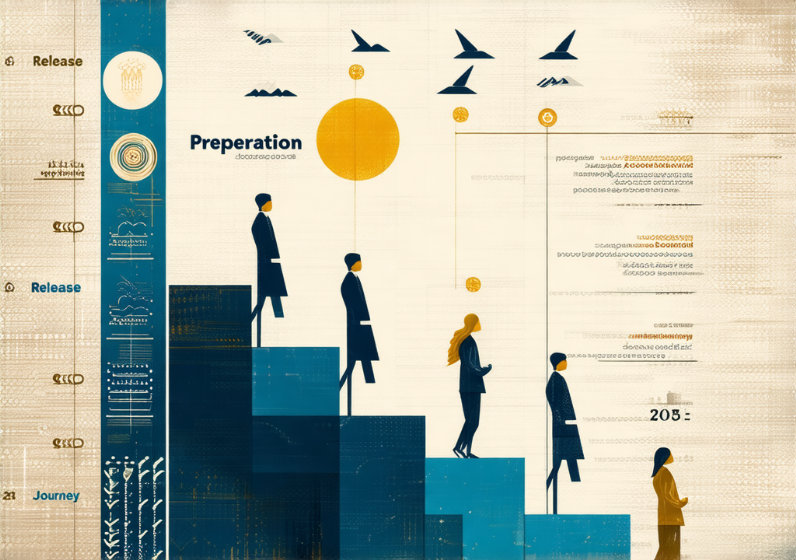
III. The Ladder to Liberation: A Step-by-Step Methodology
Here is where we move from theory to practice. What follows is a structured sequence, refined over decades by practitioners across traditions. Each step builds on the last. Do not skip ahead. Mastery of one stage enables mastery of the next. Attempting to leap from relaxation to full projection without training the intermediate states is like trying to run before you can walk; you will fall and lose confidence.
Step One: Stabilize the Breath
Once your body has settled into deep relaxation, turn attention to the breath. Do not count it. Do not control its depth or pace. Simply observe it. Feel the cool air entering your nostrils, the expansion of your ribs, the gentle deflation as you exhale. Your goal is not to change your breathing; it is to anchor awareness in a rhythmic, natural process. The breath is the bridge between body and mind. When your attention rests on it, the mental chatter begins to thin. You are no longer lost in thought; you are present in sensation.
Stay here for as long as needed—five minutes, twenty minutes, an hour. There is no timer that matters except your own readiness. You will know when you are ready because a subtle shift occurs: the breath seems to fade into the background, and awareness expands beyond the nostrils. The body becomes less real; not gone, but secondary. A faint hum may arise in the ears—a vibration like distant thunder or a low-frequency tone. This is a sign that your nervous system is shifting from sympathetic (active) to parasympathetic (restorative). You are entering the threshold.
Step Two: Isolate the Body-Mind Boundary
Now comes the critical moment of separation. While maintaining awareness, begin to lift attention away from physical sensation and toward inner perception. Imagine your consciousness as a point of light at the center of your chest—your heart center, or what yogis call the anahata chakra. From this point, radiate awareness outward. Do not look with eyes; perceive with mind. Sense the boundaries of your body: where skin meets air, where bone ends and void begins.
Then do something counterintuitive: try to feel the space just beyond your skin. Not on it—beyond it. A centimeter outside. Then ten centimeters. Then a meter. You are mapping the field around you without moving a muscle. This exercise trains the mind to operate in three dimensions of subtle perception rather than two dimensions of surface contact. Most people stop at the skin. You need to move past it.
As you do this, you may feel a tingling, a buzzing, or a sense of lightness in your limbs. Some practitioners experience a full-body vibration—a deep hum that seems to come from everywhere and nowhere. This is good. It indicates that energy is redistributing away from the physical system and into the subtle body. Do not chase these sensations; let them wash over you like waves. Your job is to remain centered, still, and aware of the expansion happening around your point of light.
Step Three: Detach the Vehicle
This is the step most beginners struggle with. You need to convince your mind that you can be separate from your body. And not just intellectually—experientially. Here is a classic technique called the roll-off method. While lying in bed, fully relaxed and aware, imagine your consciousness lifting slightly above your physical form. Not moving away—just hovering, like a leaf resting on still water. Then, imagine yourself rolling slowly to one side. You are not rolling your body; you are rolling your awareness around it. Feel the subtle weight of detachment.
As you "roll," begin to pull yourself gently upward and away from the bed. Do this in slow motion, as if moving through thick honey. Your physical body remains still on the mattress. Your consciousness is peeling off like a transparent film. You may feel a slight resistance—a sticky quality—as though an invisible thread tethers you to your chest. This is the silver cord forming or tightening. Let it stretch. Do not yank. Trust that the connection will hold.
Continue pulling until you sense that you are floating above your body, perhaps two feet or five. You can look down and see yourself lying in bed, small and still. Your "self" is now separate. This moment of dual perception—seeing yourself while being yourself—is one of the most profound experiences a human consciousness can have. It rewrites your understanding of identity. Breathe into it. Let it sink deep into your awareness.
Step Four: Stabilize the Projection
Now that you are separated, do not rush to go anywhere. Beginners often jump up and try to walk or fly immediately, only to find their projection unstable, flickering, or pulling them back prematurely. Take a moment to stabilize. Find a point of focus in your projected state—a wall, a doorframe, an object—and rest your attention on it. Sense its texture, color, depth. These details will feel sharper than in waking life because you are perceiving with pure mind rather than filtered through eyes.
Practice simple movements. Raise your hand. Turn your head. Walk to the edge of the room and back. Each movement should be deliberate, slow, and accompanied by full sensory attention. You are teaching your projected self that it is real, stable, and capable. This stage may take ten minutes or an hour on early attempts. Be patient. Stability grows with repetition.
Step Five: Navigate and Explore
Once you feel confident in your projection—stable, coherent, and responsive—you can begin to explore. Start small. Move through your own home. Visit a room you know well. Then expand outward. Walk outside if possible. Travel down the street. Each step builds your comfort with the expanded field of perception.
As you gain experience, you will discover that the astral plane is not a mirror of the physical world. It is layered. A single space may contain multiple versions of itself—a house appears as it was in childhood and as it stands today simultaneously. People appear as their essential energy patterns rather than their social masks. Time becomes non-linear; past, present, and future coexist like strata in a stone.
You will also begin to encounter other projectors—beings or presences that exist primarily on the subtle plane. Some are familiar: friends or family members who have passed. Others are guides, teachers, or entities that have been projecting for far longer than you. Interact with them respectfully. Ask questions if you wish. But remember: not everything in the astral realm is benevolent or truthful. Your own mental patterns can project as presences. Distinguish between what is real and what is reflected from your subconscious.
Step Six: Maintain Awareness Through Movement
A critical skill that separates casual projectioners from true masters is sustained lucidity. Many people project, wander for a few minutes, and then slip into dream-state or lose coherence—becoming passive observers of their own experience rather than active participants. To avoid this, maintain an internal voice of observation. Narrate what you are doing in your mind: "I am walking along the path. I see a tree. I reach out and touch its bark." This continuous self-narrative anchors consciousness and prevents the drift into passive dreaming.
You can also use focal points—bright objects, geometric shapes, or colors that feel stable to you—and rest attention on them when coherence begins to waver. Some practitioners use mantras or prayer phrases repeated silently in the mind to maintain structure. Choose what resonates with your tradition and temperament. The method matters less than the consistency of application.
Step Seven: Return Consciously
Returning is as important as leaving. If you let yourself be pulled back passively, you risk waking up confused, disoriented, or with fragmented memories. Instead, choose to return deliberately. Find a stable point in your projected state, center your awareness there, and then turn your attention toward your body. Sense the location of your physical form—the bed, the mattress, the position of your limbs. Then gently draw yourself back along the silver cord.
As you approach, imagine the two versions of yourself—projected and physical—merging like two streams flowing into one river. Feel the reintegration. Your awareness settles back into the body; sensation returns; breath deepens; the world solidifies around you. Open your eyes slowly. Do not jump up immediately. Give your nervous system a moment to resettle.
Some practitioners use a physical trigger for return—a light switch they flip, a bell they ring, or a partner who calls their name. This external signal helps anchor the transition and prevents lingering in the subtle state after waking. Experiment with what works for you.
IV. Deepening the Practice: Advanced Techniques and Refinements
Once you have achieved stable projection multiple times—perhaps ten to twenty sessions—you can begin refining your skill. The following techniques are not prerequisites; they are amplifiers. Use them when your foundation is solid.
The Vibrational Method: Rather than using the roll-off technique, some practitioners focus on building a full-body vibration. While in deep relaxation, concentrate attention at the base of the spine and imagine a low-frequency hum rising upward through each chakra center—root, sacral, solar plexus, heart, throat, third eye, crown. As the vibration builds, it becomes overwhelming, and your body simply "shakes off" the physical form, leaving you in full projection. This method is more energetic but less precise than roll-off. Some people find one works better than the other; others alternate between them.
The Sound Barrier: In deep silence, a certain resonance can trigger detachment. Some practitioners use a sustained tone—a humming voice, a singing bowl, or even white noise—played at low volume just before beginning. The steady sound gives the mind an anchor to hold onto as it detaches from physical sensation. Once projection is achieved, the sound fades and you are left in pure clarity.
Lucid Dream Bridging: Not every session must be full projection. Sometimes your best path into the subtle state comes through lucid dreaming. If you have experience controlling dreams, you can use a dream as a doorway. Within a lucid dream, find a stable point—a door, a window, a mirror—and step "through" it or look deeply into it. The transition from dream-state to projection is often seamless and less physically demanding than waking roll-off. Many experienced projectors report that their most stable projections began as lucid dreams that expanded in clarity until the boundary between dream and projection dissolved.
Energy Work Integration: If you practice yoga, tai chi, qigong, or any form of subtle energy work, integrate those practices into your projection sessions. Moving qi or prana through the body before projecting creates a reservoir of fine energy that fuels stable projection. A weak energy system produces shaky projections; a strong one produces clear, durable ones.
Meditation Depth: The deeper your meditation practice, the easier projection becomes. If you can sit in stillness for twenty minutes without drifting, you are already practicing the core skill of projection—sustained awareness detached from physical sensation. Meditation and projection are siblings; they share the same root. Invest time in both.
V. Troubleshooting Common Obstacles
Even with disciplined practice, obstacles will arise. Knowing how to recognize and work through them saves months of frustration.
Premature Awakening: You feel yourself separating but then jolt awake before full projection sets in. This is usually caused by too much physical tension or too little mental relaxation. Return to your preparation routine. Focus on releasing the jaw, the shoulders, the diaphragm. Also check your environment for disturbances—noises, temperature changes, or people moving around you.
Vibration Without Detachment: You feel the full-body buzz but cannot separate. This is common in intermediate practitioners. The vibration is energy building up but not finding an exit. Try increasing your focus on a single point—your heart center, for example—and imagine the vibration concentrating there until it becomes so intense that it "pops" you into projection. Alternatively, shift from vibrational to roll-off method; sometimes changing technique breaks the pattern.
Unstable Projection: Your projected self flickers or fades in and out. This indicates weak coherence between mind and subtle body. Practice stabilization exercises longer—ten minutes instead of two before exploring. Use focal points more deliberately. Reduce the complexity of your explorations; stick to familiar spaces until stability improves.
Memory Loss After Returning: You project, explore, but wake up with little or no memory. This is a sign that you were not fully conscious during projection—you were in a semi-dream state. Practice maintaining internal narration throughout. Also try returning more slowly, spending extra time on the reintegration step. Your brain needs time to encode subtle experiences into long-term memory; rushing this process leaves gaps.
Fear or Disorientation: Some people feel anxious once they are projected—fear of not being able to return, fear of the unfamiliar landscapes, or a sense of vulnerability. This is normal and often tied to ego resistance to loss of control. Address it before you begin each session. Sit in stillness and affirm your intention: "I will project safely. I will return when ready. The silver cord holds." Write this affirmation down if helpful. Repeating it silently during projection also helps anchor confidence.
VI. The Ethical Dimension: Responsibility of the Projector
Astral projection is not a solitary pleasure; it is a practice that interacts with a shared subtle space. You are not alone on the astral plane, and your presence affects others—projectors, non-physical beings, and even the energetic fields around you. This calls for ethical awareness.
Respect Privacy: If you enter someone else's home or personal space in projection, do so quietly and without interference unless invited. Imagine knocking before entering a room. Some practitioners leave a small light or intention at their practice spot as a sign to other projectors that the space is in use.
Honesty in Interaction: When you meet other beings on the subtle plane, be truthful about your intent. Do not pose as someone else or exaggerate your abilities. The astral realm amplifies sincerity; pretense shows through clearly.
Minimal Interference with Non-Physical Beings: Not all presences are comfortable being observed. If you encounter a spirit, guide, or entity that seems to be in a state of rest or work, give it space. Do not hover over them or demand attention unless they invite interaction. Some traditions teach that certain beings are in transitional states and should not be disturbed.
Gratitude: Close each session with gratitude—toward your body for its service, toward the subtle realm for its openness, toward any guides or presences you encountered. Gratitude stabilizes the energy of the practice and creates a positive feedback loop that makes future sessions easier.
VII. Living in Two Worlds: Integrating Projection into Daily Life
One of the most transformative aspects of astral projection is how it reshapes your relationship with waking life. Once you have experienced consciousness outside the body, you see physical existence differently. It becomes less absolute, less confining. You understand that your identity is not limited to flesh and bone; it extends into fields, frequencies, and relationships that most people never perceive.
This expanded awareness affects how you relate to others. You begin to sense emotional undercurrents more clearly. You become more patient with human limitations because you know there is a larger self behind each face. You may find yourself less attached to material outcomes because you have glimpsed the subtler realms where meaning resides beyond form.
Practically, projection also improves your meditation, creativity, and problem-solving ability. The state of detached awareness you cultivate for projection is exactly what you need for deep focus in work or art. Many writers, musicians, and scientists report that their best ideas come from a state close to projection—a quiet, expansive clarity where mental patterns can be seen from above rather than tangled within.
Finally, projection cultivates courage. When you have willingly left the safety of your body and navigated an unfamiliar landscape, small fears in waking life lose some of their power. You know you are more than your circumstances. You know you can detach and reattach at will. This knowledge becomes a quiet confidence that carries through every interaction, decision, and moment of uncertainty.
VIII. A Final Word: The Path Is the Destination
Astral projection is not a destination; it is a practice. There is no final achievement where you project perfectly and never need to train again. Each session teaches something new—a nuance in sensation, a shift in perception, a deeper understanding of your own consciousness. Some practitioners report that after years of practice, the boundary between projection and waking life becomes so thin that they can project while partially awake, or maintain subtle awareness during deep meditation without formal technique.
This is not to say the work ends; it transforms. The struggle becomes flow. The effort becomes ease. And in that transformation, you discover what all great traditions have hinted at: that consciousness is not a product of the brain but the source from which body, mind, and world arise. You are not a small thing trapped in a large universe. You are the universe experiencing itself through a single point of awareness—and when you step beyond that point, you find yourself everywhere at once.
Begin where you are. Prepare your space. Settle your body. Anchor your breath. Detach with patience. Stabilize with focus. Explore with curiosity. Return with gratitude. Repeat until it is no longer an exercise but a state of being. The path is long for those who walk it slowly and short for those who understand that they have already arrived.
May your silver cord hold strong. May your awareness expand without limit. And may you find, in the silence beyond skin and bone, the vastness that has always been waiting to be perceived.
☾ ✦ ☽