How Long Does It Take To Learn Astral Projection?
✦ How Long Does It Take to Learn Astral Projection? ✦
by Seraphina Voss, Keeper of the Veil
You have felt it before — that thinning of the boundary between here and elsewhere. The half-awake moment when your body is still but something in you has already stepped sideways into a corridor of blue silence. You are wondering: how long will it take for this to become reliable, repeatable, fully real?
This question arrives at different crossroads for every seeker, and the honest answer is more layered than any single number can capture. What follows is not a timeline carved in stone but a map of terrain — the stages you will likely pass through, the variables that stretch or compress each stage, and the practical wisdom that separates those who drift for years without progress from those who cross over within months.
The First Threshold: Learning to Leave the Body
The very first hour on this path is not spent in meditation. It is spent learning a skill so basic it seems almost absurd to name it: shutting down the body's sensory machinery. Most people who attempt astral projection for the first time do not fail because they lack spiritual gift or cosmic alignment. They fail because their brainstem never fully releases the grip of the waking world. The eyes are still processing light. The ears are still parsing sound. The skin is still registering temperature and pressure. And so the mind, trying to slip out through the temple, keeps bumping into the furniture of a body that has not yet gone quiet.
This first stage — call it sensory decoupling — typically takes anywhere from two weeks to three months for most practitioners. It involves learning deep progressive relaxation, controlling the diaphragm without moving the chest wall, and training the mind to sustain a state of alert stillness. The classic "vibration" that many accounts describe — that humming or buzzing sensation in the head and limbs — is not a sign you are about to project. It is usually the nervous system redistributing energy as it transitions from sympathetic dominance (fight-or-flight) into parasympathetic rest. You must pass through vibration, not stop at it.
A realistic benchmark: most people who practice consistently for three weeks begin to experience stable sleep paralysis episodes — the point where you are fully conscious while your body is locked in REM atonia. This is your first confirmed foothold on the other side of the veil. You can feel your limbs as if they belong to someone else. You can hear sounds with an eerie, muffled clarity, as though listening through water. At this stage, you have not yet projected. But you have proven that your mind and body can operate independently, which is the single most important prerequisite for everything that follows.
The Second Threshold: Crossing the Veil
Between sleep paralysis and first full projection lies a gap that trips up perhaps 60 percent of beginners. You are conscious in a paralyzed body. You want to slide out. And the instinctive way to do this — pushing, straining, willing with your mental muscles — is almost always the wrong way. The projected body does not move through effort. It moves through perception.
Here is the counterintuitive principle: you project by becoming more present in the place you wish to go, not by dragging yourself there. You stop trying to pull your awareness out of your chest and instead let it settle into a point in front of you — an imagined doorway, a patch of moonlight, the surface of a still lake. Your attention gathers at that point with gentle but sustained focus. And then, usually within ten to thirty seconds, the body simply... follows.
For many practitioners, this first full projection happens somewhere between month two and month four of daily practice. "Full" here means you have a coherent, navigable experience in another perceptual layer — not a fleeting flash of white light or a single image that dissolves when you try to look at it directly. You can turn your head. You can walk a few steps. You can observe an environment with more than two or three discrete objects. The experience lasts anywhere from five seconds to several minutes in this early phase.
A useful self-test: after the experience, can you recall at least four distinct spatial relationships? (e.g., "a staircase was to my left, a window above it, a tree beyond the window, and a path running along the base of the wall.") If yes, you have crossed. Most first-time projectors can only name one or two objects. That is normal. The mind has not yet learned that the projected state has its own stable physics.
Variables That Compress or Stretch Your Timeline
If someone tells you "you will be projecting within six weeks" and another says "give it a year," both may be correct. The difference lies in variables you can actually influence:
Sleep architecture. Astral projection most reliably occurs during the hypnagogic transition (waking → sleep) or the hypnopompic transition (sleep → waking). If your circadian rhythm is erratic — shift work, irregular sleep hours, heavy caffeine use after noon — you are fighting a biological tide. Stabilizing your sleep window to within 30 minutes of your natural wake time can shave weeks off your timeline.
Nervous system tone. People with high baseline anxiety or chronic muscle tension have more sensory noise to quiet down before the mind can decouple. A consistent practice — even ten minutes of slow diaphragmatic breathing, or a daily walk without a phone in hand — measurably reduces the time required for sensory decoupling.
Cognitive style. Analytical thinkers (engineers, accountants, scientists) often struggle at the second threshold because they want to understand the projection rather than inhabit it. They narrate their experience: "I am now looking at a corridor." And narration pulls attention back into the body's sensory channel. Intuitive or artistically inclined minds tend to cross faster because they are already comfortable letting perception lead without verbal commentary.
Age and neuroplasticity. Nothing here is age-locked, but the data from practitioner communities suggests that people in their twenties and early thirties often reach stable projection within 2–4 months of daily practice. Those starting in their forties or fifties may need 6–10 months for the same stability. This is not a limit — it reflects general neural flexibility, not spiritual worthiness.
Consistency over intensity. A 15-minute session every night outperforms a 90-minute session three times a week. The nervous system learns through repetition and consolidation during sleep. You need daily exposure to the threshold state for the brain's pattern-matching circuits (the reticular activating system, the thalamocortical loops) to encode the body-mind separation as a stable, repeatable motor-cognitive skill.
A Practical Phased Timeline
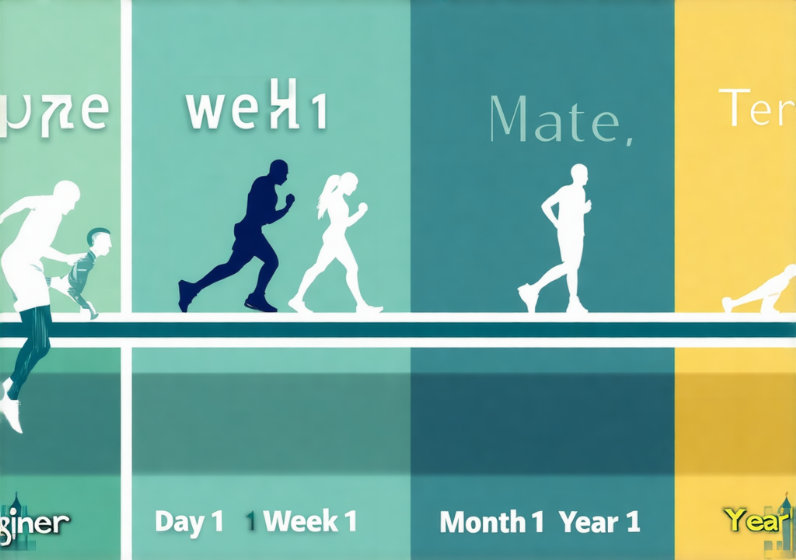
Rather than a single number, think in phases:
Phase 1 — Sensory Decoupling (Weeks 1–6)
Goal: Stable sleep paralysis. You can feel your limbs are separate from your awareness. You can hear and see through the body's "muffled" channel. Duration: most practitioners reach this by week four with daily practice of 20–30 minutes per session, ideally in the hypnagogic window (lying down, eyes closed, at a time you do not need to wake up for hours).
Phase 2 — First Crossing (Months 2–4)
Goal: One or more coherent projection experiences lasting 10 seconds to a few minutes. You can orient yourself in the projected space and perceive multiple objects. Duration: variable; most practitioners achieve this within month three if Phase 1 was solid.
Phase 3 — Stabilization (Months 4–9)
Goal: Projection on demand, or near-demand. You can enter the state reliably when you intend to. Experiences last five minutes to an hour. You can navigate complex environments, interact with objects, and sometimes encounter other projected beings. This phase involves learning "body control" in the projected state — the ability to walk, open doors, turn corners without collapsing back into sleep paralysis or the physical body.
Phase 4 — Integration (Months 9–18+)
Goal: Projection as a stable practice rather than an event. You project multiple times per week with minimal effort. The experiences are rich, sustained, and you can set intentions before entering and follow through on them. At this stage, the question "how long does it take" has largely answered itself — you have moved from learning to practicing.
Common Time Wasters
A few patterns extend the timeline unnecessarily:
Practicing in a state of urgency. If you are checking your phone before and after each session, reviewing notes mid-session, or mentally rehearsing "I must succeed tonight," your autonomic nervous system stays partially activated. The body reads this as mild stress and holds on to sensory input. The projection wants quiet. Give it quiet.
Skipping the physical preparation. Most failed sessions are failures of physiology, not spirituality. A full bladder, a tight waistband, a cold room, an uncomfortable pillow — any of these create micro-tensions that the nervous system reports as sensory noise. Two minutes of adjusting your environment can save twenty minutes of frustrated practice.
Chasing the experience instead of the state. Beginners often want to see what is on the other side before they have built a stable doorway. Spend more time in the threshold — the vibration, the muffled perception, the sense of body-separation — than you spend trying to "get out." The crossing follows naturally from a well-habituated threshold.
What "Learning" Actually Means Here
Astral projection is not knowledge in the way algebra or history is knowledge. You cannot read about it and thereby possess it. It is closer to learning to ride a bicycle or learn to hear an interval on piano: your body acquires a new sensory-motor pattern that, once formed, becomes nearly automatic. The "how long" question is really asking how many repetitions of the threshold state does my nervous system need before the pattern stabilizes?
For most people with a healthy nervous system and consistent practice, that number translates to roughly three to six months from first attempt to reliable weekly projection. Some exceptional cases — high baseline mindfulness, naturally low muscle tension, strong hypnagogic imagination — compress this to four to eight weeks. Others, managing chronic pain, medication that affects REM sleep, or a highly analytical mind, may need nine to twelve months.
And at some point — usually around month six — the question quietly dissolves. You stop asking how long it will take because you are already there, moving through rooms of light and shadow, speaking to presences that have no fixed form, watching sunsets in colors that do not exist in the visible spectrum. The learning has become a living practice, and the timeline has become a memory: oh, I used to wonder how long it would take.
Begin tonight. Lie down. Quiet the room. Breathe into your belly until the walls of your chest stop moving. Let the sound of your own blood fill the silence. And when you feel that first humming — that vibration in your temples and wrists — do not push. Do not pull. Simply... let your attention rest just ahead of your face, like a candle flame resting on a still table.
The body will follow. It always does. The only question is whether you have made the room quiet enough for it to hear you.