From Storybook to Spellbook: The Evolution of Witchcraft
🌙🕯️ The Unwritten Grimoire: How the Old Magic Became Our New Myth
By Elowen Blackthorn, Keeper of Forgotten Rites
There is a peculiar strangeness in the way we have chosen to remember the witch. In our collective imagination—the one fed by centuries of pulp fiction, Hollywood adaptations, and social media aesthetics—she has become something almost entirely different from what she was for most of history. She has shifted from a figure of genuine terror and theological dread into an icon of empowerment, mysticism, and self-care. This is not merely a change in popularity; it is a fundamental reversal of narrative power. To understand this shift is to read the evolution of witchcraft itself: how she went from being the storybook villain we were taught to fear, to becoming the spellbook hero we now choose to embody.
Let us walk through this transformation carefully. Not as a historian peering through dusty glass, but as a student of the living magic that still hums beneath our feet. The path from the medieval stake to the modern coven is not a straight line; it is a spiral, returning again and again to the same central truth: that witchcraft has always been about power. The only question that changes across the centuries is who gets to hold it.
📜 The Age of Fear: When Witches Were Accused
For most of recorded history, witches were not celebrated. They were hunted. And they were feared with a specificity that deserves our full attention. To understand where we are today, we must first sit in the discomfort of where we came from.
In medieval and early modern Europe, the witch was a theological construct as much as a social one. The famous triad—maleficium (the power to do harm), commerce with the Devil, and heretical belief—defined what it meant to be a witch. This was not about gentle herb women in the woods. This was about a woman who had made a pact with Satan, who broke eggs on doorsills, who whispered curses that could sour milk or break bones, and who had gathered with other women in secret meetings at crossroads under moonlight. The imagery is already there: the coven, the cauldron, the familiar animal, the midnight gathering. These are not inventions of the 20th century; they are echoes of the very features that got people burned.
What makes this particularly fascinating from a magician's perspective is how much truth was buried under false accusation. The witches' trials of the 16th through 18th centuries—Salem, France, Germany, England—produced some of the richest source material for modern witchcraft, and not accidentally. Margaret Murray, the early 20th-century anthropologist whose work (rightly or wrongly) shaped much of modern Wicca, looked at trial records and argued that they were actually describing a surviving pre-Christian fertility cult, misread by Christian judges as devil worship. The trials' descriptions of outdoor rituals, communal gatherings, bodily freedom, and knowledge of nature—features so threatening to patriarchal society that they had to be explained away as Satanic—are precisely the features that modern witchcraft has reclaimed as sacred rather than sinful.
In other words: the storybook version of the witch is actually a distorted mirror of the real thing. The accusations contain the truth, just refracted through fear and gender politics. Every time someone described a coven gathering at night, they were describing something close to how women had been celebrating spring for thousands of years. The trial records are, in a sense, a spellbook written by our enemies.
And this is key: witchcraft survived the burnings precisely because it was pushed underground. When a practice is so feared that practitioners will only discuss it in whispers or behind closed doors, that very secrecy becomes part of its power structure. The witches who went into hiding—the midwives, the herbalists, the women who kept the old stories alive—were building the tradition that would resurface two centuries later.
🌿 The Rescue: Rediscovering the Old Ways
Fast forward to the late 19th and early 20th centuries, and something remarkable begins to happen. A group of men—mostly educated, mostly white, mostly English—start writing books about witchcraft. Charles de Fréminet in France, Margaret Murray in England, Mary Asher and others across Europe and America. They weren't witches themselves by any traditional definition; they were scholars, writers, and artists who looked at the old records and said: wait a minute, these women knew something.
The Romantic movement had already done some of this groundwork—turning medievalism into aesthetic pleasure rather than pure fear. The Pre-Raphaelites painted fairy queens and forest spirits with a tenderness that no one would have granted them in the 14th century. But it was writers like Murray who did the real alchemical work: taking something that had been positioned as Satanic, heretical, and evil, and repositioning it as ancient, natural, and beautiful.
Murray's The Witch-Cult in Western Europe (1933) argued for a continuous pre-Christian fertility religion that survived under the surface of Christianity, with witches as its last practitioners. Modern scholars have challenged many of her specific claims—there were probably not quite so many organized "covens" meeting on hillsides—but the broader point stood: witchcraft had deep roots, and those roots were worth celebrating rather than merely fearing.
Around the same time, in England, Gerald Gardner was doing something even more direct. He built a new religious tradition—Wicca—explicitly modeled on what he claimed to have learned from an old coven. Wicca took the imagery of the witch (moon goddess, sun god, coven structure, seasonal festivals) and wrapped it in a clean, modern, aesthetically pleasing package that didn't require you to be born into a family line or learn a secret oral tradition. You could just join. You could read a book. You could light a candle and feel like magic was real again.
This is the moment where witchcraft stops being purely historical artifact and becomes a living practice available to anyone. The spellbook, in the modern sense, is born here. Not because we invented witchcraft—though Gardner's specific system was largely invented—but because we made it accessible. The gate that had been locked for centuries swung open, and people started walking through.
✨ The Modern Coven: Witchcraft as Identity and Practice
By the 1970s and '80s, something shifted again. Feminist writers—Robert McCloskey's Witch (a novel), Doreen Redford's An American Heritage of Witchcraft, and others—began using witchcraft not just as a religious system but as a lens for understanding women's history, bodily autonomy, and resistance to patriarchal culture. The witch became a symbol: the woman who knows things the powerful don't want her to know, who gathers in secret, who serves nature rather than state or church, who is strong enough to be feared by those who have more conventional power.
Simultaneously, the personal practice side of modern witchcraft exploded. Books like Scott Cunningham's Spells and Potions (1985) made it possible for a teenager in suburban Ohio to buy a book at the local bookstore, learn how to make a protection charm or a love working, and feel like she had access to real magic. The spellbook was no longer something passed down through family lines or hidden from prying eyes. It was in paperback. It was on the shelf next to the cookbooks. You could photocopy pages. You could adapt recipes. You could make it your own.
This democratization is perhaps the most important development in the evolution of witchcraft. For centuries, magical knowledge was gatekept—by churches (who claimed all true magic came from God and all other magic came from the Devil), by families (who passed secrets only to their children), or by specific traditions (each with its own rules about initiation and lineage). The modern spellbook says: the door is open. Come in. Use what works for you.
And people did come in—and they kept coming. Today, witchcraft has become so culturally visible that it's almost mainstream. You see witchy aesthetics in high fashion (think Gucci, or the cottagecore movement on social media). You see "witchy" as a descriptor in book marketing, music reviews, film criticism. You see crystals and candles in retail stores that have nothing to do with spirituality—target shops, grocery stores, department stores selling sage bundles and moon-phase calendars. The witch has fully made it from the margins of society to the center of cultural production.
🌍 From Fear to Freedom: What Changed?
So how did we get here? How did the figure who was burned at the stake become the figure who sells self-care kits online? A few things converged.
The recovery of women's history. As historians and writers began recovering the stories of medieval and early modern women—midwives, herbalists, healers, artists, scholars—witchcraft stopped being a story about evil and started being a story about survival. These women knew more than their culture allowed them to publicly display. They practiced in secret. They were smart, resourceful, and creative under conditions that wanted to suppress them. Witchcraft became a lens for understanding how marginalized people build power structures within systems designed to limit them.
The counterculture of the 1960s and '70s. The broader cultural shift toward personal freedom, nature-based living, non-Western spiritualities, and skepticism of institutional authority created a perfect soil in which witchcraft could take root again. If you were questioning the church, the state, and the corporate world, it made sense to look at an older tradition that valued individual intuition, natural cycles, and community over hierarchy.
The accessibility of information. The printing press (and later, the internet) meant that magical knowledge could spread without gatekeepers. You didn't need a coven to learn how to do a working. You didn't need to be in England or Ireland to practice something connected to those traditions. A book, a website, a YouTube video—any of these could teach you enough to begin. The spellbook literally went digital, which means it's available 24/7, free or cheap, and adaptable to anyone's situation.
The aestheticization of witchcraft. This is perhaps the most visible change. Witchcraft has become aesthetic—something that looks good in photos, feels cozy and mystical, and can be incorporated into a lifestyle brand. The modern "witchy" person often cares more about the candle than the ceremony, more about the photo of their altar than the working they're doing. Is this shallow? Sometimes. But it's also a form of cultural acceptance: witchcraft is no longer just for practitioners. It's for everyone who likes how it feels. And that feeling—mysterious, natural, a little bit rebellious—is what made people in earlier centuries fear witches in the first place. The same qualities are now desirable.
The intersection with other spiritualities. Modern witchcraft doesn't exist in isolation. It borrows freely from Buddhism (mindfulness, intention), Taoism (flow, balance), Native American traditions (relationship to land and animals), African diasporic traditions (ancestors, spirits, ritual), and countless others. The modern spellbook is a synthesis—a creative mixing of sources that would have been heretical or even impossible in earlier centuries. This openness is both its strength and sometimes its point of criticism from purists.
🔮 The Spellbook Today: What It Really Is
So what is the modern spellbook? If you walk into any bookshop or browse an online store, you'll find hundreds of options. Some are beautifully illustrated guides to candle magic. Some are structured curricula for a specific tradition (Wicca, Paganism, hoodoo, fae working). Some are themed collections—spells for love, for money, for protection, for self-care. Some are memoirs by practitioners who share their personal practice.
What all of these have in common is that they're accessible. You don't need permission to read them or use them. You don't need to be initiated into a coven before you light a candle and set an intention. The spellbook has become the great equalizer: a document that says, "You can do this magic too."
And here's where the evolution becomes genuinely magical (pun intended): the modern practitioner doesn't just copy from the book. They adapt. They take a recipe for a luck charm and tweak it to match their own situation. They read a chapter on moon-phase workings and decide which phases resonate with their own life rhythms. They borrow imagery from one tradition, technique from another, and aesthetic inspiration from a third. The spellbook is not a fixed text; it's a living document that each practitioner rewrites in some small way by using it.
This stands in contrast to the medieval view of magic as something you either had or didn't have—something inherited from family lines or granted by divine (or diabolical) favor. The modern spellbook says: magic is a skill, and skills can be learned. You don't need bloodline. You don't need a birthmark. You just need to pay attention, do the work, and trust your own intuition.
🕯️ What We Still Carry From the Old Story
Even as witchcraft has been reclaimed, reimagined, and repackaged, certain elements from the old stories persist—sometimes in ways we don't even notice. The image of the witch still carries a faint edge of transgression. To be called "witchy" is not just to describe an aesthetic; it's to claim a quality that cultures have historically wanted to suppress: womanly knowledge, bodily autonomy, and the ability to work outside institutional frameworks.
The modern witch still gathers in small groups (covens), though often online or by choice rather than necessity. The modern witch still keeps some things close—sharing practices selectively, maintaining personal altars as private spaces, treating certain workings as intimate rather than public. The modern witch still navigates a cultural landscape where being open about your practice is possible but not universally comfortable. People will compliment your candle arrangement and then change the subject when you mention that you actually do moon rituals.
And the modern witch still knows something that feels like power: that she can look at her own life, identify what needs changing or protecting or healing, and do something about it through a combination of intention, ritual, and attention. That's not so different from what the old witches knew. The midwife who knew how to ease labor. The herbalist who knew which plant stopped bleeding. The woman in the village who could tell you when the harvest would come or where the lost child was hiding. They had knowledge that felt like magic because it wasn't explained by mainstream institutions. We have that same knowledge now, just distributed through books and websites rather than family lines.
🌙 The Spiral Continues
If we think of this evolution as a spiral—returning to similar images and symbols but at higher levels of self-awareness—we can see how the modern witch is in some ways closer to her ancestors than she knows. The cauldron that was said to be used for Devil-worship is now used for tea, or for cooking ritual food, or simply as an aesthetic centerpiece on a shelf. The coven meeting at midnight has become a Zoom call where five women share their moon observations and plan a seasonal ritual. The familiar animal has become the cat who sleeps on the altar during meditations.
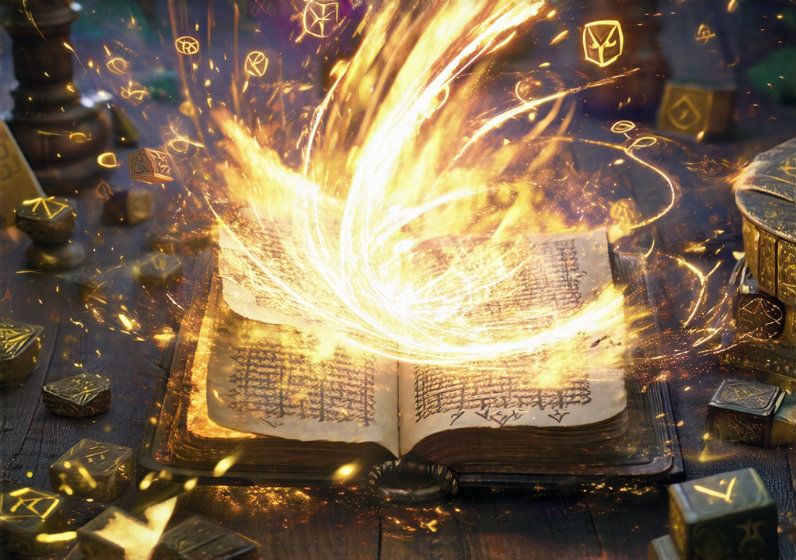
The spellbook is not just a book of recipes. It's a record of how a practice survived, adapted, and reclaimed its own narrative. It's how the storybook became the spellbook: by taking something we were told to fear, finding the truth buried in the accusations, and saying this is beautiful, this is powerful, this belongs to all of us.
And that, in the end, is what magic has always been about. Not just the candle or the incantation or the precise alignment of planets at a specific time. It's about taking back your own story. About deciding that you are not limited by what others say you can or cannot do. About gathering with those who understand and creating something new together. About paying attention to the natural world—the moon, the seasons, the growth and decay of things—and seeing yourself as part of it rather than separate from it.
The witch in the storybook was a symbol of fear: what happens when someone has knowledge that challenges your power structures. The witch in the spellbook is a symbol of freedom: what you can do when you decide to trust your own perception, your own intuition, and your own connection to the living world.
And between those two images—fear and freedom, storybook and spellbook—lives the whole evolution. It's not a straight line from bad to good. It's a continuous conversation across centuries, where each generation takes what it needs from the last and makes it their own. The old witches are still with us in the pages of trial records and fairy tales. The new witches are writing new spellbooks right now—on phone screens, in notebooks, on the backs of old receipts.
The cauldron is still bubbling. The candle is still lit. And the story is still being told—just by different voices than before. And that's exactly how it should be.