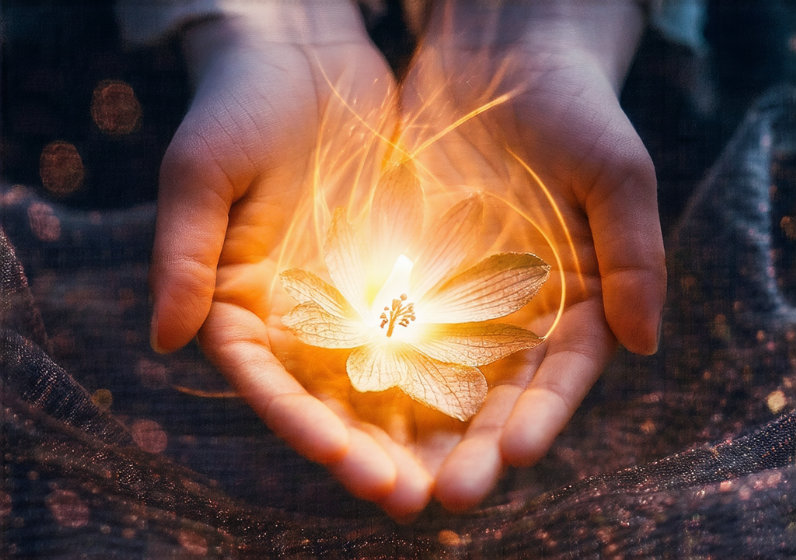
From Ordinary to Extraordinary: The Ceremonial Witch's Way
✶ The Ceremonial Witch's Path ✶
By Seren Blackthorne, Keeper of the Veil
There is a moment—familiar to anyone who has walked this path—when the ordinary dissolves and something greater steps forward to meet you. You are still standing in your kitchen, or perhaps at your desk, or in the quiet of an early morning room. But the air has shifted. The light falls differently. And for one breathless instant, you understand that you are not merely a person going through the motions of a day; you are a vessel, a threshold, a living ceremony in itself.
This is what I mean when I speak of moving from ordinary to extraordinary—not as an escape from daily life, but as a deepening within it. The Ceremonial Witch does not abandon the mundane world. She inhabits it fully, then layers the sacred over it like incense smoke rising through still air. Every act becomes potential. Every moment becomes ritual.
This is the path I have walked for many years, and what follows is an invitation to walk it alongside me—not as a set of rigid rules, but as a living philosophy woven into the fabric of being.
The Foundation: Why Ceremony Matters in a Mundane World
Let us begin with a simple truth that is often overlooked: most people live entirely within the ordinary. They eat, work, sleep, repeat. There is nothing wrong with this—there is no sin in the routine. But there is something missing. A kind of spiritual atrophy. The senses dull. The inner life flattens. We become observers of our own lives rather than participants in them.
The Ceremonial Witch restores that participation through a simple but profound act: intention. She does not merely open a jar of salt; she acknowledges the mineral, honors its earthy origin, and offers it as a symbol of purification and preservation. She does not simply light a candle; she speaks to the flame, asks for clarity or courage or peace, and watches the wax melt as a meditation on impermanence.
This is not performance. This is not pretense. This is the ancient understanding that how you do something shapes what it becomes in your inner life. Ceremony is the bridge between the physical act and its spiritual meaning. It transforms motion into ritual, habit into rite, and routine into resurrection of the self.
In ceremonial tradition—whether drawn from Hermeticism, Kabbalah, or the older folk wisdom that undergirds all Western esotericism—the word ceremony comes from the Latin caerus, meaning "holy" or "sacred." To make something ceremonial is to declare it worthy of attention. To set it apart as significant. To say: this moment, this action, this object, matters.
And in a world that constantly tells us we are small, replaceable, and unremarkable—ceremony becomes an act of quiet rebellion. It says: I am here. I am intentional. My life is not merely happening to me; it is being shaped by me.
The Four Pillars of Ceremonial Practice
To build a life that moves from ordinary to extraordinary, we need structure—though never rigid structure. I have found that four pillars hold up the arch of ceremonial living: Space, Time, Object, and Word. Each one opens a different door into the sacred. Let us walk through them in turn.
1. Space: The Altar as Anchor
You do not need a large room or an elaborate shrine. You need a place. Even if it is a small shelf, a corner of a table, or a flat stone on your windowsill—a designated spot where the sacred is kept separate from the purely practical.
The altar is not a storage area for decorative crystals and dried flowers (though those may appear there). The altar is an anchor point. It is where you go to center yourself before beginning any significant task, before going to bed, or whenever you feel scattered. It says: here is where I meet myself. Here is where the world meets the spirit.
When you build your altar, choose objects that speak to you—truly speak to you, not just look pretty in a photograph. A small bowl of water for clarity and reflection. A candle for illumination. A stone or crystal that resonates with your temperament. A written prayer, a poem, a single sentence that captures something essential about who you are or what you seek.
The key is intentional placement. Each object on the altar should have a reason for being there. Ask yourself: what does this represent to me? What quality do I invoke when I look at it? A dried rose speaks of love and transience. A small bell speaks of awakening and calling. A black candle may speak of protection, mystery, or the fertile darkness in which new things grow.
Tend your altar as you would a garden. Cleanse it regularly—burning sage is one method, but simply wiping it down with intention and a clean cloth carries its own quiet power. Rearrange it when your needs shift. Let it evolve with you. The altar should feel alive, not frozen in time.
2. Time: Rites of Passage for the Hours
The Ceremonial Witch does not merely keep time; she ritualizes it. This means marking the transitions—dawn and dusk, the turning of seasons, the beginning and ending of days—with small but meaningful acts. You do not need grand ceremonies for this. Smallness is the point. The small act done with full presence becomes more powerful than a large act done half-heartedly.
A few examples:
Morning: Before you reach for your phone or your coffee, stand still for three breaths. Feel your feet on the ground. Name one thing you are grateful for. This is not meditation in any formal sense—it is orientation. You are telling yourself and the universe: I am here. Today is beginning. Let us do it well.
Evening: As the day closes, sit with a candle or simply close your eyes. Review the day without judgment—what went well, what felt heavy, what surprised you. Then release it. Imagine the small details of the day lifting off like smoke and dissolving into the night air. You are not erasing anything; you are setting it down.
Seasonal Turns: At each solstice and equinox, mark it with a small ceremony. Light a candle for the sun's return or its long departure. Write a short letter to yourself about where you are in your inner year. Step outside, even if just for two minutes, and feel the quality of the light change. The world is shifting; acknowledge that shift within yourself.
Personal Milestones: Birthdays, anniversaries, completions of projects, endings of relationships—these are all rites of passage. The ceremonial instinct says: mark them. Light a candle. Write a few lines. Speak a small prayer aloud so the words leave your body and enter the world. Give yourself permission to pause in a life that rarely permits it.
3. Object: The Sacred Materiality
We live in an age of disposability, and this seeps into our spirituality too. We collect objects—crystals, candles, incense sticks—and treat them as tools or decorations rather than as participants in the ritual. The Ceremonial Witch treats her objects with a kind of reverence that borders on love, without becoming sentimental about it.
A candle is not just a flame source. It is a column of light between you and the unseen. When you light it, you are performing an act of creation—you are bringing something luminous into a room that was darker than before. Acknowledge that. Say "thank you" to the flame if it feels right. Blow it out with intention when the ritual concludes.
A bowl of water is not just hydration for your plants or a decorative element. It is a mirror, a cleanser, a symbol of the subconscious and of emotional truth. Look into it before you speak about something difficult. Watch the surface undulate and settle. Let it show you what you already know but have been avoiding.
A stone from a meaningful place—a riverbed, a mountain trail, a garden where something important happened—carries that place's memory within its mineral body. Hold it when you need grounding. Press it into your palm before a difficult conversation. Let it remind you of the specific quality of earth or water or stillness that you associate with that place.
The point is this: in ceremonial practice, objects are not used—they co-operate. They have their own agency, their own subtle energy, their own story. To treat them as such changes your relationship to all material things. You begin to handle a cup of tea differently when you understand that the act of pouring it is itself a small ritual—a transfer from one container to another, a sharing, an offering made visible.
4. Word: The Alchemy of Speech and Silence
The Ceremonial Witch speaks with intention—and also practices silence with equal discipline. Both are forms of ceremony.
Prayer and Affirmation: You do not need elaborate liturgies. A simple sentence spoken aloud carries more weight than a paragraph whispered without presence. "I am ready for this day." "Let my words be kind today." "Help me see what I cannot yet see." These are small sentences, but spoken with full attention and felt in the body—mouth, throat, chest—they become incantations. Not because of magical formulas (though those have their place) but because you are making them real by giving them breath.
Journaling as Ritual: Keep a journal that is treated as sacred text—not necessarily a beautiful leather-bound book, but one you write in with the same care you would bring to writing a letter to someone you love. Use a pen you like. Write at a time of day when your mind is quiet. Read back past entries on significant days. You are building an archive of your inner life, and the act of reading it becomes its own small ceremony—a meeting with past self.
Silence: In a world that fills every moment with noise—notifications, background music, conversation—the Ceremonial Witch carves out pockets of quiet. Five minutes of true silence each day is a powerful ritual. No phone. No fidgeting. Just sitting and breathing and being present in the body. Silence is not empty; it is full of everything you are not actively speaking or thinking about. It is where the subtlest impressions live.
The Word as Boundary: Learn to speak your boundaries clearly, calmly, and without apology. "I need some time before I can answer that." "This does not work for me." "I will consider it overnight." These small spoken acts are ceremonies of self-respect. They draw lines in the air—visible, audible, real. The world responds to them.
Weaving the Path: A Day Lived Ceremonially
Let me sketch what a day might look like for someone walking this path—not as a prescription, but as an illustration.
You wake, and before your hand finds the alarm or the phone, you open your eyes in stillness. You breathe three times, feeling the room around you—the quality of the light, the temperature of the air, the sound of the world settling into morning. You say one word aloud: Begin. It is a small rite, but it sets the tone for everything that follows.
You make your tea or coffee slowly. You watch the water pour. You feel the warmth of the cup in your hands. This is not wasted time; this is ceremony. You are present with a simple act and you have made it sacred by attending to it.
You work, but you do not merely work. Before each significant task—a difficult email, a creative project, a conversation that matters—you pause for one breath. You set your intention for the hour ahead. "Let me be clear." "Let me be generous with my attention." "Let me listen more than I speak." These small internal rituals keep you anchored in purpose rather than drifting through autopilot.
At midday or whenever a natural break occurs, you step outside or simply stand still. You look at the sky. You feel the sun or the wind on your skin. This is not exercise; this is communion—a brief meeting between your inner world and the outer one. It reminds you that you are part of something vast and ongoing.
In the evening, you return to your altar or your quiet corner. You light a candle. You sit for ten minutes in silence. You write three lines about the day. You blow out the candle. The room goes gently dark. You carry that darkness with you as you move toward sleep, letting it hold everything unresolved until morning brings new light and new possibility.
This is not complicated. It is not expensive. It does not require a grand temple or a coven of adepts. It requires only one thing: attention. And attention, in the ceremonial sense, is the highest form of love you can offer to your own life.
The Deeper Currents: What Ceremony Actually Does
Beneath all the practical details above lies a deeper truth about what ceremony does to the human being and why it has been practiced across nearly every culture for thousands of years.
Ceremony externalizes inner states. When you light a candle and say "clarity," you are not performing a magic trick. You are taking an abstract desire—something that lives only as a vague feeling in your chest—and giving it form, direction, and voice. The flame becomes the clarity you seek. The spoken word becomes the intention you otherwise might never articulate to yourself. And once something is externalized, it can be worked with, shaped, tended.
Ceremony creates memory. Humans are meaning-making creatures, and ceremony gives our days a structure that makes them memorable in a way that unstructured time does not. You remember the day you lit the candle and made your promise. You remember the season you marked with a small rite. These memories accumulate into a kind of inner archive—a personal mythology—that gives your life coherence and narrative weight.
Ceremony connects you to lineage. Every ritual you perform, no matter how personal it is, echoes rituals performed by those who walked before you. The woman who lit a candle in a cave thirty thousand years ago. The priestess who poured libation at the spring equinox. The grandmother who pressed dried flowers into her Bible. You are part of an unbroken chain of human beings who understood that life is not merely something that happens; it is something to be met, honored, and shaped with care.
Ceremony transcends time. In a small ritual moment—lighting the candle, pouring the water, speaking the word—you step out of the linear flow of past-present-future and into a kind of eternal now. The ceremony exists outside of clock-time. It belongs to the realm where meaning lives rather than merely minutes pass. This is what makes it feel so restorative: you are not just killing time; you are inhabiting it fully for the first time in hours or days.
Practical Beginnings: Where to Start If You Are New
If this has stirred something in you—but you do not yet have an altar, a journal, or a consistent practice—do not be discouraged. The path is built one small step at a time. Here are three gentle starting points:
One: Choose one object that already exists in your home—a cup, a stone, a candle, a photograph—and place it in a visible spot you will see multiple times a day. Each time you see it, pause for two seconds and feel its presence. That is the beginning of ceremony. You have turned an ordinary sight into a small anchor point.
Two: Tomorrow morning, before you reach for any device or task, stand still for three breaths. Feel your body in the room. Name one thing you are grateful for—anything at all: warm light, fresh air, a sleeping pet, the sound of birds outside. That is your first morning rite. It takes less than ten seconds and it changes the quality of your entire day.
Three: Tonight before bed, write three lines in a notebook or on your phone about what you felt during the day—not just what happened, but how it lived in your body. "I felt proud when I finished that task." "My shoulders were tight all afternoon." "There was a moment of unexpected joy when my friend called." This is the beginning of an inner archive. Tend it as you would any living thing.
You do not need to do all three at once. You do not need to buy new objects or learn elaborate rituals. The path opens through attention, and attention is free, available, and grows stronger with use like a muscle that has been underutilized for years.
A Final Word: The Ordinary Is the Starting Point
Here is what I want you to carry from these words: the extraordinary does not replace the ordinary; it emerges through it. You do not have to become someone else, adopt an elaborate persona, or perform a grand transformation. You only have to meet your own life with more presence, more intention, and more love than you currently bring to it.
The Ceremonial Witch is not a character you put on like a costume. She is the version of yourself that pays attention. That speaks her intentions aloud. That treats small moments as worthy of full presence. That builds a life made of small sacred acts rather than one long unbroken drift through time.
You are already this person. You have simply not been meeting her often enough. Start where you are. Use what you have. And let the ordinary hours become the ground from which your extraordinary life grows—quietly, steadily, and with a light that is entirely your own.
The veil between the mundane and the sacred was never thick. It was only slightly fogged by inattention. Breathe on it, and it clears.