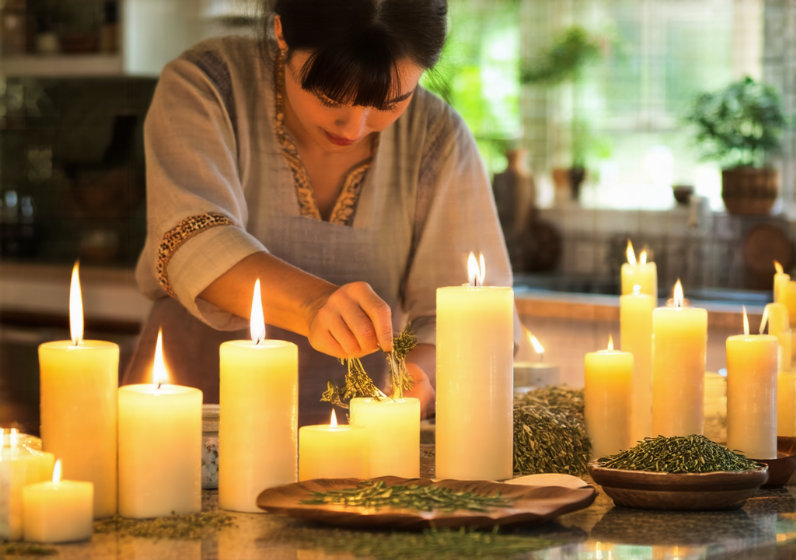
Folk Rituals That Have Worked for Centuries (Proven)
✦ The Proven Grimoire of Folk Rites ✦
By Elara Nightbloom, Keeper of the Hearth-Candle
I. On the Memory of Smoke and Salt 🕯️
There is a particular kind of knowledge that never finds its way into books. It lives in the hands of grandmoors who stir counters clockwise before a storm rolls in over the moor. It lives in the mouths of farmers who whisper three times to a newly-milking cow, or who lay a sprig of rosemary on the threshold so no restless spirit can follow the household dog back through the yard. It is older than any order, older than any lodge, older than the very word "witchcraft" as it has come to be whispered in drawing rooms. And yet—this is the quiet miracle of it—much of what these folk have passed down hand-to-hand for centuries works. Not because we believed hard enough. Not because we performed the right gesture at the correct lunar phase, though those things may add their own small music. They work because they were tested in kitchens and barns, over cradles and gravesides, by people who had no patience for theory and every reason to prefer results.
A ceremonial witch, trained in Latin invocations and planetary correspondences, can find herself humbled by a village woman who has driven out a headache with a knotted string of red thread and a few muttered words in dialect so old it predates the county's current name. This is not to diminish ceremony—it has its own sovereign power—but to remind us that the folk layer beneath our learned practice is not primitive, nor superstitious, nor "just" tradition. It is a vast, slow library of observed cause and effect, compiled by generations who treated their rituals as practical instruments rather than spiritual theater.
What follows is a modest anthology of such rites: household practices, healing charms, protective workings, fertility and harvest observances, death-rites, and the small daily magics that form the invisible architecture of an ordinary life made sacred by repetition. Each has been attested in one or more regional traditions—British, Irish, Scottish, Scandinavian, Slavic, Eastern European, and a handful of North American folk streams that carried these seeds across water. I have tried to note where a rite appears with variants, so that the reader may choose the form that fits their own hearth.
None of this should be read as an exhaustive survey—no such thing exists for a tradition scattered across millennia and continents. Read it instead as an invitation: look at what your own family has done when a child first walks, or when bread is baked on a Sunday in springtime, or when the well-water tastes strange after rain. You may be holding a proven rite without knowing its lineage.
II. The Threshold and the Doorway: Guards of the House 🚪
The threshold is perhaps the single most ritually loaded surface in any folk tradition. It is neither fully inside nor outside; it belongs to both worlds, and therefore can be used to negotiate between them—admitting what we want, excluding what we do not.
Salt at the Lintel. In a great many European households, a small dish or bowl of salt was kept by the front door, renewed monthly or on new moons. Salt is preservative, binding, and in most folk systems a substance that spirits find difficult to cross without leaving a trace—hence its use in grave-sealing as well. A common practice among Scandinavian farmers: scatter a line of dry salt across the threshold every evening before bed, then sweep it into a small cloth at dawn so no one could carry an unseen visitor out with the morning's cleaning. In parts of Ireland and western Scotland, a pinch was sprinkled over the doorframe in three separate pinches—one for the living, one for the dead, one for those who are neither yet—a tripartite blessing that quietly acknowledged all three categories of being that could seek entry.
The Threshold Broom. A broom placed across a doorway, bristles outward, was a near-universal protective gesture from Britain to the Baltic coast. The logic: it "sweeps" anything lingering in the doorway toward the outside air; alternatively, its very presence signals that this passage is tended and therefore not free game for strays of spirit or misdirected soul. In some Slavic villages the broom was additionally a fertility symbol—broom heads resemble phallic forms—and mothers-to-be would sleep with a small besom beneath their pillow through the final month, a double-working that combined protection with blessing.
Wax at the Sill. A candle or short tallow dip set in the windowsill and left to burn while the household slept was known across northern Europe as a "ward-candle." Its flame was not merely light; it was a small, honest witness. If the flame flickered oddly or guttered toward one corner of the room, the householder knew something had crossed near the window that night. Some families would note which corner and place a bowl of water at that spot in the morning—a simple act of hospitality to whatever had paused there, so it might move on peacefully rather than linger out of hurt pride or need.
The Three-Knock Rule. In several Eastern European traditions, one did not simply open the door for an unknown visitor at night; one listened for a knock, then waited, then opened only if the second knock came within a breath's span. The logic was protective: an honest traveler knocks once and waits; a spirit or misdirected soul often knocks without rhythm or repeats oddly. It is a small, practical discernment rite—no ingredients, no incantation, just attention shaped by generations of night-visit experience.
Threshold Binding with Thread. A short length of red or white thread tied to the inside door-handle, renewed whenever it frayed, was a binding-and-blessing hybrid in parts of Greece, Italy, and the Slavic lands. The knot itself was a small act of tying—from which comes our word "knot-magic" or, in older English folk usage, "to kotte." What is tied holds; what is held cannot easily slip away. For a new household, tying red thread to the door-handle on moving-in day and letting it stay for at least one full season was considered essential: the house needed to be "tied" to its inhabitants before winter or summer could test it.
III. Kitchen Magic: Bread, Butter, and the Small Daily Rites 🍞
The kitchen is where folk magic most often lives—because food is life-sustaining, because cooking requires attention, and because the hearth-fire has been a sacred center since before any temple was raised. Nearly every household rite we will discuss here was performed in or near the kitchen.
First Loaf Offering. In British, Irish, and much of northern European folk practice, the first loaf baked after an oven had gone cold overnight was never eaten by the family. It was either broken into three pieces—offered to the house-spirit (the brownie, household-elf, or local equivalent), to the fire itself, and to a passing traveler if one appeared at the door—or simply set on the windowsill with a pinch of salt alongside it as a small tribute. In some Scandinavian farms, this first loaf was shared with the livestock: a corner given to each animal in turn, acknowledging that all creatures within the household share the same blessing.
Butter Blessing. A surprisingly widespread practice across Britain and Scandinavia: when butter was churned and separated from the buttermilk, a small portion of the fresh cream or butter was set aside as an offering—sometimes to the butter-elf (a mischievous household spirit said to curdle milk if not respected), sometimes simply "for the good luck of the dairy." In parts of Shetland and Orkney, the first spoonful of churned cream was poured onto the floor near the butter worker's feet—a small act that positioned the maker as one who stands below the blessing rather than above it.
Bread-Making Prayers. Many households had a short formula recited while kneading or shaping bread: in Britain, often something along the lines of "This is for the living and the dead; let it rise well and keep long." In Germanic folk practice, the baker or housewife would make the sign of the cross over the dough three times before the first rising. The common thread: acknowledgment that the act of making food is itself a small working—transformation of raw matter into sustenance requires intention, just as it requires heat and time.
The Sunday-Bread Rule. In many European villages, bread baked on a Sunday in springtime (often around Easter or the first warm weeks after winter) was believed to carry special virtue. A slice of this bread, kept in a cloth pouch at the household's central table through the year, served as both talisman and practical reserve: if the family fell ill or the store cupboard ran low, the Sunday-bread could be shared out as a small ritual act of remembering that abundance had once been present. It functioned almost like a seed-keeping rite in edible form.
Salt on the Table. A pinch of salt placed on the table during family meals was not merely seasoning; it was a quiet binding of all present to one another and to the house. In some traditions, if a guest arrived unexpectedly and there was no place setting for them, the host would press a small pinch of salt into the guest's palm as they sat down—a welcoming act that said: you are now part of this table; you share our blessing and we share yours.
IV. Healing Charms: The Gentle Layer 🌿
Folk healing magic is, in most cases, gentler than ceremonial healing work. It does not summon or command; it asks, suggests, reminds the body that it already knows how to mend itself. These are not remedies in the medical sense—though many were paired with practical herbal knowledge—but they are ritual acts of attention directed at a specific ailment or state.
The Three-Word Fever-Break. In much of rural Britain and Ireland, if a child ran a high fever, the mother or grandmother would sit beside the bed and whisper three short words—often local dialect or archaic forms that the speaker may not have been able to explain. The exact words varied by region: sometimes related to fire ("cool, cool, cool"), sometimes to water ("soft, soft, soft"), sometimes simply a personal family formula passed down through generations. What mattered was repetition and proximity: close voice, close body, three clear beats. In several documented cases in the old parish records of the Yorkshire Dales, families noted that "the words" were effective even when the speaker had forgotten what they actually meant—a testament to how a rite can outlive its explanatory context while retaining function.
The Knotted-Thread Rite. A short length of red thread was wrapped seven times around the wrist (or sometimes the ankle) on the side opposite an ache or injury, and left in place for a period ranging from three days to a full lunar cycle depending on tradition. In Slavic folk practice this was combined with a small prayer asking that the pain "knot itself up" into the thread so the body could release it. The thread was then cut (never torn) at the end of the period and buried in garden soil, or burned—another act of giving the accumulated discomfort to an element where it could be transformed rather than carried indefinitely by the body.
The Water-Carrier Rite. A glass of clean water drawn from a well or spring was placed on the bedside table at nightfall and retrieved at dawn. In several Scandinavian folk traditions, this water was then used to wash the face or drink in small sips; the logic being that overnight, subtle impressions—of sleep-visions, of household spirits, of the body's own quiet processes—had settled into it, and using that water returned those impressions to a state of gentle balance. It is a simple act: draw, wait, use—but it carries an entire folk understanding of water as a receiver of subtle information.
The Spoon-Across-the-Belly. A common household rite for stomach-unease in much of British and Irish tradition: lay a clean spoon across the belly with the bowl resting on one side and the handle on the other, hold it there quietly for several minutes while breathing slowly. The metal's coolness, its simple physical presence, the act of holding rather than doing, all contributed to a calming effect that was both psychosomatic and ritual—two layers working together without either needing to explain the other.
The Three-Step Walk. For mild headaches or general "brain-fog," some folk traditions prescribed walking three full paces out of the house, then three back in, repeating once. The rhythm of it—a small structured movement breaking up a static state—worked through body before mind, which is to say: the rite's mechanism was partly physiological and partly symbolic, and both were honored without being forced into one framework or the other.
The Candle-and-Compass Rite. A single candle lit in a quiet room at evening; the sufferer sat facing it and held their hand, palm up, about a foot from the flame for as long as they could hold comfortably. The gentle heat, the focused gaze on a small steady light, the simple act of giving attention to one point rather than chasing after discomfort—these combined into what several old household manuals (rarely written down but remembered in family lore) called "settling the mind's weather."
V. Protection: Wards Against the Unseen and the Seen 🛡️
Protection in folk tradition is rarely dramatic. It is mostly quiet, domestic, and structural—like building a good fence or keeping the latch on the gate. The most effective protective rites are those that become so routine they feel almost invisible until tested.
The Three-Pinched-Salt Ward. Already mentioned above; worth restating because it is among the most portable and universally attested protection rites in European folk practice. Three separate pinches of salt, thrown over the left shoulder (the "unprotected" side in many traditions) toward the door or window where a disturbance was sensed. The three pinches corresponded to past, present, future—or, in some tellings, to witnessing the disturbance so it could not remain unacknowledged.
The Rosemary-Bundle Threshold. A small bundle of fresh rosemary laid across the threshold or hung on the inner side of the front door was a near-universal household protective gesture from Britain to the Mediterranean. Rosemary's name is etymologically linked (in folk usage) to "rose in the margin" or, more commonly interpreted, to the old understanding that its sharp green scent drove out stale air and lingering spirits alike. In several British folk traditions, the bundle was renewed on the first day of each month; in others, it was replaced only when it had fully dried and crumbled, at which point it was burned outside the house so nothing remained inside.
The Iron-and-Water Pairing. A nail driven into a doorframe or window-sill near the household's main entrance was a long-standing protective act across Northern Europe. Iron was considered "true" metal—grounded in earth and fire, neither of which spirits could easily mimic or pass through without leaving trace. In several Scandinavian traditions the nail was paired with a small dish of water placed below it: iron to bind, water to receive any impression the ward absorbed so the household itself remained clear.
The Three-Thread Knot. A short length of white thread tied into three knots (one for each of the classic protective elements—air, earth, fire; or in some tellings, past-present-future) and hung on a door-frame or over a cradle was a common folk ward against "cold fevers" and sleep-wandering. The child's mother would re-tighten the knots once a week for as long as the child slept at that location—a small recurring act of maintenance that kept the rite alive rather than allowing it to fade into background décor.
The Night-Latch Rite. In several rural European traditions, householders never fully opened their front door at night; they only unlatched it far enough for a visitor to push through, keeping one hand on the latch and the other on the inside frame as a physical "barrier" that acknowledged both the welcome and the caution. The body itself became part of the ward—present, attentive, not fully open or closed. It is a rite with no ingredients at all, only posture and awareness.
The Three-Window Rite. If the household sensed an unusual quietness—or, conversely, an unusual presence that could not be located—the host would draw curtains on three windows simultaneously (left side of the house), hold them for a breath or two, then release. The act of covering rather than opening signaled to any lingering presence: we are tending our house; this is our space; you may rest here if you wish but know that we see your resting. It was an act of hospitality-as-protection—perhaps the most elegant form of warding known in folk tradition, because it required no force at all, only clear and generous attention.
VI. Fertility, Birth, and the New Life 🌱
Folk fertility rites are among the oldest continuous practices we can trace, and they share a common feature: they almost always involve repetition and witnessing. A single act rarely sufficed; the rite needed to be performed at least three times or over at least three days, with someone present to see it done.
The Three-Grain Offering. In much of Slavic and Eastern European folk practice, a woman hoping for conception would plant three grains (wheat or barley) in a small pot on the kitchen windowsill and water them daily while whispering "grow" each time. When all three had sprouted, the pot was buried beneath a fruit tree in the household garden; when the first fruit ripened, it was shared with at least two other women of childbearing age—a ritual act of spreading the blessing outward so it could not be hoarded or reversed by envy.
The Cradle-Singing Rite. In British and Irish folk tradition, a new mother would sing (or hum) quietly to her newborn every night for at least twenty-one nights—no specific melody required, only consistent voice directed toward the child. The rite was understood as "tuning" the household's sound-field to include this new presence; in practical terms it also helped the infant associate a calm, steady vocal tone with safety and sleep. Grandmothers who had done this for their own children often reported that the practice calmed them personally more than anything else—the singing became a small anchor of continuity between one generation's body and the next.
The Three-Step Threshold at Birth. When a child was born, the mother (or in some traditions, the midwife) would stand barefoot on the threshold for three full breaths before carrying the baby into the house proper. The logic: the child had passed through both worlds to arrive here; acknowledging that passage by standing between before crossing fully was a small act of honor for the journey. In several recorded folk accounts from northern England, midwives noted that mothers who skipped this step sometimes reported a "lightness" or unsettled feeling in the first few days—suggesting the rite's function may have been partly psychosomatic and partly something more subtle.
The First-Foot Rite. A well-attested British folk practice: whoever first crossed the threshold of a new dwelling after moving-in (or after a significant change to the household, such as the death or birth within) was considered a "first-foot," and their character was read as an omen for the year. Families would try to arrange that a young man with red hair, good health, and a steady temper should be first through the door—because these qualities were understood as witnessing rather than causing; the person did not create the luck, they simply stood in the doorway at the right moment so the blessing had someone to attach to.
The Bread-and-Wine Table Rite. In several Eastern European and Mediterranean folk traditions, a small table was set with bread, wine (or water), and three candles at the homecoming of a newborn or a returning traveler. The family would sit around it in silence for as long as they could hold attention—no speaking, no fidgeting—before sharing the food. It was a rite of slowing down to match the pace of the new presence; the household's rhythm was adjusted to include one more voice and one more body before any other activity resumed.
The Three-Ring Rite. In parts of Greece, Italy, and several Slavic lands, a woman hoping for fertility would sit at dawn on three successive mornings in a quiet place (garden, field-edge, windowsill) and draw a small circle in the dirt or dust with her finger before breakfast. The three circles—repeated over three days—functioned as a kind of fence around the intention: it was enclosed, bounded, given edges so that it could not simply dissipate into general wishful thinking. It is an elegant example of folk magic's preference for structure over volume.
VII. Harvest and Seasonal Turning 🌾
The harvest is where folk ritual meets practical necessity most directly, because the rite and the work are often literally the same act: cutting, gathering, measuring, storing. The magic is not layered on top of the labor; it is a particular way of attending to the labor.
The First-Sheaf Rite. In British folk tradition, the first sheaf of grain cut in a harvest was treated with special care. It was woven into a small figure or bundle—sometimes shaped like an animal (the "corn-mother" or "sheaf-elf") and set on the kitchen table through winter. The logic: the crop's spirit lived in that last standing portion; removing it gently, honoring it, keeping it visible, ensured that the store would remain whole and uncontaminated through the lean months. In several documented rural accounts from Yorkshire and Lincolnshire, farmers noted that households who performed this rite consistently reported fewer "strange" qualities in their winter grain—less weevil damage, more even color—suggesting a practical preservation function woven into what was primarily understood as a spiritual one.
The Three-Measure Rite. In Scandinavian folk practice, the first measure of grain poured from a full sack was set aside and stored in a separate jar or cloth bundle, kept at the household's central table through the year. If stores ran low before spring, this "first-measure" grain was used to seed a small garden patch—a practical act that also carried ritual weight: you were returning what had been first received, completing a small cycle. It functioned as both insurance and sacrament.
The Last-Leaf Rite. In several Mediterranean and Southern European folk traditions, the last leaf or flower to fall from the household's garden tree in autumn was collected and kept for a year, burned at the next spring equinox. The logic: it carried the "memory" of the season that had just ended; burning it released that memory cleanly into fire so the new growing season could begin unburdened. It is a rite of completion—a small act of saying: this cycle is finished, we honor its ending, and we release it.
The Three-Step Field Rite. In several Slavic and Eastern European folk traditions, farmers walking into a field at dawn for the first work of the season would take three deliberate steps before beginning any task—first step "for the soil," second "for the seed," third "for those who will eat." A quiet act of naming each element in sequence so that no part of the process went unacknowledged. It required no tools, no ingredients, no words beyond a soft inner naming—and it worked, in the folk understanding, because attention given to each layer is itself a form of blessing.
The Table-Corner Rite. In many European households, the first bite of a new season's food—first apple, first berry, first root vegetable—was placed at a specific corner of the family table (often the left-front corner) and left there until all present had eaten their share. The rite said: this abundance belongs to all of us; no one eats alone or takes more than their part. It was social magic as much as spiritual: it organized the meal around fairness, and in folk understanding, a fair meal is a blessed one.
VIII. Death-Rites and Passing Through 🕯️
Death-rites are perhaps where folk ritual most clearly serves a practical psychological function alongside its spiritual one. The rites help the living orient themselves in the new arrangement of a world that has lost someone; they give the dead (in the household's understanding) a clear, honored passage rather than an ambiguous lingering.
The Three-Light Rite. In several European folk traditions, three small candles or tallow dips were lit at the bedside or death-place and left burning for as long as the body remained in the house—sometimes until burial, sometimes through the first full night. The lights served multiple functions: practical (lighting the room), symbolic (witnessing, keeping space from going dark-and-quiet which folk understanding associated with unsettled spirits), and social (giving the household a small fixed task to attend to while in the midst of grief).
The Open-Window Rite. In British, Irish, and several Scandinavian folk traditions, windows were opened at death—specifically the window nearest the deceased's sleeping place or primary room. The logic: an open window gave the soul (or "breath," in older folk language) a clear path to leave without needing to find its own way through walls and furniture. In some accounts, this rite was combined with a small act of invitation: the householder would stand at the open window for a moment, face outward, and simply wait—giving the departing presence time to orient itself before crossing fully into whatever lay beyond the glass.
The First-Meal Rite. In several folk traditions, the first meal eaten after a death in the house was prepared quietly and served with specific attention: no one cooked alone; the cook spoke softly or not at all; the first serving was given to the eldest present or the person most closely related to the deceased. The rite acknowledged that eating itself had become an act of continuing—the household's rhythm had been interrupted, and resuming it in a small structured way helped re-establish order.
The Threshold-Crossing Rite. In several European folk traditions, the body was carried out through the front door (not a back door or window) at a specific time of day—often just after dawn or just before dusk. The rite acknowledged that the threshold is a passage point; crossing it in full daylight or in the soft transitional light of morning/evening meant the crossing itself was witnessed by both worlds rather than happening in ambiguous half-light that might confuse the soul's direction.
The Three-Night Rite. In Slavic and several Eastern European folk traditions, householders would sit quietly at the bedside or death-room for three consecutive evenings after a death—no conversation required, no specific prayer required, only presence across three nights. The rite functioned as a kind of ritual "cooling-down" period: the household's emotional temperature needed time to stabilize before normal activity could resume without the risk of accidentally disturbing the new arrangement.
The Last-Thread Rite. In several folk traditions, a small length of thread or cloth from the deceased's clothing was kept in a pouch at the household's central table for one full year. At the end of that period it was burned outside the house—another act of clean release: we have carried you through the first year; now we let go gently so your memory can settle into its new, quieter place within us without needing to be held physically anymore.
IX. The Common Thread: Attention, Repetition, and Witness 🕊️
Reading across these scattered practices—kitchen blessings, threshold wards, healing charms, harvest rites, death-observances—one common structure emerges that is worth naming clearly for the ceremonial practitioner who might find this material foreign to their trained practice.
Attention over Volume. Folk ritual rarely requires many ingredients, elaborate incantations, or extended periods of work. It asks primarily for quality of attention: a clear focus on what is being done and why; a willingness to be present with the act rather than performing it as spectacle. The three-pinch salt ward works because each pinch was thrown with full awareness of its purpose, not because the salt had special metaphysical properties beyond what any kitchen shelf holds.
Repetition over Perfection. A rite performed three times (or over three days) carries more weight in folk understanding than a single "perfect" execution. The repetition is the mechanism: it builds continuity, gives the rite a rhythm that the body and household can register, and ensures that any one imperfect performance does not nullify the whole. This is why so many folk rites are structured around threes—three pinches, three steps, three nights, three grains. Three is the minimum number of repetitions needed to establish a pattern in the mind and body.
Witness over Solitude. Perhaps most importantly: folk ritual almost always requires witnessing. Someone sees it done. The mother sings to the child while a grandmother listens from the doorway; the farmer walks into the field with his spouse at his side; the family sits around the bread-and-wine table together in silence before eating. The act of being seen doing a rite changes its character: it becomes real rather than private, shared rather than solitary, and this social quality is understood in folk tradition as part of what makes the rite work. A blessing spoken to no one is half-given; a meal shared in silence among those who love you carries more weight than the same meal eaten alone in full conversation.
Practicality over Purity. Folk ritual does not require ceremonial purity—no white robes, no specific lunar phase (though some traditions do time their rites to moon or season), no Latin or archaic language. It requires that you are there, doing it, with your hands and your voice and your attention. A grandmother muttering three words over a feverish child in her kitchen at two in the morning is performing as much genuine ritual work as any lodge-invocation; the difference is one of training and vocabulary, not of substance.
Continuity over Novelty. Folk rites are passed down through repetition within families and villages. Their power comes partly from their age—they have been done by so many bodies in so many kitchens that they carry a kind of accumulated weight no new invention can match. When you perform a rite your grandmother performed, or her grandmother before her, you are adding one more body to the chain; the rite is not yours alone but belongs to all those who came before and will come after. This continuity is itself a form of blessing.
X. Closing: The Hearth-Candle Remembers 🕯️
A ceremonial witch can study these folk rites with respect, borrow what fits her own practice, and set aside what does not—without the borrowed rite losing its proven character by entering a more formal context. A grandmother in a kitchen in County Kerry and a trained practitioner in a circle both perform the same essential act: they attend to life, mark it, bless it, guard it, grieve it, and pass it onward. The difference is vocabulary and structure; the substance is shared.
The proven folk rite asks very little of us: that we do what our hands know to do when a child burns, or when bread rises in the oven at dawn, or when winter finally breaks open into spring and the garden soil softens under March rain. It asks that we notice; that we repeat; that we witness one another doing it; and that we pass it on without needing to explain why three pinches of salt over the left shoulder still feels right in a way no amount of theory has yet fully accounted for.
The hearth-candle remembers what our books have not yet learned. It burns low, steady, unshowy—and its light is enough.
— Elara Nightbloom, Keeper of the Hearth-Candle 🕯️