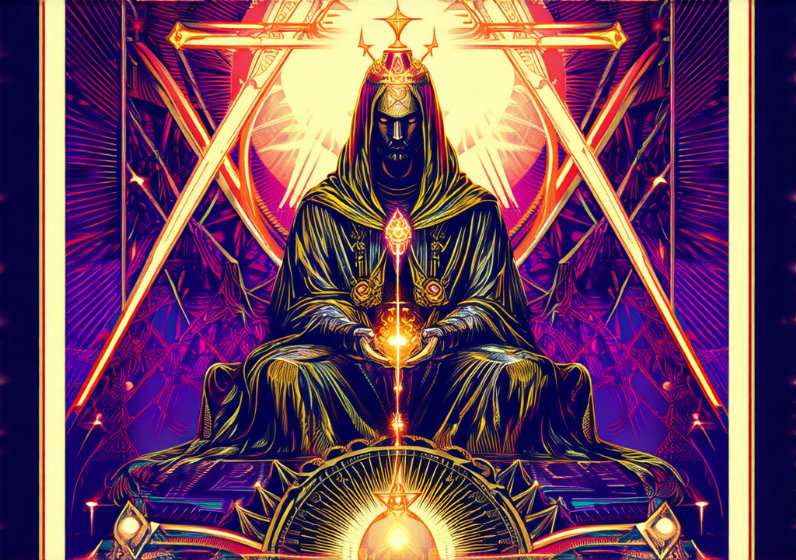
Belief as a Tool: The Philosophy Behind Chaos Magic
I need to search for context regarding chaos magic philosophy to write an authoritative article.
𝛫 The Mask That Makes the Magic: Belief as a mere instrument in Chaos Magic ✧
by Seraphiel Vane, Keeper of the Unnamed Door
July 2017 · Misk Atavi
To the orthodox magician, belief is a currency. You spend it. You save it. You guard it like a miser guarding gold in a drawer that no one will ever open. To the Chaos Magician, belief is clothing. And more than that—it is a cheap, disposable kind of clothing, bought at an airport gift shop for two dollars and thrown into a bin the moment you land in another country.
This distinction is not nuance. It is the entire architecture of the tradition, and it is where most practitioners fall off.
The Dogma Problem
Traditional Western magic inherited a heavy metaphysical baggage from Hellenism: hierarchies, angels, planetary spirits, divine names arranged in ascending order. To make the magic work, you had to believe in something—believe that the names were real, that the spirit would answer if you phrased the request properly, that your own soul was worth saving before it reached the final judgment.
Belief functioned as fuel. Without enough belief, nothing lit up.
The problem? Belief is expensive. It requires years of study, emotional investment, and a certain temperament that modernity tends to corrode. And worse—belief is fragile. One embarrassing moment in front of friends can undo months of devotional practice. The Chaos Magicians recognized this empirically: they had watched the candle burn down to nothing over and over again, each time producing more belief than magic.
Their solution was brutally simple: make belief a tool rather than a requirement.
Elroy Dimmell’s Contribution
The philosopher who most explicitly framed this position for Chaos Magic is Elroy Dimmell, the Australian occultist whose work on Chaos Magic became one of the standard references. What Dimmell articulated (building on the experimental groundwork laid by others) was a theory of belief that treated it as what he called "useful fiction."
The magician does not need to believe in the demon. The magician needs to behave as though the demon is there, with sufficient intensity and focus that the nervous system responds. The demon is fictional—but the physiological response to believing in him is real. Fear. Excitement. A raised hair on the back of your neck. These are all measurable bioevents. And these bioevents can be directed toward a magical outcome.
Dimmell’s formulation was almost brutal in its simplicity: "A belief system is just a collection of stories that you use to organize experience." Stories work, even when they’re false. Even when you know they’re false. Especially when you know they’re false. The knowing makes the fiction available on demand.
The Mask Concept
This is where Belief as a Tool becomes more than theory. It becomes practice.
The Chaos Magician’s mask is not a disguise to hide their identity—it is an instrument. A mask for acting, and acting requires belief in character, even when the actor knows they are playing a role.
Consider the professional musician who plays Bach with full emotional commitment while privately thinking about dinner. Or the stage performer who weeps on cue during a tragic monologue while backstage worrying about their mortgage. The emotion is real at the moment it happens. It doesn’t matter that it’s constructed. What matters is that it is available.
The Chaos Magician’s mask works exactly this way. The mask of the priest, the mask of the witch, the mask of the sorcerer—these are not identities to be inhabited permanently. They are masks to be put on and taken off. And crucially: they can be mixed.
You don’t have to choose one mask forever. You can wear the mask of a Kabbalist on Tuesday, the mask of an atheist philosopher on Wednesday, and the mask of a street musician on Thursday—provided each mask serves the purpose at hand. The belief system attached to each mask is modular. It plugs in when needed.
This is a radical departure from traditional magic, where the system was often inseparable from your identity. You were either the priest or you weren’t. Chaos Magic says: you are the player wearing all the masks. The player doesn’t need to identify with any single role. The player just needs to be able to act.
The Godhead of Belief
Here’s where it gets strange—and here is where the philosophy becomes truly interesting.
If belief is a tool, then what happens when you stop believing in your own tools?
The Chaos Magician faces this paradox constantly. They use the mask of the priest to generate belief energy—but they know deep down that God isn’t real. And if God isn’t real, how much does the priest-mask matter? The answer is: it doesn’t have to be true. It only has to work.
This produces what some Chaos Magicians call "the Godhead of Belief"—a concept where belief itself becomes a kind of deity. Not the object of belief, but the act of believing. In other words: belief in believing is enough to make magic happen. The belief system doesn’t need external validation. It just needs internal consistency while it’s being used.
This has practical consequences. A Chaos Magician who uses a particular ritual from an unfamiliar tradition—say, a Tibetan Buddhist ceremony they’ve never studied deeply—can still make it work if they believe sufficiently in the moment. They don’t need to master the entire philosophy of Buddhism. They only need to suspend disbelief for as long as the ritual lasts.
The Cost of Belief-as-Tool
But there’s a price, and Chaos Magicians who practice honestly will tell you this:
Belief-as-tool is cheaper than belief-as-foundation—but it is also thinner. It doesn’t protect you from existential dread in the same way. If your belief system starts to crack—if you spend too much time staring at the mask and remembering that there’s no face underneath—you can fall into a kind of spiritual nihilism. The mask looks like a mask. And if it looks like a mask, what happens when you take it off?
Many Chaos Magicians describe this as "the void between masks." It’s not empty in the bad sense—it’s empty in the productive sense. You’re free from any single system. But freedom is terrifying. Without commitment to one belief structure, you have to generate your own framework constantly. Every ritual becomes a choice, not an inheritance.
This is the Chaos Magician’s daily reality: every mask must be earned. There is no inherited authority, no ancestral tradition holding up the roof. The roof collapses unless you build it yourself each morning. And that is exhausting.
Why It Works (Or At Least Seems To)
There are at least three defensible reasons why belief-as-tool produces results:
First, the nervous system doesn’t care about your metaphysics. If you act like you believe, your body responds as though you do. The biochemistry of belief is identical whether the belief is "real" or "constructed." Fear, excitement, focus—these are all states, and states can be induced without theological commitment.
Second, the ritual itself functions as a kind of attentional filter. When you’re wearing the mask of a specific tradition, your attention narrows to what that tradition considers important. You stop worrying about irrelevant details. You become more precise in your movements. The mask does for belief what focus does for meditation—it concentrates you.
Third, and this is where it gets truly occult: the mask may be doing something to reality itself. Traditional magic assumed that belief was a form of energy. Chaos Magic suggests something bolder: belief is a form of information. And information, even false information, can reorganize the system in which it’s embedded.
The fiction doesn’t have to be true. It only has to be coherent enough to generate the right pattern of attention and response. The mask works because it makes you consistent, not because it makes you correct.
Practical Implications
If you’re going to use belief as a tool, here’s what actually matters:
Choose your masks deliberately. Not randomly, but with awareness that they are masks. Name them. Give each one a purpose. A mask without a purpose is just costume.
Don’t mix too many at once. The Chaos Magician who wears five masks simultaneously generates confusion, not power. Each mask should be used for its intended purpose and retired when the purpose ends.
Track your results honestly. If you’re using belief-as-tool, you owe it to yourself to record what actually happens. Did the mask work? What did you observe? The Chaos Magician’s notebook is sacred—not because of tradition, but because memory doesn’t lie even when belief does.
Allow yourself to discard masks that stop working. This is the hardest one. Traditional magicians rarely throw away their traditions. Chaos Magicians must be willing to say "this mask no longer fits" and walk away without guilt. The mask isn’t your soul. It’s a tool in your workshop, and tools wear out.
And finally: remember that belief-as-tool doesn’t mean belief is cheap. Just because you can generate belief on demand doesn’t mean it comes free of cost. The cost is awareness. You have to be more awake than the person who believes "for real." Because you’re holding a mask in your hand while everyone else thinks it’s their face. And that takes attention.
The Final Word
Chaos Magic’s philosophy of belief is not nihilism. It is not cynicism either, despite how it sounds to those raised on traditional systems. It is something harder: it is discipline. The discipline of treating your own convictions as tools rather than truths. The discipline of choosing the right tool for the job and then putting it back in the drawer afterward.
And here’s what makes it genuinely magical: when belief becomes a tool, you are no longer at the mercy of whatever beliefs happen to be available to you by accident of birth or culture. You become an author rather than an inheritor. You can write your own story, test it, revise it, discard it, and start again. The mask is yours. You decide when to put it on.
And if—after all that work—you find yourself believing in something despite treating belief as a tool? Well. That’s the Chaos at work. The void between masks has produced its own mask: the mask of the person who knows they don’t know. And that, paradoxically, turns out to be the most powerful one of all.
𝛫 ✧ 𝛫