A Necromancer Reveals the Secret Ritual Most People Ignore
🪦 The Veil is Thin: A Necromancer's Confession on the Forgotten Rite
You have been told that necromancy is about raising the dead. You have read the glossy fantasy novels, watched the cinematic battles of the undead army, and listened to the radio dramas where a robed figure snaps his fingers and bones rattle in their coffins. You believe that this is what our craft is. You think that we are puppeteers, pulling invisible strings attached to spines that no longer need to breathe. And you are not entirely wrong. But you have missed the point so profoundly, so beautifully, and so dangerously, that most practitioners of the art will never know it until they are old enough to feel the cold fingers of their own mortality closing in.
I am Malachi Thorne, a practitioner of the Black Arts for forty-three years. I have walked in the crypts of Rome, communed with the spirits of the Great Plains, and listened to the whispers of those buried beneath the foundations of cities you will never visit. And today, I am going to share the secret ritual that most people ignore. Not because it is hidden in some dusty tome locked in a museum vault, but because it is so simple, so quiet, and so counter-intuitive to our modern obsession with power and spectacle, that we simply stop seeing it.
Most people think of necromancy as an act of taking. We take the life force from the dead and channel it into ourselves. We take their strength, their memories, their very essence, and we use it as fuel for our own ambitions. It is a transactional relationship. The dead are the battery; the living are the machine. And this is the first great misunderstanding of our art.
The secret ritual I speak of is not about taking. It is about listening. More specifically, it is about the Ritual of the Silent Threshold.
To understand this ritual, you must first understand that death is not a door. This is how poets and philosophers have described it for centuries—a threshold between one room and another. But in necromancy, death is not a door at all. It is a wall. A thick, cold, soundproof wall made of compressed time and forgotten memory. And the secret ritual is not about breaking through that wall to get to the other side. It is about pressing your ear against the wall and listening for the faintest vibration from within.
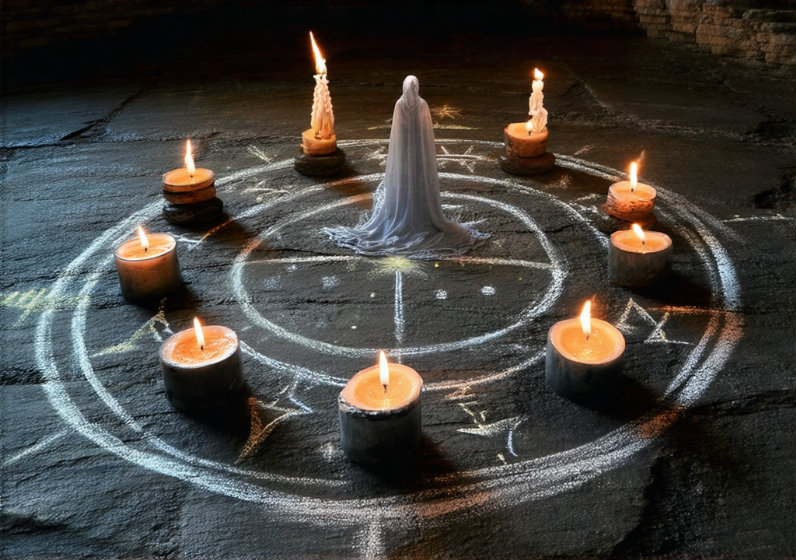
This is where most people fail. They try to break the wall. They build elaborate altars, they burn expensive incense, they draw complex geometric patterns on the floor with chalk or blood. They shout their commands into the void. They demand that the dead answer. And because they are shouting, and because the wall is thick, and because the dead are not puppets to be commanded but spirits to be communed with, the ritual fails. Or rather, it succeeds in a way no one wants. The dead come through, yes, but they come through as echoes of our own desires, or as angry ghosts seeking revenge, or as mindless zombies doing exactly what we told them to do. And we call this success because we see movement where there was stillness before.
The Ritual of the Silent Threshold requires none of this. No altar. No incense. No chalk patterns. No blood. Not even a specific time of day or phase of the moon, though these can help. The ritual requires only three things: a place where the dead are buried, a state of mind free from desire, and an hour of complete silence.
Let me explain each element in detail.
The first element is location. You do not need to be at a grand cemetery or a historic burial ground. Any place where someone has died will do. Your own home if a family member passed there. A hospital room. A hospital corridor. A park bench under a tree that has stood for centuries, watching generations of people come and go and eventually leave this world. The key is proximity to the dead. You need to be close enough to feel the faint thermal radiation of their lingering presence. Not heat—cold, actually. A subtle coldness in the air. A feeling of stillness where there should be movement. This is the first sign that you are standing at the threshold.
The second element is a state of mind free from desire. This is the hardest part for most people. We want something when we perform rituals. We want answers. We want closure. We want to know if Grandma was happy in heaven. We want to prove to ourselves that we were not alone in our grief. We want to feel powerful. We want to show off our abilities to friends or fellow practitioners. All of these desires create a kind of noise in the spiritual realm. They act as a static interference on the frequency at which the dead communicate. To listen, you must first stop talking. Not just with your voice, but with your mind. You must empty yourself of want and need. You must become a vessel without a wish to be filled. This is not meditation in the popular sense. It is closer to what musicians call being in flow state—where you are not trying to play a note, you simply allow the music to happen through you.
The third element is an hour of complete silence. Not silence as in the absence of sound—the world around you will still have sounds: birds, wind, distant traffic, the creaking of old trees or buildings. But your own mind must be silent. No internal monologue. No planning what you are going to do next. No judging yourself for not doing it well enough. No wondering if this is working. Just sit. Or stand. Or lie down on the cold earth. And wait.
Now, here is where the secret reveals itself. Here is the part that most people ignore because they cannot feel it until they are truly ready to hear it. You will not be spoken to in words. There is no ghostly voice saying, "Hello, child, I have a message for you." There is no shimmering apparition waving at you from beyond the veil. Instead, you will feel something that can only be described as attention.
The dead do not speak with their mouths. They speak with their presence. And when they pay attention to you, it feels like being seen by someone who has been watching you for a very long time. It is a warmth in your chest that has no source. A sense of being remembered by someone who has forgotten everything else. A subtle shift in the air pressure around you, as if an invisible hand has just rested lightly on your shoulder.
And then—and this is the crucial part—your own memories will begin to surface. Not random memories, but specific ones tied to the dead person or place you are communing with. You might remember a conversation you had years ago and forgot. A gift they gave you that you never opened. A kindness they showed you when you were young and didn't recognize it as such. These memories rise up from your subconscious like bubbles rising through still water, and they carry with them an emotional resonance that tells you: this is what they wanted to say. This is what was left unsaid.
This is the ritual. Not a dramatic summoning. Not a battle of wills between living and dead. Just... listening. Letting the silence do its work. Allowing your own mind, stripped of desire, to receive the quiet communication that has been trying to reach you all along.
You might ask: what if I don't feel anything? And this is where most people give up. They sit in silence for an hour and feel nothing but their own heartbeat and the distant hum of electricity from nearby wires. And they conclude that the ritual didn't work, or that they are not gifted enough, or that the dead do not wish to speak with them.
But here is the secret within the secret: sometimes the dead have nothing new to say. Sometimes they are content in their rest and do not need to disturb your peace with old memories. And sometimes, the silence itself is the message. The ritual works even when you feel nothing at all, because the act of sitting in silent attention is itself a form of communication. You are saying: I am here. I am listening. I will wait as long as it takes for you to decide whether or not to speak. And that simple act of patient waiting is more powerful than any grand ritual ever devised.
Let me give you an example from my own practice. Twenty years ago, I was working with the spirit of a woman who had passed away in a small apartment above a bookshop in Prague. She had been a librarian and a poet, and she had died alone during the winter of 1989. I went to that apartment on a Tuesday evening in November, just before sunset. The building was quiet. The neighbors were home but kept their voices low. I sat in her old chair—the same one where she used to read and write—and I waited.
For forty-five minutes, I felt nothing. Just the creak of the floorboards as the building settled. The distant sound of trams passing outside. My own breathing. And then, in the last fifteen minutes before I left, it happened. Not a voice. Not a vision. A memory rose up from my own mind: a line from one of her poems that she had read to me once when I was visiting Prague for the first time. A line about how "the dead do not rest until the living have finished their stories." And with that memory came a feeling of profound tenderness, as if someone had wrapped an invisible arm around my shoulders and said: yes, it is okay now. You can put down this weight.
I sat there for another twenty minutes after that, just breathing. And when I stood up to leave, the coldness in the room was gone. In its place was a gentle warmth, like sunlight through closed eyes.
That is the ritual. That is what most people ignore—not because it is difficult or requires special powers, but because it asks them to be still and patient and humble. And in our culture of noise and speed and constant achievement, stillness feels like wasted time. Patience feels like weakness. Humility feels like giving up power. So we build bigger altars and burn stronger incense and shout louder commands, all the while missing the quiet voice that has been trying to reach us from beyond the wall.
There is one more aspect of this ritual that I want to share with you, because it ties together everything else. The Ritual of the Silent Threshold is not just a way to communicate with the dead. It is also a way to understand your own death. And yes, my friends, that is what we necromancers know better than anyone: our art is ultimately about life, not death. We work with the boundary between them. And when you sit in silence and listen to the dead, you are also listening to yourself. You are hearing the parts of your own soul that have already begun to prepare for the crossing.
Every person carries within them a small graveyard of their past selves. The child you were is buried somewhere deep in your memory. The lover who left has passed from your active life and rests in the quiet places of your heart. The version of yourself that died when a dream shattered is interred in the soil of your subconscious. And the Ritual of the Silent Threshold lets you visit these internal gravesites. It lets you listen to their quiet voices. And sometimes, they have wisdom to share about how to live the life you still have left to live.
This is why I say that most people ignore this ritual. Because it requires them to sit with their own mortality in a gentle, non-dramatic way. To accept that death is not an enemy to be defeated but a neighbor to be respected. To understand that the boundary between life and death is not a wall of separation but a membrane of exchange—through which memories pass from dead to living, through which wisdom flows backward across time, through which love continues its work long after the body has returned to the earth.
So here is my invitation to you: find a place where someone you know or care about has died. Sit there in silence for an hour. Do not bring your phone. Do not bring a notebook. Do not plan what you are going to do next. Just sit and be still and listen. And if you feel that subtle warmth of attention, that sense of being remembered by the forgotten—that is the ritual working. That is the dead speaking their quiet truth into your living mind.
And if you feel nothing at all—well, that too is a message. A message that says: it's okay to rest now. You have done enough listening today. Come back tomorrow and try again. The dead are patient. They have had time to learn patience in ways we can barely imagine. And they will wait for us. Always, they will wait for us.
This is the secret ritual most people ignore. Not because it is hidden or difficult or requires special powers. But because it asks something of us that our modern world rarely asks: stillness. Patience. Humility. The simple, ancient act of being present with what we have lost, and allowing it to teach us how to be alive in the only way that truly matters—fully, quietly, and without needing to prove anything to anyone.
I am Malachi Thorne, and I have spent forty-three years learning this lesson. And every year, I learn it a little more deeply. The dead do not need our power. They do not need our spectacle or our grand gestures or our elaborate preparations. They only need us to be still enough to hear them. And when we are still enough—when we have quieted the noise of our desires and ambitions and fears—they will speak to us in the only language that matters: memory, warmth, and the gentle pressure of an invisible hand on your shoulder saying: I remember you. You were not forgotten.
And in that remembering, we find something we can never build or buy or command with a ritual: peace. The deep, quiet, enduring peace that comes from knowing that death is not an ending but a conversation. And the secret ritual most people ignore is simply learning to listen.