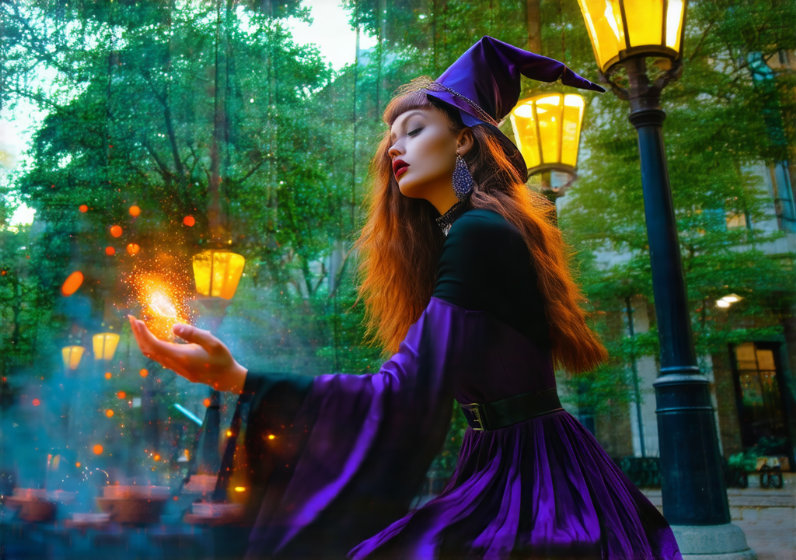
7 Signs You're a Natural Born Ceremonial Witch
The Seven Seals of the Innate Priestess
A Treatise on Recognizing the Ancient Bloodline
To speak of ceremonial witchcraft is to speak of architecture. It is not merely the casting of a spell or the brewing of an herb; it is the construction of a bridge between the mundane and the mythic, the material and the mystical. While folk magic is often intuitive, fluid, and personal—relying on dreams, signs, and the whisper of the wind—ceremonial witchcraft demands structure. It requires the circle, the ritual, the incantation, the liturgy, and the precise alignment of time and space.
Yet, not everyone learns this craft through a book or a coven. Some are born into it. They carry the rhythm of the ritual in their bones before they have ever read a word about the elements or the quarters. Their bodies know how to breathe in 4-7-8 patterns because their ancestors did so by candlelight. Their minds parse reality through narrative, symbolism, and hierarchy.
If you suspect that your affinity for structure, symbolism, and the sacred is more than just a hobby, consider these seven signs. They are not tests to pass or fail; they are mirrors. Look into them honestly. If you see yourself reflected in three or more of these seals, you may be a natural-born ceremonial witch, carrying an old bloodline that simply forgot its name.
1. You Think in Circles, Not Lines
Most modern minds think linearly. We plan: Step A leads to Step B, which leads to Step C. We view time as a straight road from birth to death. But the ceremonial witch thinks in circles. Time is cyclical; it returns, it repeats, it spirals. You naturally understand that Monday does not simply follow Sunday—it completes it and begins again.
A natural-born ceremonial witch has an intuitive grasp of cyclicality. You feel the weight of seasons shifting in your body before you see the leaves change. You know that a new moon is not just a dark sky; it is a void waiting to be filled, a beginning disguised as an ending. You understand the significance of nodes—Solstices, Equinoxes, New Moons, Full Moons—not because a calendar told you so, but because your internal clock ticks to this rhythm.
This circular thinking extends beyond time and into space. When you design a room, a garden, or even a business strategy, you think in containment. You need boundaries. A square has four sides; it is stable, logical, masculine. A circle has no beginning or end; it is infinite, flowing, feminine. The ceremonial witch often feels uncomfortable with open-endedness. You want the work contained within a sacred space so that the energy cannot leak out and dissipate into the mundane world. You understand that to create magic, you must first create a container for it. If you find yourself naturally checking your surroundings, ensuring doors are closed, or feeling uneasy in large, unstructured crowds, this is a sign of your innate need for ritualistic containment.
2. You Are Haunted by Symbolism
To the casual observer, a symbol is just an image. A triangle is a shape; a moon is a celestial body; a chalice is a cup. To the ceremonial witch, symbols are vessels. They are doors. When you look at a pentacle, you do not see five points on a circle; you see the five elements, the five senses, and the unity of spirit. When you light a candle, you do not see wax burning; you see consciousness made visible, the soul’s flame being tended.
A natural-born ceremonial witch cannot look at an object without seeing its layered meanings. This can be exhausting in a modern world that values literalism and efficiency. People say "I’m feeling blue," and most people think of sadness or the color. You might pause and consider the element of water, the throat chakra, the emotional body, or the sky above. You are constantly decoding reality.
This symbol-reading is not just intellectual; it is visceral. Certain colors evoke emotions in you that seem disproportionate to their mere visual presence. Red feels like fire, like passion, like blood. White feels like purity, like moonlight, like bone. Blue feels like depth, like truth, like the void. You know intuitively which symbols invoke which energies without having studied them academically. If you have ever picked up a random item in a shop and felt a sudden jolt of recognition or resonance—a silver ring that made your heart beat faster, a green stone that calmed your anxiety—your soul was recognizing its own language.
Furthermore, you likely have a personal iconography. You may not know why, but certain motifs feel "yours." Perhaps it is the spiral, representing growth and evolution. Perhaps it is the ankh, representing eternal life. Or perhaps it is the triskelion, representing the three worlds. These are not just aesthetic choices; they are talismans of identity. You use symbols to organize your inner world because you know that if you can name a thing symbolically, you can command it energetically.
3. Your Home Is a Temple, Not a House
This is perhaps the most practical sign. How does a natural-born ceremonial witch live? They do not just inhabit their space; they curate it. To them, a house without ritual items, candles, crystals, or intentional decor feels like a dungeon. It feels dead. Airless. Spiritually stagnant.
A natural-born ceremonial witch treats their living space as an altar that has been expanded to the size of a room. Every object has a purpose. The candle in the corner is not just for light; it is a guardian flame. The statue on the shelf is not just decoration; it is a focus for meditation or a representation of a deity. The incense is not just fragrance; it is a bridge between the physical and the ethereal.
You likely have a specific "shrine" or "altar" space in your home, even if you don’t formally call it that. It might be a small table with a few items on it, a corner of a desk, or a dedicated shelf. You feel an instinctive need to keep this space clean and orderly. Dusting the altar is not just housekeeping; it is a devotional act. If someone leaves a dirty dish near your sacred space, you might find it mildly offensive or even angry, as if they have disturbed a quiet room in a library.
You also pay attention to flow. In ceremonial magic, the flow of energy (qi, prana, chi) is crucial. You naturally notice where light enters a room and how it moves. You place mirrors strategically to bounce energy; you position plants to ground space; you choose colors to invoke specific moods. Your home feels like a temple because you have unconsciously applied the principles of sacred architecture to your domestic life. If you enjoy meditating in a specific spot, or if you feel most "yourself" when you are sitting at a particular table with a candle lit, you are living as a ceremonial witch by default.
4. You Communicate Through Liturgy and Rhythm
Not all speech is equal to the ceremonial mind. Casual conversation—chatter, small talk, rapid-fire exchange of information—is often draining or boring for a natural-born ceremonial witch. They prefer structured communication. They prefer language that has weight.
You might find yourself drawn to poetry, prayer, mantras, and formal titles. You like when words are spoken with intention. If you recite a blessing over food before eating, or if you say "thank you" while making eye contact in a specific, ritualistic way, you are practicing micro-ceremonies.
You also respond well to rhythm. Chanting, mantras, rhythmic breathing—these are not just relaxation techniques for you; they are tools of power. You know that sound creates vibration, and vibration moves energy. If you have ever hummed a tune while working on a project or meditated using a repeated phrase, you were using the ancient technology of liturgy.
In group settings, you often take on the role of the "scriptwriter" or the "director." You like to know what is going to happen next. You prefer meetings that have an agenda, a beginning, a middle, and an end. You dislike chaotic brainstorming sessions where ideas are thrown around without structure. To you, structure is respect for time and energy. A natural-born ceremonial witch understands that ritual provides a script that allows the subconscious mind to step forward. When the conscious mind knows exactly what to do next (light the candle, say the word), it relaxes, and deeper states of consciousness can emerge. You instinctively create these scripts in your personal life, turning daily actions into mini-rituals to enhance their significance.
5. You Have a Strong Sense of Hierarchy and Lineage
Ceremonial magic is deeply hierarchical. It acknowledges the Great Chain of Being: Divinity > Angels/Demons > Humans > Animals > Plants > Minerals. A natural-born ceremonial witch naturally understands and respects this hierarchy, even in secular contexts.
You likely have a deep respect for tradition, elders, and masters. You understand that knowledge must be passed down; it cannot simply be downloaded or googled effectively without the context of lineage. You feel a connection to your ancestors. You might research your family tree not just for genealogy, but for spiritual heritage. Who were they? What did they believe? How did they live? You sense that their spirits are still active in your life, influencing your decisions and temperament.
You also respect the hierarchy of roles within a group. In a coven or a circle, you understand that there is a Head Priest/Priestess, a Scribe, an Altar Keeper, a Gatekeeper. These are not just job titles; they are energetic functions. You naturally know who should be leading the ritual and why. If someone tries to do a ritual without understanding their role or without permission from the group, you feel a subtle sense of dissonance.
This respect for hierarchy extends to your relationship with deities or spirits. You do not treat them as casual friends; you treat them as patrons, guides, or powers to be respected and served. You understand that you are offering something in return—prayer, sacrifice, service—and that this exchange is the basis of spiritual relationship. A natural-born ceremonial witch rarely thinks "I want X from God/Spirit/Universe." Instead, they think "How can I honor X? How can I serve this power?" This transactional yet respectful view of the divine is a hallmark of ceremonial thought.
6. You Are Drawn to the Esoteric and the Hidden
Where folk magic looks at nature and sees herbs, stones, and weather, ceremonial witchcraft looks at nature and sees geometry, alchemy, Kabbalah, astrology, and mythology. A natural-born ceremonial witch is inherently curious about the hidden structures of reality.
You are likely interested in more than one system. You might dabble in Tarot, but you also read about the Tree of Life. You like astrology, but you study planetary rulerships and elemental correspondences. You enjoy reading myths from Norse, Greek, Egyptian, or Celtic traditions, not just for story, but for the symbolic archetypes they represent.
You are fascinated by the "why" behind things. Why is this day called Sunday? Why does this symbol have these lines? What is the alchemical process of calcination and why does it matter in a meditation? A natural-born ceremonial witch loves to dig into the roots of symbols and rituals. You want to know the etymology, the history, and the metaphysics behind every element of your practice.
This interest often leads you to collect knowledge like a scholar collects books. Your library is likely filled with esoteric texts, even if you haven’t read them all yet. You have an encyclopedic memory for dates, correspondences, and planetary rulerships. This is not just memorization; it is an intuitive sense that these facts are keys to unlocking deeper understanding. You know that knowing the name of a star or the element of a color gives you power over it.
7. You Experience Ritual as a State of Being
The final sign, and perhaps the most profound, is how you experience ritual itself. For many people, a ritual is a chore. It’s something you do to get a result. "I’ll light this candle so my wish comes true."
For a natural-born ceremonial witch, the ritual is the point. The process of lighting the candle, speaking the words, and moving through the steps is where the magic happens. You are not just performing an action; you are entering a state of being. Your heart rate changes. Your breathing deepens. Your perception shifts. You feel "present" in a way that you rarely do in casual conversation or while scrolling on your phone.
You might describe this feeling as "awakening." It’s as if the fog lifts, and you see reality more clearly. Colors are brighter, sounds are clearer, time feels different. This is the state of ritual consciousness. A natural-born ceremonial witch craves this state. They seek out opportunities to enter it—through meditation, prayer, ceremony, or even intense focus on a craft project.
You also have a strong sense of "sealing." After a ritual or a focused period of work, you feel the need to close the circle, return to normalcy, and ground yourself. You might drink water, touch the earth, or take a shower after an intense magical working. This is not superstition; it is hygiene for the energetic body. A natural-born ceremonial witch knows that if you open a door (to spirit, to power), you must close it properly so that energy doesn’t leak out or unwanted entities get in. You understand the importance of transition—moving from the mundane world into the sacred space and back again.
The Quiet Priestess Within
If these seven signs resonate with you, do not feel isolated. Many natural-born ceremonial witches spend years trying to fit into a folk magic mold or feeling like they are "overthinking" their practice. They wonder why they need so much structure, so many symbols, and so many books when other witches seem to just "feel" things.
You are not broken; you are specialized. You are part of an ancient lineage of temple keepers, ritual leaders, and sacred architects. Your mind is wired for pattern, symbol, and ceremony. Your soul craves structure because it knows that structure creates space for the infinite.
Embrace this nature. Stop apologizing for needing a script. Stop feeling guilty for wanting to know the history behind every spell you cast. You are not just doing magic; you are maintaining the architecture of meaning in your life and, by extension, in the world. Your precision is your power. Your structure is your sanctuary.
So, light the candle. Speak the words. Draw the circle. And remember: you were born for this. The ritual was waiting for you.