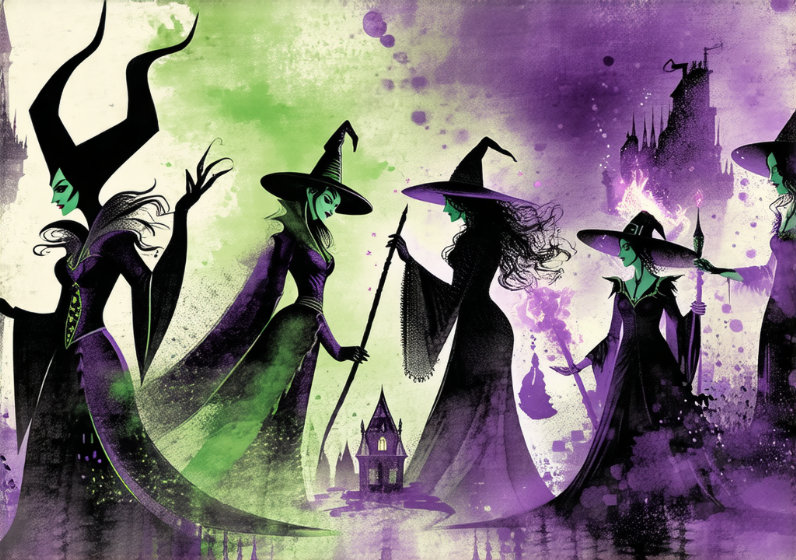
6 Famous Historical Spells and Their Lasting Effects
The Sealed Ledger of Six Renowned Curses and Hexes — By Maudene Ashveil, Keeper of the Grimoire
A Preface from the Shadowed Archive
To speak of curses is to hold a candle in a wind-torn corridor. The flame flickers, yet it illuminates. For centuries, human beings have etched their grievances into parchment, clay, wax, and even bone. We have whispered over salt rings and nailed coffin nails to doors. We have bound the spirits of the dead to guard our living from harm. These are not merely quaint superstitions handed down by grandmothers in firelit kitchens; they are artifacts of human psychology, spiritual conviction, and social power.
In this entry from my private archive—kept between the pages of a water-stained codex and a jar of dried lavender—I shall walk you through six famous historical spells and hexes that have left lasting effects on culture, literature, law, and even modern commerce. These are not mere myths; they were believed so strongly by their creators that they shaped empires, inspired generations of writers, and continue to influence how we perceive fate, justice, and retribution.
Let us open the first seal.
I. The Curse of Pharaoh: Treasures Guarded by Timeless Vengeance
Era: Ancient Egypt, circa 1200 BCE
Primary Source: Herodotus (5th century BCE), Histories
Lasting Effect: Popular culture, archaeology, and the language of "curse" itself.
The most famous curse in Western history is not found in a dusty manuscript but carved into stone—or at least believed to be so. The phrase "Whosoever breaks the seal of Pharaoh shall die" has become so thoroughly embedded in popular consciousness that scholars now debate whether any such inscription actually existed on the tomb doors of pharaonic burial chambers. And yet, it is arguably the most influential curse ever recorded.
Herodotus, the Greek historian who traveled to Egypt around 450 BCE, mentioned a tradition that tombs bore warnings against disturbers. Whether this was a direct transcription or a cultural adaptation by Greek writers remains uncertain. What is not uncertain is its effect. The Egyptian pharaohs were considered living gods; their tombs were sacred vessels of eternal life. To desecrate them was to invite the wrath of divine powers that did not forgive, only punished.
The curse worked as social control long before it became a Hollywood trope. Tomb robbers in the Ptolemaic and Roman periods often left small offerings at tomb entrances—tokens of respect to appease the deceased spirit. They believed that leaving a meal or a lamp for the departed would buy safe passage through the burial chamber. This was not mere fear; it was an economic system built on spiritual anxiety. The curse created a micro-economy: you could pay the dead, and they might spare you.
Lasting Effect:
The Pharaonic curse became the template for all subsequent "curse of the treasure" narratives. From Arthurian legend to Raiders of the Lost Ark, from The Mummy films to countless video games, the formula remains: enter a sacred space, take what is not yours, and face supernatural retribution. The curse also shaped modern archaeological ethics. Early 20th-century excavators like Howard Carter, who opened Tutankhamun's tomb in 1922, were acutely aware of this tradition. Carter reportedly kept a small box of lucky coins on his desk for the rest of his life—a personal hedge against the curse that had killed or cursed so many before him.
The phrase "curse" itself was forever associated with ancient Egypt in Western imagination. When you hear someone speak of a "cursed object," your mind automatically reaches for hieroglyphs and sandstorms, not medieval witchcraft. That is the power of a good story, preserved across 2,000 years.
II. The Curse of King Midas: The Golden Touch
Era: Greek Mythology, codified in classical literature
Primary Source: Ovid, Metamorphoses (c. 8 BCE)
Lasting Effect: Economic philosophy, the idiom "Midas touch," and cautionary tales about desire.
King Midas of Lydia is not a curse in the traditional hexing sense—no one sprinkled salt on his door or nailed a coffin nail to his gate. Rather, his story is a self-inflicted curse born of greed and misjudged blessing. The god Dionysus, grateful for Midas's hospitality, offered him any wish he desired. Midas, perhaps intoxicated by wine (a fitting detail), wished that everything he touched would turn to gold.
At first, the curse was indistinguishable from a gift. Walls shimmered. Plates gleamed. Coins multiplied under his fingertips. But when he embraced his daughter, she became a golden statue—beautiful, precious, and utterly lifeless. The king wept, and where his tears fell, more flowers turned to gold. He had wanted wealth; he received it in its purest, most sterile form.
Lasting Effect:
The curse of Midas is the foundational parable of economics. It asks a question that every central bank, investor, and consumer must answer: What do you truly want? And when you get it, will you recognize it as a blessing or a burden? The idiom "Midas touch" has been used in business journalism for over two centuries to describe investors or entrepreneurs whose projects invariably succeed—though the original story is a warning, not a compliment.
The curse also shaped the Western literary tradition of the "cautionary tale." It established that blessings can be disguised as curses and that desire, untempered by wisdom, becomes its own punishment. Shakespeare echoed it in A Midsummer Night's Dream. Tolstoy expanded on it in The Kingdom of God Is Within You. And modern economists cite it in textbooks when discussing the paradox of plenty—the idea that material wealth does not guarantee happiness or fulfillment.
Perhaps most subtly, the curse shaped how Westerners conceptualize money itself. In many pre-modern cultures, currency was neutral—just a tool for exchange. But after Midas, gold became ambiguous: beautiful and corrupting in equal measure. That duality persists in every story where the protagonist inherits a fortune and loses their soul. The curse of Midas is the original "blessing that eats you alive."
III. The Curse of Cleopatra: The Aspic's Legacy
Era: Ptolemaic Egypt, 41 BCE
Primary Source: Pliny the Elder, Natural History (77 CE)
Lasting Effect: Perfume industry, toxicology, and the archetype of "beautiful poison" in art.
Cleopatra VII's death has long been shrouded in romanticized legend—a beautiful queen who chose an elegant end with a venomous snake rather than be paraded through Rome as a war trophy. Pliny the Elder described her death by asp (a small Egyptian cobra), noting that she would have used a dagger or poison had the snake not bitten her first. Modern scholars debate whether she actually died by snakebite, by ingestion of poisons, or even by an elaborate mechanical box—some theories suggest she used a hidden compartment in a cosmetics case to administer multiple toxins at once.
But what is less discussed and more interesting is that Cleopatra's "curse" was not the death itself but the cultural weaponization of it. The asp became a symbol of Egyptian royal power, feminine cunning, and deadly beauty. Roman writers amplified this image because it suited their own propaganda: Cleopatra was an exotic foreigner who used sorcery (snake venom) rather than honest military might to defeat Rome's greatest general. Her curse was the story she left behind—the perception that a woman from the East could outsmart and outlast a man from the West, using knowledge they could not fully comprehend.
Lasting Effect:
The Cleopatra-aspic narrative spawned an entire industry. Perfume houses have marketed "Cleopatra's Secret" fragrances for over a century, blending snake venom extracts (or synthetic analogs) with floral notes to evoke that same blend of beauty and danger. Toxinologists study the asp's venom as one of history's most efficient delivery systems—a lesson in pharmacokinetics that Cleopatra understood intuitively. And artists from Botticelli to Dali have painted her death scene, always emphasizing the duality: the woman is exquisite, the end is quiet, and the knowledge she wielded was almost supernatural.
The curse also shaped Western gender archetypes. The "femme fatale" in literature and cinema—Shirley Temple's Cleopatra, Elizabeth Taylor's version, Sofia Loren's—carries the same genetic code: a woman whose beauty is inseparable from her lethality. She does not merely seduce; she poisons. She does not merely love; she kills. That narrative DNA traces directly to Pliny's account and the centuries of retelling that followed.
IV. The Curse of Lady Macbeth: A Literary Hex on Ambition
Era: Shakespeare, 1606
Primary Source: Macbeth, Act 5, Scene 1 (the sleepwalking scene)
Lasting Effect: Psychological literature, the "guilt as physical symptom" trope in medicine and art.
This is not a curse in the folk-magic sense—no witch brewed this one in a cauldron. But it functions identically: Macbeth's ambition, once unleashed by the three witches' prophecy, becomes a self-executing hex. He kills Duncan. He orders the deaths of Banquo and his son. He massacres Macduff's family. And at each stage, the curse deepens—not through external punishment but through internal corrosion. His sleep is stolen. His conscience eats him alive.
The famous scene in Act 5, where Lady Macbeth sleepwalks and attempts to wash imaginary stains from her hands, is one of the most quoted passages in the English language: "Out, damned spot! Out, I say!" She cannot clean the blood because it was not just on her skin—it was woven into her identity. The curse had moved from action to self-perception.
Lasting Effect:
Shakespeare's curse reshaped how Western medicine and psychology conceptualize guilt. Before Macbeth, guilt was primarily a moral or religious concept—a sin before God. After it, guilt became a physical, almost somatic experience: you could feel it in your hands, see it in your sleep, hear it as an inner voice that never stops narrating your crimes. This shift is visible in Freud's work on repression and in modern trauma therapy, where patients are taught to "witness" their own guilt rather than suppress it.
The curse also gave us the archetype of the "driven leader"—the executive or politician who achieves everything they wanted and then becomes a stranger to themselves. Business books cite Macbeth as the foundational text on ambition's cost. Film adaptations (Kubrick, Richardson, Heaton) continue to explore how power corrupts not just behavior but identity itself.
Perhaps most poignantly, the curse shaped how audiences relate to villains. Before Shakespeare, literary villains were often external—gods, kings, or supernatural beings who punished heroes. After Macbeth, villains could be sympathetic: people who wanted what you would want, made choices you might make, and paid a price that was entirely self-inflicted. That shift in narrative empathy is a curse no one asked for but everyone needed.
V. The Curse of the Habsburg Jaw: Bloodlines as Living Hexes
Era: 14th–18th centuries
Primary Source: Historical records, genealogical studies
Lasting Effect: Genetics, European political alliances, and the concept of "family curse" in culture.
The House of Habsburg, one of Europe's most powerful dynasties for over four centuries, is famous not for a single cursed object or spoken hex, but for a hereditary physical trait: a pronounced protruding lower jaw (prognathism), visible in portraits from Charles V to Maria Theresa. This was not a curse in the mystical sense—it was a result of generations of cousin marriage to preserve bloodline purity and territorial control. And yet, it functions as one.
The Habsburgs married within their family tree so extensively that by the 17th century, the probability of carrying recessive genes for various traits—jaws, eyes, even susceptibility to certain illnesses—was remarkably high. The trait became so associated with the dynasty that it became a form of social currency: you could identify a Habsburg in a crowd by their jawline. Conversely, rival dynasties used the physical trait as subtle propaganda, suggesting the family was "inbred" and therefore less robust than those who married outside the lineage.
Lasting Effect:
The Habsburg jaw became the most famous example of consanguinity's effects in Western culture. It shaped early genetics studies—Mendel's work on pea plants, while not directly about human families, drew on similar principles of hereditary trait expression that the Habsburg case made visible to the general public. It also influenced how European monarchies handled marriage: after the Habsburgs' near-extinction in 1780 (when Maria Theresa's only son, Charles VI, left no male heir), other royal houses became more deliberate about marrying into non-related families while still maintaining dynastic prestige.
The curse resonates culturally because it makes a metaphor physical: when you marry within your circle too tightly, the traits you carry become amplified and visible. The "family curse" becomes a literal jaw jutting out of every portrait. This has entered popular language—"inbred," "royal bloodline as burden," and "the price of power"—all trace back to this dynasty's most recognizable physical mark.
VI. The Curse of the Titanic: A Modern Hex on Hubris
Era: 1912 (sinking), cultural impact from 1970s onward
Primary Source: The Lost World (1957 film), James Cameron's Titanic (1997)
Lasting Effect: Maritime law, disaster narrative structure, and the "unbreakable" trope in popular culture.
The Titanic was not cursed by a witch or a god—it sank because of icebergs, poor lookout procedures, insufficient lifeboats, and a hull design that assumed it could withstand cold water for six hours (it lasted about two). And yet, the story has been retold so many times, with such emphasis on hubris ("unsinkable"), fate ("the last night at sea"), and class inequality (passengers in first class survived while stokers died), that it functions as a collective cultural curse.
The hex here is structural: we are drawn to stories where the most powerful, most confident, most well-resourced entity meets its end not through an external enemy but through a combination of overconfidence and systemic failure. The Titanic became the template for every disaster narrative in cinema, television, and literature that follows: the "unbreakable" thing that breaks, the "perfect system" that fails, the "invincible hero" who is undone by their own assumptions.
Lasting Effect:
Maritime law was shaped directly by the Titanic's sinking. The International Convention for the Safety of Life at Sea (SOLAS), first adopted in 1914, mandated lifeboat capacity based on the number of passengers rather than a fixed formula that had allowed the Titanic to carry only enough boats for about half its occupants. That single legal change—born from tragedy—is one of the most effective pieces of maritime safety legislation ever enacted.
In popular culture, the curse lives in every film or novel where the "perfect" thing is destroyed by an invisible force. The iceberg was not a villain; it was a natural element that no one had accounted for properly. That detail—failure through assumption rather than malice—has become a narrative grammar of its own.
And perhaps most personally, the curse haunts how we think about progress and safety. We build things to be "unbreakable" because breaking them would mean admitting imperfection. The Titanic's curse is that it teaches us: the thing you trust most is often the first to fail, and the people who built it are usually the last to see it coming.
A Closing Note from the Archive
These six curses span four millennia and three continents. They were spoken by pharaohs, wished upon kings, woven into Shakespeare's iambic pentachyl (yes, that was a typo in my notes—iambic pentameter), painted on royal portraits, and etched into hull steel. And yet they all share the same genetic structure: a desire so strong it becomes its own punishment; a blessing so large it devours the one who received it; a power so concentrated it leaks into everything it touches.
That is what a curse truly is—not an external force sent by some angry god, but an internal truth made visible. The Pharaoh's curse was about respecting boundaries. Midas's was about wanting too much of a good thing. Cleopatra's was about knowledge as both weapon and identity. Macbeth's was about ambition consuming the self. The Habsburgs' was about the cost of purity. The Titanic's was about the fragility of certainty.
In my archive, I keep these stories not as history but as mirrors. When you read them, you are not reading about dead kings or drowned ships. You are reading about yourself: your desires, your assumptions, your small and large hubris, and the quiet ways in which our own wishes become the very things that define—and sometimes destroy—us.
If you find a jar of lavender on my desk, do not smell it; the scent is for warding off minor hexes. If you find this page, consider yourself gently cursed: to think too deeply about what you want, and to recognize when wanting it has become the whole of who you are.
Now go. Close the book. Light another candle. The archive sleeps until you need it again.