3 Things Nobody Tells You Before Performing a Necromancy Ritual
✦✦ Three Things No One Tells You Before a Necromancy Working ✦✦
A Practitioner's Honest Account — for those standing at the threshold with salt, chalk, and an open grave of intent
By ⚰️ Maestra Vespera Hollowell, Kt. of the Order of the Silent Bell & Keeper of the Ninth Threshold
Bethlehem, Pennsylvania · Written under a waxing moon ✶ ✵ ✶
You have read the how-to guides. You have watched the candlelit demonstrations, copied the Latin invocations into your grimoire, bought the black salt and the beeswax candles, and you stand now in your little room — or attic, or rented apartment above a bakery — believing that because you know what to say, you are prepared for what will actually happen when you open the door.
You are not. You are nowhere near it. And this is precisely why I write: after twenty-two years of calling, listening, and occasionally being called back by things on the other side of the veil, I have found that no textbook, forum thread, or YouTube tutorial prepares a beginner for the three truths below. They will not appear in your ritual book. Your teacher, if you are lucky to have one, may whisper them. But mostly, you learn all three the old way — by being gently, sometimes very gently, corrected by the work itself.
Take these three lessons before your first calling. I promise you they are worth more than any recipe for a spirit cake.
🕯️ First Truth: The Dead Do Not Answer Because They Are Asked
This is the one that separates hobbyists from practitioners, and it should be the first thing anyone tells you. It is not a metaphysical fancy; it is an operational fact of necromantic craft.
Beginners approach a calling ritual as if they were dialing a telephone. You light the candles, speak the name three times, and expect — sometimes even demand — that the departed will answer on the other line. And when the room stays quiet, the air stays still, and nothing happens, you conclude either that your technique was flawed, your candle wax was of an inferior grade, or (most commonly) that the spirit simply did not wish to speak with you.
All three of those conclusions are incomplete. The deeper truth is this: the dead do not answer because they have been asked; they answer when the conditions of the threshold permit it. And those conditions are rarely under your direct control in the way a beginner wishes them to be.
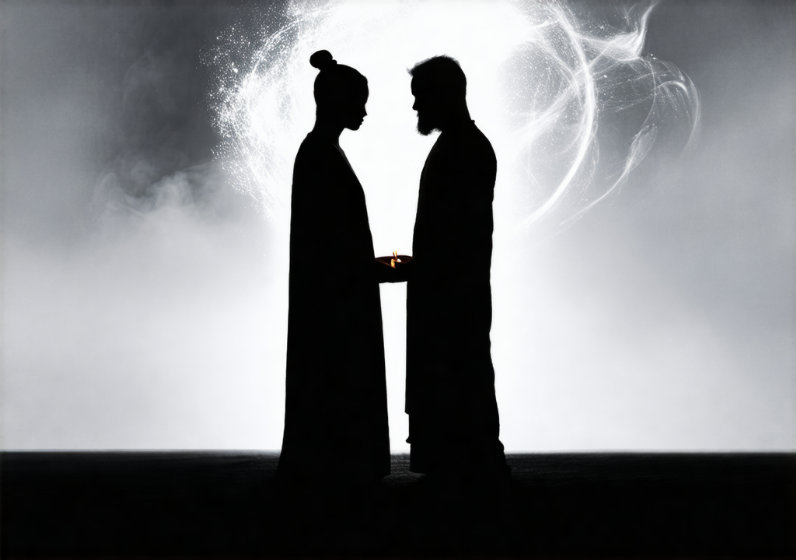
Consider what is actually happening, mechanically speaking, when you perform a necromancy working. You are not summoning a person; you are constructing a passage — a temporary corridor between two states of being that do not normally intersect. The living side is made of heat, metabolism, electrical impulse, and time moving forward in one direction only. The dead side is made of pattern, memory-residue, and time that has stopped or begun to move sideways. Your ritual — the chalk circle, the salt line, the incense smoke, the spoken name — is not a magic key you turn; it is a scaffolding. It holds open an archway for just long enough for something on the far side of the threshold to lean through and press its face up against the plaster.
That "something" may be the spirit of the person whose name you spoke. Or — and this is where beginners get their first real lesson in humility — it may be a resonance of that person: a pattern left behind by them, carried on the same psychic frequency as the original, now inhabited or shaped by others who loved, grieved for, or argued with that same name. In lesser workings, what leans through the arch is rarely a full, unfiltered consciousness in the way your grandmother was when she sat at her kitchen table and stirred her tea. It is closer to a reconstruction: a composite made of memory-traces, emotional imprints, and ambient sympathy from everyone else who still carries that name's weight.
This has practical consequences that no beginner anticipates:
The "voice" you hear will not match your mental image of the person. A mother may sound calmer than she was in life, or angrier, or more formal. A friend may use words they never used when alive. This is not a sign of impostor spirits — it is a sign that you are hearing imprints, and imprints flatten out over time, like a photograph left too long in sunlight.
The content of the answer will be shaped as much by your own grief as by the dead's truth. Grief is a very loud frequency; it drowns out subtlety. If you are calling for someone you have recently lost, expect that what leans through will confirm what you most need to hear — and may quietly omit or soften what you least want confirmed. A beginner who wants to believe their father forgave them will hear forgiveness. The honest practitioner knows they must ask a second question, colder and more specific, to test whether the answer holds up under pressure.
The dead are not always available. There are seasons — solstices, the weeks surrounding death anniversaries, the three days after a burial, full moons of particular zodiacal aspect — when the veil is thinner and the passage easier. There are also quiet times: ordinary Tuesday afternoons in November, for instance, where the far side of the threshold feels farther away than it should be, and what leans through is fainter, more abstract, harder to interpret. Beginners who call only on thin-veil days learn to mistake ease for skill; those who call on thick-veil days learn that their working did not fail — the conditions simply were not ripe.
So: light your candles. Speak the name. But release your expectation of a conversation. You are building a door, and doors do not speak. What speaks is whoever walks through them — and sometimes it is only the echo of footsteps.
🕯️ Second Truth: Necromancy Is Mostly About the Living
Here is a sentence that will make certain forum regulars want to write angry replies: the majority of what you experience in a necromancy ritual originates on your own side of the threshold, not theirs. The dead contribute perhaps twenty percent of the phenomenology; you — your memory, your grief, your hopes, your biases, your unresolved conversations with this person while they were alive — contribute the other eighty.
This is uncomfortable for beginners because it undercuts a certain romance: the idea that necromancy is hearing from the dead, as though one were receiving an incoming call. In practice, and in craft, the ritual works more like a two-way mirror. The spirit on the far side presses against the glass; you press against your own end of it. What you perceive — a voice, a scent of gardenia or old smoke, a single word that forms itself in your mind — is the composite of both pressures meeting at the glass. And because your pressure is stronger (you are warmer, heavier, more electrically active), the composite skews toward you.
Practitioners deal with this in several ways, and I will name the most useful:
1. Keep a witness. Not a camera — cameras do not catch what needs catching here. A person: someone who sits at the edge of your circle or just outside it, watching your face, your breathing, whether you weep without knowing why, whether you nod to something no one spoke. The witness's job is to tell you afterward: "You smiled for three seconds when you said her name. You did not know you were doing that." This is how you begin to separate the spirit's contribution from your own grief reflexes.
2. Ask open questions, never leading ones. A beginner asks, Did you forgive me? and hears a warm affirmative tone in the room. An experienced practitioner asks, What did I do that weighed on you most? — a question that cannot be answered with a simple yes or no, and therefore requires more genuine engagement from whatever leans through. Leading questions are answered by your own subconscious; open questions must be answered by the threshold itself.
3. Expect residue to speak. This is a truth I wish someone had told me in my first year of practice. The dead often come through carrying other people's grief. When you call for a friend who died ten years ago, what leans through may not be only your memory of them — it carries the residual emotional charge of everyone else who loved that friend. A mother's worry. A sibling's resentment. A stranger's pity. You will sometimes hear a tone in "their" voice that does not match how they spoke to you. That is other people's imprint riding along on the same frequency. Distinguishing your portion of the residue from others' requires years of practice, but knowing it exists is step one: you are not always talking only to the person whose name you speak.
4. Your body will keep score. After a working — especially a first or a heavy one — you may feel warm for an hour, as though someone has held both your hands; or cold at the base of the skull, as though you have been sitting in a drafty church; or you may find yourself wanting to eat something very specific (warm bread, bitter chocolate, sour fruit) that you have no rational reason to crave. This is the living side of the two-way mirror doing its work: your metabolism has participated in the threshold and now wants to be nourished back toward ordinary life. Attend to it. Drink water. Eat something warm. Go outside and stand in a sky so wide it resets your sense of scale. The dead do not need your body; you need yours, and after a working, that need is louder than usual.
None of this means the dead are absent from the ritual. It means they are distributed through it — in the voice-timbre you hear, in the specific word that forms unbidden, in the one detail (a phrase, a color, a small fact) that matches only what your father actually said and no one else could have invented. Those details — the ones you did not expect to hear — are the genuine contributions of the far side of the glass. Learn to recognize them: they will feel specific, almost uncomfortably so, in a way your own subconscious would never quite arrange on its own.
🕯️ Third Truth: You Must Close What You Opened — and Closing Is Its Own Craft
This is the one that separates finished work from half-finished work, and it is the reason some practitioners develop a genuine respect — bordering on reverence — for the simple act of ending.
A beginner treats closure as an afterthought: "Now that I've got my answer, let's just… stop." They blow out the candles in any order. They sweep the chalk with a broom while reading their phone. They leave the salt where it fell and go make tea. And for the most part — on good days, when the working was light and the spirit was cooperative — this is fine. The passage holds. No one lingers in the doorway. Your room returns to being a normal room.
But here is what no tutorial tells you: a necromancy ritual does not simply end; it must be completed. And the difference matters more than beginners can know until — usually, around their fifth or tenth working — they experience what happens when closure was sloppy, half-hearted, or skipped entirely.
In craft terms, a completed ritual leaves behind a clean threshold: the passage you built is sealed from both sides, and neither side bleeds into the other. An incomplete one leaves the archway partially propped open. And because you are made of living matter — warm, breathing, electrically noisy — and the far side is made of pattern and memory-residue, a half-open threshold behaves less like a door and more like a leak. The two substances begin to seep into each other. You will not see it happen in a dramatic way; there are no floating candles or rattling chains (though those happen too, for the theatrically inclined). What you feel is subtler:
A lingering sense of company that does not match any person actually in the room. You turn to speak and catch yourself checking whether someone is listening at the window.
Emotional bleed-through. You find yourself feeling calm about something you should be anxious about, or irritated by a small thing that would normally amuse you — and cannot fully explain why. Someone else's residue, left in your threshold, is coloring your mood for hours.
Sleep disturbance specific to the person called. Not nightmares exactly; rather, you dream of rooms from your childhood with different wallpaper, or wake at 3:14 a.m. because a clock in the dream was ticking backward. Small, strange, personal in a way that points back to the working and not to ordinary life.
A faint taste at the back of the throat — chalk, smoke, old flowers — on days you have done no incense burning whatsoever. Your own body is still metabolizing the threshold's chemistry.
None of this is a curse or a punishment; it is simply what happens when two substances that do not naturally mix are left in partial contact. You can think of it like leaving a window cracked open between two rooms at different temperatures: eventually, one room starts to feel like the other. A completed ritual closes that window cleanly.
So: how does one close properly? There is no single universal method — different lineages teach different sequences — but there are common principles that hold across traditions:
1. Thank the threshold itself, not only the spirit. This sounds quaint until you have done it a hundred times and felt the difference. The working has two parties: the one who leaned through (the spirit) and the structure that made leaning possible (your circle, your candles, your own body as a living anchor). Blessing or acknowledging both — "Thank you for speaking; thank you for holding" — leaves less loose thread in the weave of the finished work.
2. Reverse your opening sequence. If you lit four candles from north to south, extinguish them from south to north. If you spoke the name three times to open, speak it three more times to close — or, in some lineages, once, softly, like a door-latch falling. The reversal is not superstition; it tells your own nervous system that the state has changed, and since your nervous system is half of the two-way mirror, keeping it informed matters.
3. Sweep outward, not inward. When you clean the chalk or sweep the salt, sweep from the center of the circle toward the doorway — moving residue out of your threshold space rather than stirring it around inside one. This sounds trivial until you have done it both ways and noticed which way leaves a cleaner feel in the room afterward.
4. Give yourself an exit ritual that is purely yours. Some practitioners step into another room and wash their hands under cold water while saying, "This working is complete; I return to my life." Others sit for five minutes in silence with both feet flat on the floor, feeling the weight of being alive again. The specific form does not matter; the intentionality does. You are telling your own body that it has finished its part in the threshold and may now resume being a warm, breathing, mortal instrument.
5. Wait before you touch the tools. Candles, chalk, salt — leave them where they sit for ten or fifteen minutes after closure, if you can manage it. Let them cool down from their working temperature (literal, in the case of wax; metaphorical, in the case of your intention) so that when you do pick them up and put them away, you are not still carrying a little of the threshold's charge into your ordinary storage shelf.
And one final note on this third truth: not every working needs an elaborate closure. A light, brief calling — three minutes, two candles, one question — can be closed with a simple thank you and a breath. The elaborate full-sequence closure is for heavy workings, long sessions, or any ritual in which you felt the threshold feel thick, warm, almost liquid at its edges. Learn to read your own working: when it feels light, close lightly; when it feels substantial, give it a proportional farewell. This calibration — knowing how much closure a given working deserves — is itself one of those skills that comes only with years of practice and honest self-assessment after each session.
✶ A Closing Word for Those Standing at the Threshold ✶
Let me leave you with this, and I will let it be my last paragraph: necromancy is not the most dramatic magic. There are no walking corpses, no bone-orchestras, no whispered prophecies that turn out to be accurate in a cinematic way. It is quieter than that, and more intimate, and — for the practitioner who has done it long enough — somewhat more familiar than any first session can prepare you for.
The dead are not ghosts in the popular sense: they are not sheets over frames, rattling chains, moaning in cellars. They are closer to what a photograph is to the person in it — a persistence of pattern, a resonance held by everyone and everything that has since carried their weight. When you open your threshold, you are not raising the dead; you are tending them. And tending is a word with roots: to keep safe, to look after, to attend to over time. That is what necromancy actually is, stripped of its theatrical garnish. You are attending — carefully, humbly, and with full knowledge that the work you do on your side of the glass determines as much of what happens as the work done on theirs.
So: light your candles when you are ready. But before you speak the name, take a breath, press both feet flat to the floor, and remember these three truths: they answer only when conditions permit; most of what you experience is yourself; and what you open must be closed as carefully as it was opened.
Do those three things well — not perfectly; consistently — and your practice will carry you further than any clever incantation ever could. The dead are patient. They have had all the time in the world on their side of the threshold. You, being warm-blooded and mortal, are the one who must be careful.
Safe keeping, student. May your circle hold true, your candles burn even, and your threshold close clean. ⚱️ ✶
Maestra Vespera Hollowell writes from a small stone house in Bethlehem, Pennsylvania, where she has kept the bell of the Ninth Threshold since 2013. She tends to ask for chalk and warm bread if you visit; she keeps both stocked whether or not you were expecting her.