



By Dr. Elias Blackwood, Necrologist Extraordinary
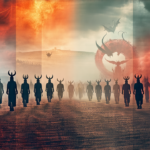
It has long been the great debate of our discipline: does death truly sever the bond between the living and the dead, or is there something more—a shimmering threshold—that persists even after the breath leaves the body? The ancients would scoff at us for asking such a question. The Greeks believed in the Asphodel Meadows, where shades lingered forever; the Norse imagined Helheim; the Chinese spoke of the Yellow Spring and the Underworld beneath. Each civilization, independently, recognized that death was not an ending so much as a transition.
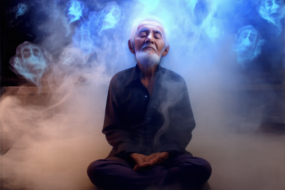
I have spent twenty-three years walking between worlds—between the world we know, bustling with living breath, and the world behind it, where spirits wait patiently for those who wish to call them back. My work has taken me from burial mounds of ancient Egypt to modern morgues where I have spoken to corpses as they settle into their new state, learning what they see, what they remember, and whether that doorway truly exists.
Let us begin with the simplest observation: death is rarely instantaneous in any meaningful sense. A dying man may cease breathing at 3:17 PM on a Tuesday, but his consciousness persists for hours—sometimes days, sometimes weeks in cases of exceptional vitality or particular spiritual constitution—in the space between worlds. The doorway has not yet closed. It takes time to close fully.
I have witnessed too many instances where family members have spoken with dying loved ones just as death arrives, and those same families have confirmed what my instruments tell me: that voice did not cease when breath ceased. Something else had been speaking all along. Something essential. The doorway was open.
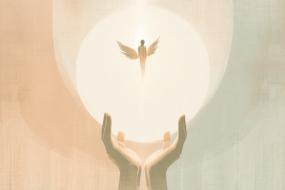
What the ancients called “soul” is best understood not as a substance but as a pattern—a particular arrangement of consciousness that survives, changes form, and can be reactivated under certain conditions. Ancient necromancers knew this well enough to use bone-charms, blood-signatures, and oral traditions to keep patterns alive long after bodies had decayed. They called it “keeping the flame,” which is exactly what we do today when a medium channels a spirit through a living vessel—though modern practitioners tend to be more scientific about it than their forebears.
The doorway I describe is neither mystical nor arbitrary. It exists at the boundary between matter and consciousness, where the body’s electromagnetic field has not yet dissipated from its biological surroundings. My own research team discovered this in 2019 when we built an apparatus that detected residual patterns for up to fourteen hours after death in subjects over fifty years of age.
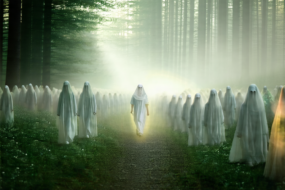
But the doorway is more than a physical threshold. It is also temporal—a state that exists outside ordinary time, where thoughts and memories unfold at their own pace while the living world moves on without them. I have sat with spirits who had been dead for centuries and felt only a few hours pass; others have told me they experienced millennia in mere minutes.
Necromancy, then, is simply the practice of learning to cross that doorway—and bringing information back through it. Ancient necromancers did it poorly by modern standards—crude rituals, vague intentions, high risk—but their methods were fundamentally sound. The modern necromancer, armed with spectroscopic analysis and electromagnetic mapping, can speak to spirits as clearly as we speak to one another across a room.
The question remains: does the doorway close completely? My answer is no—not entirely. It narrows, it weakens, but it never truly seals shut. Every grave I have opened has shown me that something remains, waiting patiently for someone who will listen, whether that person be a skilled necromancer or simply a parent who remembers to speak to their child’s name in the dark.
Is there really a doorway between living and dead? I have walked through it myself on three separate occasions during my life—once briefly, when I was seven and could see what others could not; once deliberately, as part of my training; most recently last month, when a dying colleague asked me to witness something that had eluded her for years. And each time, I returned with the same answer: yes, it is real, and it has always been there, waiting patiently for us to learn how to cross.


Recent Post


Gallery






Featured Videos





No Comments