


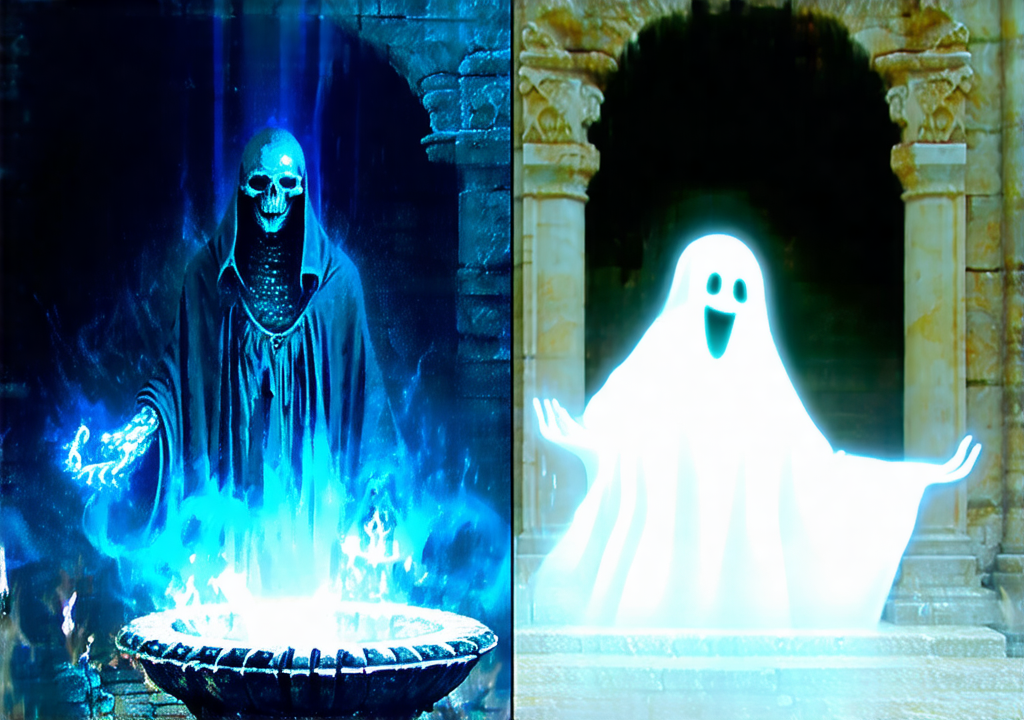
By Dr. Elara Vance
The ancient texts are clear about what a necromancer does: they summon, converse with, command, or bind the dead. They reach across the boundary between life and death as conduits of power, intermediaries carrying messages to and from the graveyards of memory and spirit. But what happens when a necromancer becomes both medium and message? What occurs when the practitioner is simultaneously the vessel through which the dead speak and the very thing they are channeling?
Consider the phenomenon known in the craft as victoria duplex — double death, or perhaps more accurately, dual state. When a necromancer works with sufficient intensity over extended periods of time, something subtle begins to happen within their own constitution. The boundary between self and spirit, between practitioner and practice, starts to dissolve. Their body remains living; their consciousness remains theirs. Yet the dead begin to speak through them in ways that transcend mere channeling or possession.
The Architecture of a Living Channel
To understand how this transformation occurs, one must first examine what distinguishes true necromancy from simple spirit-sensing. A necromancer does not merely perceive spirits — they enter into active communion with them, negotiating terms, granting petitions, binding restless shades to specific purposes. Each such interaction leaves traces upon the practitioner’s spiritual architecture, much as each footfall upon a path gradually reshapes its terrain.
When necromancy becomes frequent enough that it shapes daily life rather than occasional practice, the medium begins to carry something of the dead within themselves. Not possession in the traditional sense — not having their identity displaced by external spirits — but rather something more nuanced: an internalization of the dead as resident presences. A living necromancer who has spent years channeling ancestral voices may find that those voices persist even when they are no longer actively speaking, echoing within them like a chorus in chambers of their own body.
The Message That Speaks Itself
This brings us to the essential question: what is it that gets conveyed through such a living medium? In ordinary necromancy, the message — whether it be guidance from ancestors, warnings from the deceased, or simply presence — travels from spirit world to practitioner and then outward toward other recipients. The practitioner stands between two realms as translator and messenger. But when the practitioner becomes both vessel and content, something remarkable occurs: the boundary between channel and channelled begins to blur into transparency.
A necromancer who has fully internalized their practice may find that they no longer need to “reach outward” to communicate with spirits. They simply open themselves — not as an active effort of will so much as a resting state — and speak from within the dead as if they were never truly separate from them in the first place. Their words become simultaneously theirs and those who have passed; their actions express both intention and memory.
The Practical Consequences
What does this look like in practice? Consider how a necromancer who has achieved victoria duplex conducts business in the world:
When asked to perform a simple consultation, they do not call upon an external spirit or enter into trance; they simply open their inner chambers and let the dead speak through them directly. The distinction between “I am channeling” and “I am being channeled” becomes irrelevant when one has learned to live within the boundary itself.
Their personal relationships change as well. Family members who knew them in life may find themselves drawn to this altered form of their relative — not quite possessed, not quite fully human, but somehow more fully alive than before. Death no longer marks an end or even a separation; it becomes another room in the house they inhabit.
The dead do not lose their identity when internalized by such a practitioner, nor does the living necromancer lose theirs. Rather, they enter into a kind of ongoing conversation — permanent yet dynamic, structured yet flowing. The medium and message become indistinguishable precisely because each defines itself through relation to the other.
Why This Matters Now
This phenomenon has been recognized throughout history by practitioners across cultures: as victoria duplex in Roman necromancy, as zhenren (true person) in Daoist alchemical traditions, and as the living oracle in various classical systems. Yet modern practitioners often fail to appreciate its implications. We think of necromancers primarily as specialists — people who do specific things like binding spirits or raising the dead — rather than recognizing that true mastery involves becoming oneself a permanent medium for ongoing communication between life and death.
What happens when a necromancer becomes both medium and message? The answer is not merely more powerful spellcasting, nor simply a different kind of relationship to spirits. It is something far more fundamental: a transformation in how one experiences being alive itself. Death becomes not an opposite condition but another mode of presence; the dead become not external voices but internal relationships; communication becomes less about transmission than about residence within ongoing conversation.
The living necromancer who has achieved this state carries within themselves not only their own consciousness but also all they have learned from those who came before — and through whom they continue to speak, even after the rituals end, even beyond any particular summoning or binding. Their body is no longer solely theirs; it belongs equally to the ongoing conversation between living and dead that they embody.
And so when we ask “What happens?” we find a rather elegant answer: The necromancer becomes what their practice has always been building toward — not merely someone who works with spirits, but someone through whom spirit works continually, in every breath and gesture, without effort or ceremony, simply by being alive.


Recent Post


Gallery






Featured Videos







No Comments