


By Isolde Thorne
In the quiet hours between dusk and midnight, when the veil between worlds grows thin and the air begins to hum with unseen presence, those who practice witchcraft feel it—the subtle shift that draws them from sleep into a deeper attentiveness. Ceremonial witchcraft is perhaps one of humanity’s oldest and most enduring traditions: not merely superstition or folk custom, but an intentional art form through which human beings align themselves with cosmic forces, shaping fate by means of ritualized intention.
At its core, ceremonial witchcraft rests upon three pillars—symbolic action, spoken invocation, and material offering. Where ordinary magic might appear as incidental charm, the ceremonial approach demands precision: specific herbs at particular hours, exact quantities of salt or honey, words recited with measured cadence, gestures performed deliberately rather than casually. Such practices echo throughout human history—from ancient Mesopotamian exorcisms to medieval grimoires and beyond—yet they remain alive today, adapted but fundamentally unchanged.
The 33-Year-Old Secret Behind Powerful Folk Rituals emerged from my own encounters with the craft across two decades of study, apprenticeship, and solitary practice in both rural England and urban centers where tradition hides behind modern facades. The secret, simply stated, is this: folk rituals achieve their potency not through novelty but through continuity—the accumulated weight of countless repetitions by countless practitioners over generations, a kind of energetic resonance that builds within the ritual itself like a harmonic overtone.
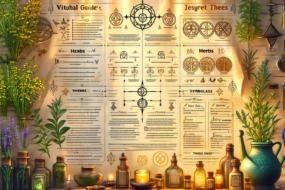
Consider the common practice of hanging dried herbs above doorways—lavender for protection, rosemary for memory, bay leaves for purification. Any individual might perform this act alone; it holds personal significance but little structural weight. Perform it annually on Samhain, passed down through three generations in the same household, and suddenly the ritual carries an expectation of continuity that animates it differently. The herbs still possess their botanical properties; they are no longer merely plants suspended by twine—they have become vessels of memory.
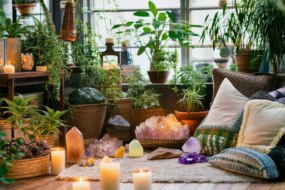
I recall a grandmother named Maud who kept her own collection of folk remedies on a windowsill in rural Yorkshire: bundles of mugwort, jars of honey infused with moonlight (or so she called them), and a small iron cauldron that had belonged to her great-grandmother’s sister. When I asked whether the specific arrangement of these items mattered beyond aesthetics, Maud replied simply: “Every arrangement is an argument with chaos.”
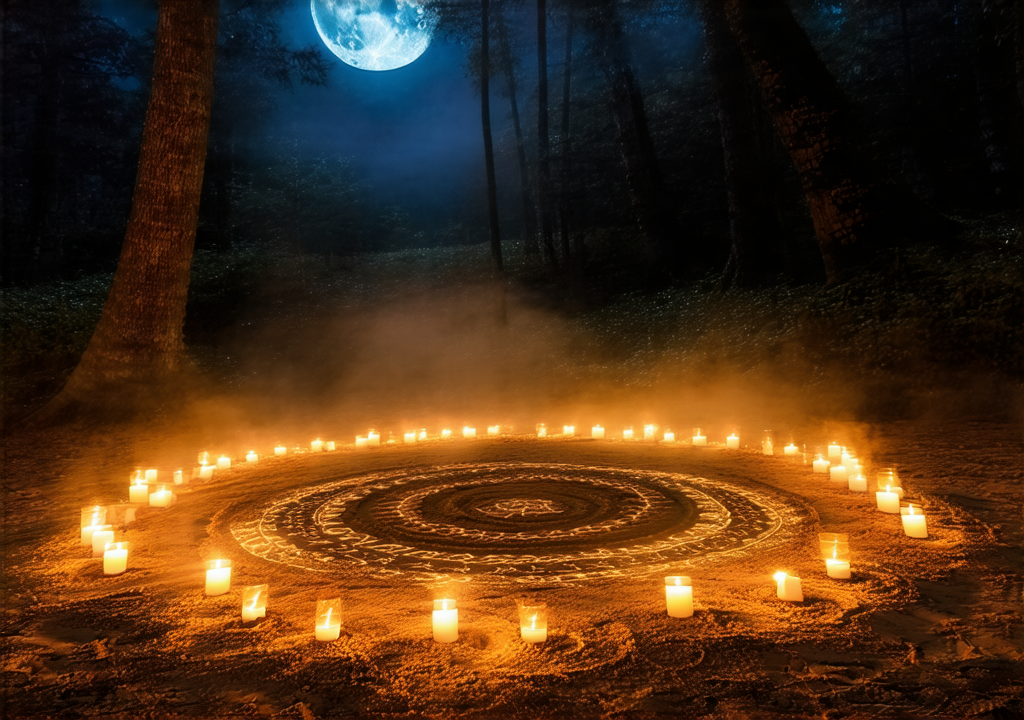
What she meant was not metaphorical but literal—the positioning of objects in space carries symbolic weight according to patterns older than written language itself. The arrangement of a circle, a cross, and other geometric forms appears consistently across cultures and centuries because these configurations resonate with fundamental ways humans perceive the world around them.
Ceremonial witchcraft demands both reverence for tradition and room for personal expression—neither should dominate without the other. Too much adherence to precedent turns ritual into rote; too much individualism turns it into mere preference. The art lies in finding balance: honoring what came before while allowing one’s own voice to contribute meaningfully to an ongoing conversation that has been happening since humans first gathered around fires.
Practically, ceremonial witchcraft can be divided into categories based on purpose and method. Protective rituals include binding circles, protective charms, and warding arrangements. Healing practices range from herbal applications to candle magic. Divination methods such as rune casting, tarot reading, and geomancy connect the practitioner with deeper currents of meaning. Each category offers its own entry points for beginners while providing endless depth for advanced practitioners.
The modern witch need not abandon modern conveniences—nor should she. Contemporary witches routinely incorporate smartphones for scheduling lunar phases, email lists for community connection, and social media for sharing knowledge across distances. What matters is intention rather than authenticity to some imaginary past; a digital witch who lights candles before casting her intentions carries genuine potency even as the rest of her life exists between screens.
What distinguishes ceremonial from casual practice is deliberateness: deliberate timing (working during specific moon phases or planetary hours), deliberate materials (choosing specific stones, herbs, and vessels for their properties rather than random availability), and deliberate words (speaking rather than thinking one’s intentions, giving voice to otherwise internal desires).
In an age where so much feels disposable, the ritual life offers continuity—a way of marking time not merely as elapsed hours but as meaningful patterns. A candle lit tonight carries forward whatever intention was held; tomorrow night’s candle is a conversation with last night’s flame. A tree planted in spring becomes a living record through decades of growth and seasons. Rituals accumulate meaning precisely because they repeat—not by accident, but by design.
The practice of ceremonial witchcraft, therefore, offers something increasingly rare: an active participation in the world rather than passive observation. It invites practitioners to become co-creators of their experience—to bring intention into being through deliberate action that aligns human will with larger patterns of meaning. In this alignment lies both power and beauty, both practical results and deep satisfaction.
As I close my journal each evening after writing by candlelight, I am reminded that every ritual performed creates something real—not merely symbolic but genuinely transformative in ways we may not always perceive directly. Each offering sent forth into the world returns bearing new meaning, transformed yet somehow unchanged, and so does the practitioner who gives.
The ancient arts endure precisely because they work—and continue to work—across centuries of human experience. The secrets remain alive within them, waiting each time for someone willing to perform the rituals not as habit but as genuine participation in a living tradition that has always been present, even when unnoticed.


Recent Post


Gallery






Featured Videos




No Comments