


By Eleanor Wychwood
We live in an age of distraction—of screens and notifications, of endless scrolling through information that arrives without invitation or consent. Yet beneath this surface noise, the world has never been more magical. What does it mean to practice ceremonial witchcraft when your kitchen is cluttered with groceries and your calendar full of obligations? Why should anyone care about casting circles in a cramped apartment or burning sage while waiting for their morning commute? The answer, I have found over two decades of study and practice, lies precisely in those mundane details.
Ceremonial witchcraft is not an escape from the ordinary world into some ethereal realm beyond—it is a deeper engagement with that same world. When you light a candle before your morning tea, when you speak to your herbs as if they were old friends, when you observe the moon’s cycle while brushing your teeth—you are participating in something ancient and vital. You are not performing magic for an audience; you are living it as one of its practitioners.
The Rituals of Ordinary Days
Consider what a witch does each day without thinking about it: she greets her plants, she tends to her fire, she speaks with intention toward the winds that bring rain or clear skies. These practices have persisted because they work—not in some mystical sense of making wishes come true, but in the real world of bodies and seasons and soil.
When you sweep out your kitchen at dusk, you are not simply tidying; you are preparing an altar for whatever visitations might occur during the evening hours. When you arrange candles on a windowsill according to their corresponding directions—red to the east where dawn begins, green to the south where growth flourishes—you are mapping the invisible architecture of your home onto the invisible architecture of the cosmos above. This is not superstition; it is geometry made visible and meaningful.
Timing as Magic
One of my teachers used to say that timing is more important than ingredients. A spell cast at the wrong time, even with perfect materials, will produce a different result from one cast at the right moment. Consider how you might apply this principle to daily life: write your intentions during daylight hours when the sun’s energy is most active; charge your crystals under full moonlight rather than fluorescent overheads; place fresh herbs on a windowsill before beginning their cultivation in soil, as if teaching them their names before they grow roots.
The ancient crafters understood this principle well enough to create calendars that tracked not just seasons and years but the subtle currents flowing between celestial bodies and earthly things. Your everyday world has never been more magical precisely because you possess access to these same principles—your smartphone can tell you when the moon will be fullest, what phase it currently occupies, how long before the next eclipse. You need only look up rather than down at your phone while walking in the street.
The Language of Signs and Symbols
We are surrounded by signs that most people ignore: birds flying across a clear sky, clouds forming particular shapes before rain, the way wind moves through particular trees or along particular streets. These are not omens; they are communications. When you learn to read them—when you begin to notice what they might mean—you become capable of finding meaning in ordinary occurrences rather than seeking signs only in extraordinary events.
I once noticed that a particular path near my home always seemed to lead me toward something worth seeing: an old oak tree with carved initials, a patch of moss growing where a stone had fallen, the way sunlight fell through leaves onto particular stones forming small pools of light. I followed this path daily for months before realizing it was guiding me not only outward but inward—as if walking toward some kind of understanding about where to begin each day’s work.
The Witch’s Workshop as a Laboratory
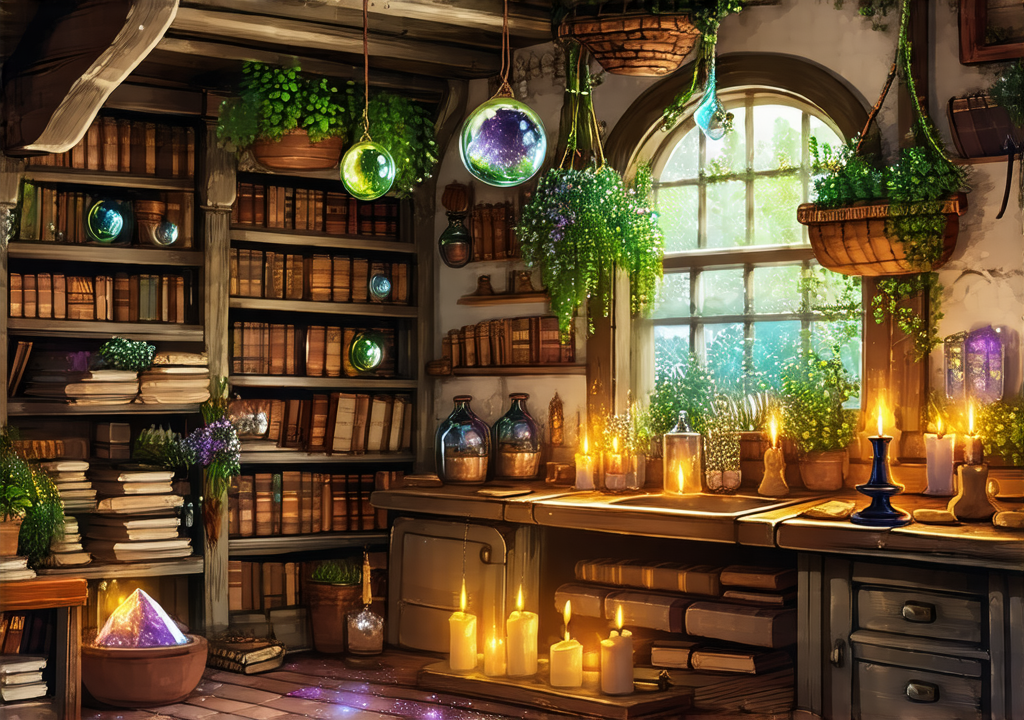
Your home becomes witchcraft laboratory when you choose to treat every object and space as potentially significant. A mirror that catches morning light becomes suitable for divination; an old jar filled with rainwater makes perfect water element; the corner beneath your bed transforms into sacred ground whenever you sweep it clean and place herbs upon its surface.
This is why I say that ceremonial witchcraft does not require elaborate apparatuses or expensive books on magic—it requires attention, intention, willingness to discover meaning in what surrounds us daily. When we learn to see our environment as alive with potential—when we treat every room as if it were an altar—we find ourselves performing rituals simply by living our lives more fully than before.
Conclusion: Living the Magic
Your everyday world has never been more magical because you possess everything needed within reach of ordinary life—the sun’s light, water from your tap, herbs from local markets or wild spaces around us—and most importantly yourself as witness and participant in whatever happens next. The magic was always there; we simply need to learn how to see it again.
Eleanor Wychwood has practiced ceremonial witchcraft for over twenty years and published several works on ritual timing, plant correspondences, and the art of living enchanted lives.


Recent Post



Gallery






Featured Videos








No Comments