



Alchemy Is Real – And This One Trick Changes Everything.
For centuries, skeptics have dismissed alchemy as mere charlatanism—a medieval preoccupation with bubbling flasks and mysterious potions, destined to be replaced by the precision of modern chemistry. They look at the ancient texts, with their cryptic symbols and poetic descriptions of fire and dissolution, and see only the primitive work of early chemists who happened upon elemental truths through accident rather than design. They forget that every major scientific discipline once stood in the same position—before it was known as science, it was natural philosophy; before it was natural philosophy, it was alchemy itself.
The truth is far more profound: alchemy operates not merely on material substances but on matter at its deepest level of being. When we speak of turning lead into gold, we are not speaking simply of physical transmutation—a change in atomic structure—though that too may occur. We are speaking of a process that touches upon the nature of reality itself, where substance and spirit are recognized as one continuum, and where transformation occurs through the deliberate manipulation of fundamental principles rather than brute mechanical force alone.
The central insight of alchemical transmutation is this: everything in the universe participates in a single, unified field of potentiality. Lead and gold, earth and air, matter and spirit—all are expressions of the same underlying substance, differentiated not by what they fundamentally are but by how they express that essence. The lead molecule is simply gold that has not yet completed its journey; it carries within itself all the properties of gold in latent form, awaiting only the appropriate conditions for manifestation.
The one trick I refer to is this: the deliberate application of intention through symbolic correspondence.
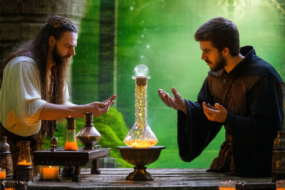
Not mere intellectual assent—a vague hope or passive belief—but active participation with full understanding and focused will. The alchemist who works at true transmutation understands that symbols are not merely decorative pictures but actual forces, genuine interactions between different levels of reality. When an alchemist places lead in a crucible while contemplating the sun—the archetypal gold, the divine light itself—something real occurs. Not magic in the sense of miracle-working, not irrationality in the sense of superstition, but a precise interaction between macrocosm and microcosm, between the symbolic image being contemplated and the material substance being transformed.
This is why alchemical texts employ such seemingly arcane language. The Sun is simultaneously: the physical star outside our window; the symbol for gold as metal; the symbol for the sun in the center of the solar system; the symbol for consciousness itself; and perhaps a fourth thing that includes all three—the sun as living principle, the golden being who is both substance and spirit. When you contemplate this fourfold meaning while holding lead or working with it chemically, your intention carries fourfold power into the crucible.
The alchemical process works through five stages, each of which corresponds to a different level of transformation:
Nigredo (blackening): The starting point—the dissolution of base matter into its essential elements. Lead must be purified, reduced to its most fundamental state, so it can receive new form.
Albedo (whitening): The emergence of purity and the beginning of transmutation. The substance takes on a luminous quality as spirit begins manifesting within matter.
Citrinitas (yellowing): The intermediate stage where gold’s potential first appears—a golden hue in the crucible, like dawn after night.
Rubedo (reddening): The final stage—the achievement of the magnum opum, the red stone, lapis philosophorum—where spirit and matter are fully unified, where lead has become gold not merely chemically but essentially.
Between each stage lies a crucial moment: the coagulation, when previously separate elements begin to unite into something new and greater than themselves. This coagulation is not mechanical mixture but spiritual binding—the invisible threads of intention drawn out from thought into substance.
Now you may ask: if alchemy works through symbolic correspondence, why does it remain relatively rare? Why are there few practitioners who achieve lasting transmutation? Because most people fail to understand the nature of symbol itself. They treat symbols as mere labels attached to things—poor, imprecise approximations at best—or worse, they treat them as superstitions that must be discarded in favor of measurable quantities and hard data. They cannot see that symbols are not secondary or derivative but primary—that gold is really primarily a symbol before it is anything else, only afterward becoming the physical metal we can hold in our hands.
The truly accomplished alchemist knows this deeply enough to work with it. When they see a piece of lead, they do not merely see a dull heavy metal; they see potential sun-gold waiting to awaken within itself. Their tools are crucibles and fire, yes—but their primary instruments are intention, contemplation, and the ability to hold multiple levels of meaning simultaneously without confusion or contradiction.
The one trick—this deliberate application of symbolic intention—is not simple for anyone to master, because it requires genuine understanding at a visceral rather than merely intellectual level. The alchemist must become what they contemplate—not simply observe gold from outside but embody its essence while contemplating it. And when they do so correctly, transmutation becomes inevitable: lead must become gold, as surely as water freezes into ice under the right conditions, because the intention has already been deposited in the crucible along with the matter itself.
So the question is not whether alchemy works but how willing we are to take it seriously—not merely as an ancient tradition preserved in texts but as a living art that can transform our own lives as surely as it transforms base metals into gold, if only we apply intention properly and understand what symbols truly are.


Recent Post


Gallery






Featured Videos




No Comments