


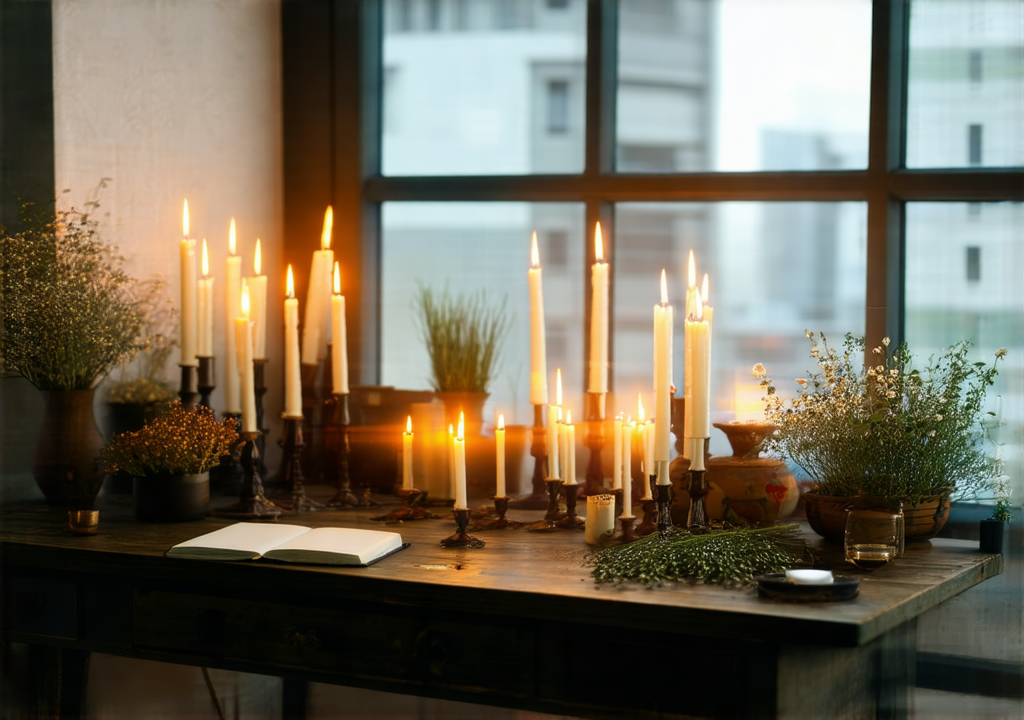
We live in an age of frenetic energy and endless notification. The constant ping of smartphones, the barrage of emails demanding immediate attention, and the relentless pressure to remain perpetually productive have created a world that feels increasingly shallow and fragmented. Amid this modern deluge, something remarkable is happening: people are turning toward ritual, seeking depth, intention, and connection in their daily lives. This isn’t merely nostalgia or the adoption of trendy practices—it’s recognition that our lives need structure more than ever, and that ceremonial magic offers a powerful framework for achieving exactly that purpose.
What Makes Rituals So Essential Today
Ritual is not about ornamentation or mere habit; it is the deliberate arrangement of actions into meaningful patterns that give shape to human experience. Every civilization throughout history has employed ritual—from ancient sun worship to medieval liturgical traditions—because rituals provide something that modern life uniquely lacks: intentionality in action and meaning in repetition.
In our contemporary context, where so much activity feels accidental or reactive, a well-structured ritual forces us to pause, consider our goals, and then execute deliberate actions toward those ends. A daily morning meditation before the day’s noise begins, an evening journaling practice that reflects on the day’s events, a weekly meal prepared with particular care—these are not trivial habits but small ceremonies that anchor us within larger patterns of meaning.
The power of ritual becomes particularly evident when we consider how rituals function as containers for human experience. Think about how a wedding ceremony transforms an ordinary couple into spouses bound by sacred vows; how a funeral marks the transition from one state of being to another; how a graduation ceremony signals passage from one life chapter to the next. Rituals create thresholds, marking transitions and giving them special significance precisely because they are enacted rather than merely spoken.
The Rise of Ceremonial Magic
Ceremonial magic—or what some might call “high ritual”—represents perhaps the most sophisticated form of symbolic action ever developed in Western tradition. Where ordinary rituals might involve simple repeated patterns (prayers, seasonal celebrations), ceremonial magic constructs elaborate systems where every gesture, word, and symbol carries specific meaning. Practitioners work with visualizations, incantations, geometric symbols like the pentagram or hexagon, ritual timing based on astrological conditions, and physical actions performed at precise moments to achieve particular ends—whether that be healing, protection, inspiration, or deeper contact with spiritual realities.
The core insight of ceremonial magic is that symbolic action works—not metaphorically but literally—in ways that affect both the practitioner’s inner state and external reality. When a magician performs an elaborate invocation, the ritual structure itself creates a kind of container in which ordinary thought patterns fall away and intention can operate freely. The precise arrangement of gestures, words, and symbols channels awareness toward specific ends much as water is directed through pipes rather than flooding the landscape aimlessly.
Why Ceremonial Magic Fits So Well Into Modern Life
What makes ceremonial magic particularly suited to our contemporary moment is its combination of structure with depth. Unlike so many spiritual practices that require complete lifestyle overhauls, ceremonial magic can be practiced within ordinary life while offering access to extraordinary states of consciousness and insight. A magician might spend ten minutes each morning performing a brief ritual—drawing on the pentagram, reciting invocations, visualizing desired outcomes—and yet still go about the rest of their day with full engagement in family, work, and social obligations.
More importantly, ceremonial magic offers a comprehensive system that addresses multiple dimensions simultaneously: body (through physical gestures), mind (through focused intention), spirit (through contact with deeper realities), and world (through symbolic action directed outward). Where so many modern approaches focus on just one aspect—whether mindfulness meditation for the mind or yoga for the body—ceremonial magic engages the whole person in a unified practice.
The Deeper Appeal: Ritual as Language of Transformation
At its heart, ceremonial magic is language—specifically the language of symbolic action. Where we normally speak only with words, we can speak through gestures, symbols, and visualizations that access deeper levels of meaning. Consider how a wedding ring signifies commitment more powerfully than any written contract; consider how a blessing spoken over food carries meaning that transcends mere nutrition; consider how anointing with oil or fire carrying smoke upward communicates intentions that words alone cannot express.
Ceremonial magic extends this principle into full systems where each component—the tools, the timing, the sequence of actions—carries specific symbolic weight and contributes to a larger pattern of meaning-making. The practitioner becomes both participant in ritual and agent of transformation, using symbolic action to shape their own consciousness while simultaneously shaping external reality through focused intention.
Practical Applications for the Modern Seeker
You don’t need to be an occult scholar or inhabit some mystical hermitage to benefit from ceremonial magic. Start simply: identify a goal (improved focus during study, better sleep, enhanced creativity), create a brief ritual structure around it—perhaps lighting a candle, visualizing your intention, reciting words that express what you seek—and practice it regularly for twenty-one days. Notice how the repeated action creates depth where before there was shallowness.
What matters most is not elaborate theory or perfect execution but genuine participation—the willingness to give full presence to each ritual act rather than going through motions mechanically. The anc knew this, which is why they called magicians “those who work with meaning”—and indeed, ceremonial magic is nothing if not the art of working deliberately within a meaningful framework where every action counts and every symbol speaks.
Conclusion: Ritual as Lifeline in an Age of Chaos
Rituals matter more than ever because we have lost our structures but still crave them desperately. Ceremonial magic offers one of the most powerful ways to reclaim depth, intention, and meaning—not through escape from modern life but through transformation of how we live within it. As someone who has practiced ceremonial magic for many years, I can say that few practices have been more transformative than learning to work deliberately with symbolic action on a regular basis—and those same transformations are available to anyone willing to begin where they are and discover what rituals their particular life requires.


Recent Post
Gallery






Featured Videos




No Comments