


Introduction: The Ancient Art of Sacred Work
Ceremonial magic, often called high ritual or white magic, is the art of working with sacred geometry, divine names, and precise ceremonial forms to effect transformation in both the practitioner and the world. Rooted in the hermetic tradition that stretches back through medieval grimoires, Renaissance magi like John Dee and Cornelius Agrippa, and modern practitioners like Aleister Crowley and Samuel Mathers, this discipline demands intention, ritual precision, and a commitment to understanding the relationship between symbols, numbers, and cosmic forces.
Unlike folk magic or intuitive divination, ceremonial magic is deliberately structured: it involves consecrated tools, defined spatial arrangements (the circle, the pentacle), and systematic invocation of divine names and archangels through their correspondences. The practice requires both technical knowledge and spiritual discipline—the practitioner becomes a microcosm mirroring the macrocosm, channeling divine energies through ritual form.
Step One: Understanding Your Goal and Tradition
Before beginning any ceremonial work, clarify what you seek. Do you wish to purify your environment? To communicate with spirits? To align yourself with celestial bodies for specific effects? Ceremonial magic encompasses several traditions—Hermetic (based on the Key of Solomon and later grimoires), Enochian (the system developed by John Dee and Edward Kelley), Solomonic (focused on planetary and elemental spirits), and others. Each tradition provides its own correspondences, names, and forms.
For a beginner’s practice, Hermetic ceremonial magic offers the most accessible path while maintaining depth of technique. The fundamental concept is that the practitioner creates sacred space through geometric forms—the circle and pentagram—invokes divine forces through their names, and then performs operations within this sanctified environment using consecrated tools aligned with specific correspondences.
Step Two: Preparing Your Physical Tools
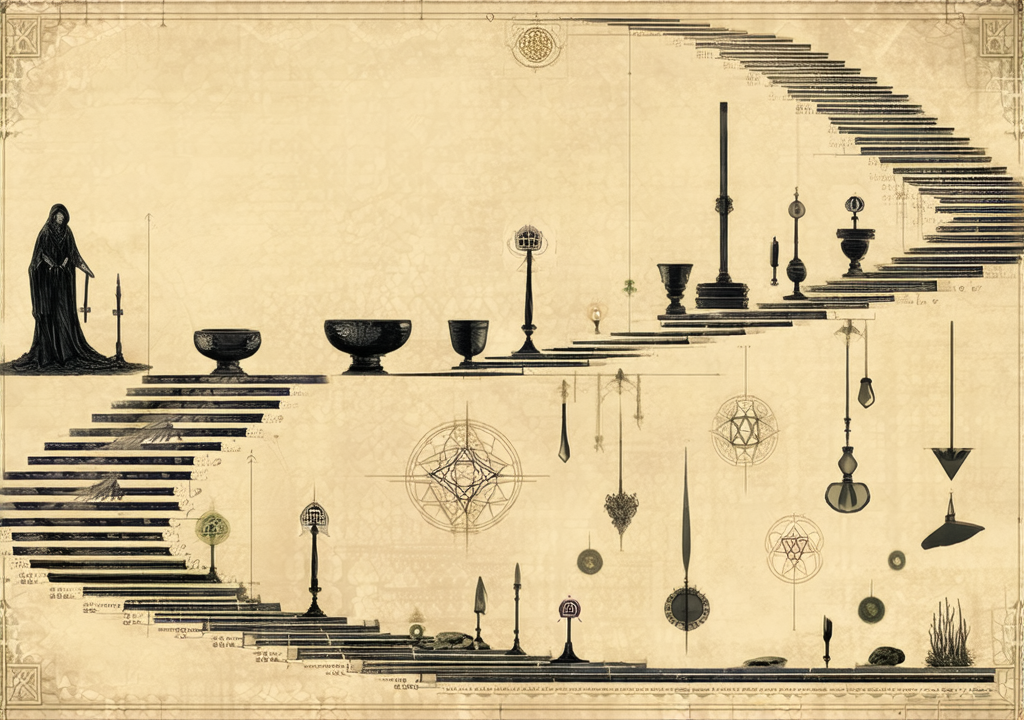
Traditional ceremonial magic requires four principal implements—each representing an element—and these serve as the foundation of any ritual:
The Pentacle: A flat disc (traditionally inscribed) placed in a pentagonal form, this tool represents earth and serves as the focus for invoking earthly spirits and solidifying intentions. Historically crafted from gold or silver, modern practitioners may use any substantial material that feels meaningful.
The Athame (or knife): Used to direct energy, cut through magical barriers, and represent air. The athame traditionally has a red handle pointing upward toward the divine force it channels.
The Wand: Symbolizing fire and serving as the primary instrument for directing will and invoking celestial forces. Length should approximately equal that of the practitioner’s forearm.
The Caduceus or Staff: Often called “the five-fold staff,” this tool represents spirit rising through earth, air, water, and fire, connecting all elements in one unified form. It is used to open the magical circle and direct energies upward.
Additionally, a bell (for calling attention of spirits), candles, incense, and chalk or salt for drawing the pentagram are essential. The most important element is not any specific tool but the practitioner’s own prepared spirit—willing, focused, and aligned with their intent.
Step Three: Creating Your Sacred Space
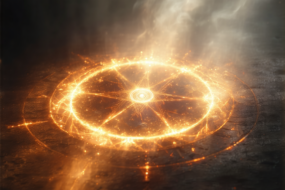
The central feature of any ceremonial magic practice is the Circle—a geometric boundary that separates the sacred from profane space. This circle functions as both protection and a conduit for divine energy. When working inside it, the magician commands forces; when drawing them in through its boundaries, they invoke power from beyond.
Begin by choosing or creating your magical circle—traditionally drawn on the ground with chalk (or salt), though practitioners may use any material that feels appropriate. The standard form is a large circular boundary marked at each of five points corresponding to elements: earth (southwest), water (east), air (north), fire (northeast), and spirit (center).
The Pentagram (five-pointed star) serves as the seal of preparation, drawn inside or outside the circle depending on whether the work is evocative (calling inward) or invocative (opening outward). The pentagram’s geometry corresponds to the human figure—head above, arms extended—and thus serves as a mirror of the microcosm within macrocosm.
Step Four: Performing Ritual Work
The ritual process begins with consecration—the sanctification of tools and space through prayer, invocation, and geometric forms. The standard ceremony follows these phases:
- Opening: Draw the pentagram (invocative if opening to divine forces) at each cardinal point, invoking through their names (YHVH, Adonai, Tetragrams). Establish the circle by tracing with athame or wand while calling archangel Michael or other guardians.
- Invocation of Divine Names: Using known names and seals from traditional grimoires, call upon divine forces according to your purpose—whether for purification, knowledge, protection, or specific operations.
- Working within the Circle: Perform whatever action you intend (meditation, visualization, spell-making) while maintaining awareness of the sacred boundary around you. The pentacle and athame serve as focal points for directing energy during this phase.
- Closing: Seal the work by reversing the opening ceremony—tracing the pentagon once more, closing the circle, and calling down earth’s influence to ground the energies you’ve worked with.
Step Five: Maintaining Practice and Deepening Knowledge
Consistent practice distinguishes ceremonial magic from occasional spell-casting. Begin with simple operations daily—a brief invocation upon waking, drawing the pentagram before beginning any magical work—then progress toward more elaborate ceremonies as your knowledge deepens.
Study traditional texts such as the Key of Solomon, Agrippa’s Four Books of Occult Philosophy, and modern works on Hermeticism and Kabbalah. Pay particular attention to:
- Correspondences between symbols, colors, numbers, and planets (each system has its own set)
- The names of angels and their hierarchies
- Geometric forms that embody cosmic principles
Conclusion: Your Sacred Work Continues
Building a ceremonial magic practice is not about memorizing complex formulas but about learning to create sacred space intentionally—within yourself and around you. With each ritual performed consciously, you deepen both your understanding and the effectiveness of your work. As an ancient maxim states: “As above, so below”—by aligning your inner world with cosmic forces through precise ceremony, you manifest transformation that echoes beyond. Begin simply; grow steadily; let your practice be as deliberate as it is alive.


Recent Post
Gallery






Featured Videos






No Comments