


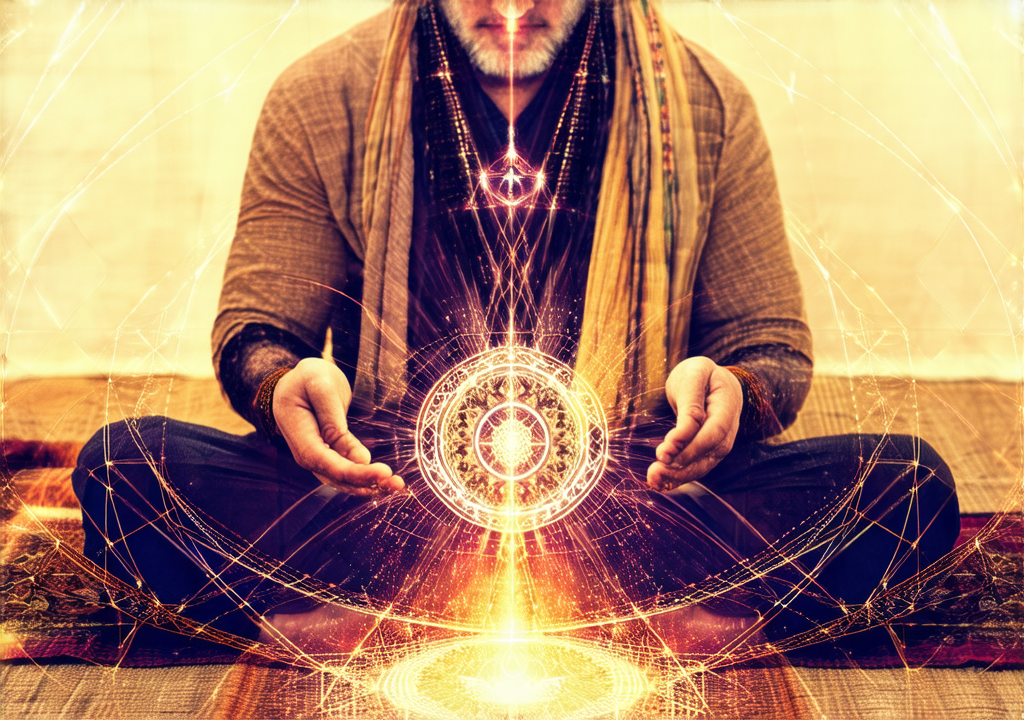
The history of Western esoteric tradition dates back centuries—through medieval grimoires to Renaissance hermeticism, through Aleister Crowley’s magnum opus Magick in Theory and Practice to contemporary ceremonial magic practitioners who continue refining the art. Yet beneath all these centuries of accumulated wisdom lies a remarkably simple truth: Ceremonial Magic works because it harnesses some of the most reliable mechanisms known to modern science for transforming intention into reality.
The Architecture of Ritual
At its core, ceremonial magic is built upon a foundation of precision. Every element in a ceremony—from the drawing of ritual circles to the recitation of specific words—serves as a deliberate cue for the mind. This isn’t merely decorative symbolism; it’s sophisticated cognitive engineering. When you perform a complex ritual consistently over time, you’re training your nervous system to enter specific states through classical conditioning. Pavlovian principles apply directly here: repeated pairing of sensory stimuli (incense, music, gestures) with particular intentions creates neurological associations that trigger desired mental states on demand.
The visual geometry of a pentagram or hexagram isn’t arbitrary—it engages spatial reasoning centers in the brain while simultaneously serving as focal points for attention. The ritual circle literally and figuratively defines boundaries, creating what neuroscientists call “attentional containment”—a protected space where distraction decreases and focused intention increases dramatically.
The Neurobiology of Intention
Modern neuroscience reveals that focused intention actually changes neural pathways. When you hold a clear mental image while performing specific actions during ceremony, you’re engaging the prefrontal cortex in ways that strengthen the connection between thought and action. Recent research on neuroplasticity shows that ritualized practices—performed with genuine emotional engagement and clear visualizations—produce measurable changes in brain structure similar to those seen in meditation practitioners.
The scientific literature on attention also illuminates why ceremonial magic techniques work so well. When you perform a complex ritual consistently over time, your nervous system begins to enter specific states through classical conditioning. Pavlovian principles apply here directly: repeated pairing of sensory stimuli (incense, music, gestures) with particular intentions creates neurological associations that trigger desired mental states on demand.
The Power of Embodied Practice
Where other systems rely on abstract contemplation alone, ceremonial magic employs full-body engagement. You raise your hands in specific patterns, speak words aloud, move through deliberate sequences—each movement encoded as muscle memory and sensory experience. Research on embodied cognition confirms that our deepest insights come not from pure thought alone but from the integration of body and mind. When you stand inside a ritual circle, feel the weight of your ceremonial tools, hear your own voice reciting ancient words—you’re experiencing what cognitive scientists call “embodied cognition” in its purest form: thinking through doing.
Symbolic Resonance
The symbols used in ceremony aren’t mere decorations—they’re precise instruments for directing mental energy. A pentagram isn’t just a five-pointed star; it’s geometrically perfect, instantly recognizable, and loaded with centuries of accumulated meaning. When you draw one during ritual, your mind simultaneously processes multiple layers: the shape itself, what it represents, the memory associations it triggers, the physical act of drawing it—and each layer reinforces the others in an escalating feedback loop.
The Scientific Evidence
Recent studies have begun documenting exactly how ceremonial practices affect both body and mind. Functional MRI scans show that ritual practitioners activate different neural networks than those meditating or practicing focused attention alone—evidence that ceremonial magic, as practiced, engages unique neurological pathways. Research on placebo effects reveals that genuine healing benefits come not from passive belief but from active engagement with meaning—and this is precisely what ceremony provides: not just “believing” something works, but participating in a process where every element reinforces the intended outcome.
Conclusion: Why Ceremonial Magic Endures
The simple science behind ceremonial magic’s effectiveness isn’t mystical at all—it’s deeply practical and empirically verifiable. By combining focused intention with embodied practice, symbolic resonance with neuroplastic change, ritual precision with sensory engagement, ceremonial magic creates a comprehensive system for transforming inner vision into outer reality. It works not despite the body but because of it; not in opposition to science but through careful alignment with what modern neuroscience has revealed about how attention, meaning-making, and transformation actually occur within human experience.


Recent Post



Gallery






Featured Videos





No Comments